
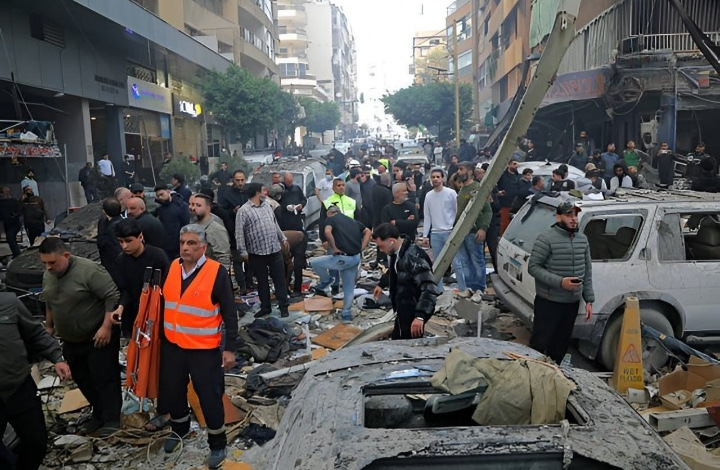
After the Beirut Massacre: Iranian Alert and Harsh Response Options in the Face of Zionist Escalation
Following the horrific Zionist massacre that targeted the Lebanese capital, Beirut, and large areas in the south, the Islamic Republic of Iran is moving towards a calculated escalation, placing “deterrence” at the forefront of its options, given the continued violations of the ceasefire agreement by the Israeli enemy and the expansion of its aggression.
Informed security and military sources revealed that Tehran has entered the final assessment phase for implementing a deterrent operation targeting military sites belonging to the Zionist enemy army in the occupied territories. They confirmed that the state of military readiness has been raised to advanced levels, in parallel with close monitoring of enemy movements on various fronts.
According to these sources, the Iranian interpretation of the Zionist escalation points to two dangerous possibilities: either the United States’ inability to restrain the criminal Netanyahu government, or the existence of a tacit green light from the US Central Command (CENTCOM), which reinforces Tehran’s conviction of the necessity to impose new deterrence equations by force.
In the diplomatic context, Iranian Foreign Minister Abbas Araqchi held a call with Pakistani Army Chief General Asim Munir, during which they discussed Ceasefire violations in Iran and Lebanon indicate escalating regional coordination to contain the repercussions of the Israeli aggression.
For his part, Iran’s representative to the United Nations in Geneva, Ali Bahreini, affirmed that his country would proceed with extreme caution in any negotiations with Washington, given the deep chasm of mistrust, while simultaneously emphasizing that Iran would remain in a state of constant military readiness.
On the ground and politically, these positions coincided with growing calls within Iran for more decisive action. Ebrahim Rezaei, spokesman for the National Security Committee in the Iranian Parliament, called for a strong and decisive strike against the Israeli enemy, proposing the option of halting maritime traffic in the Strait of Hormuz as a direct deterrent measure. He stressed that the equation must be clear: “Either a ceasefire on all fronts or no ceasefire on any front.”
In the military sphere, the Khatam al-Anbiya Headquarters announced that the Iranian armed forces are closely monitoring enemy movements, warning that any further transgression will be met with a more devastating response, while simultaneously asserting that Iran manages the Strait of Hormuz with full capabilities and control. Smart, which enhances its strategic position in any confrontation equation.
In Lebanon, as the death toll from the Zionist raids rose to dozens of martyrs and hundreds of wounded, political stances rejecting the aggression intensified. MP Ibrahim Mousawi, a member of the Loyalty to the Resistance Bloc, stressed that Lebanon is explicitly included in the ceasefire agreement, based on its declared provisions, emphasizing that the Zionist enemy is attempting to circumvent the agreement in its initial stages.
Mousawi affirmed that the resistance and its supporting axis will not accept the continuation of this violation, indicating that the Israeli enemy cannot violate the ceasefire and expect others to remain silent. This clearly suggests that the option of retaliation is now firmly on the table if the aggression continues.
This rapidly unfolding situation reflects the region’s transition to a highly sensitive phase, where the Zionist escalation in Lebanon intersects with Iran’s readiness to impose new deterrent equations. All fronts appear open to a wide range of possibilities, the most prominent of which is breaking the Zionist monopoly and imposing a new balance of power.