
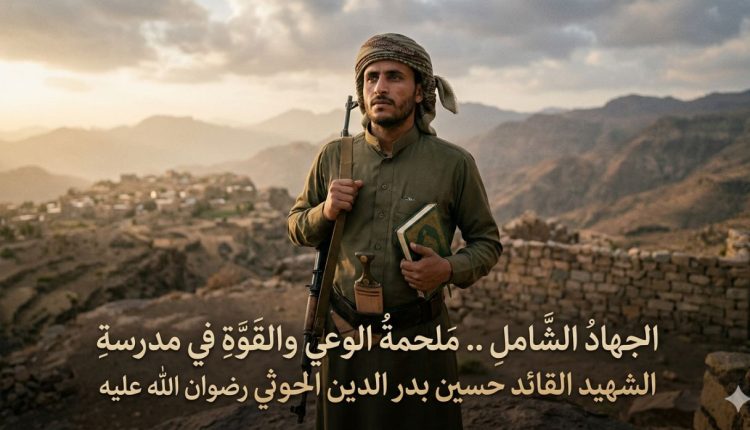
Comprehensive Jihad: An Epic of Awareness and Strength in the School of the Martyr Leader
The concept of jihad is a central one in Islamic thought, and throughout history it has witnessed numerous interpretations and applications. Within the context of contemporary Islamic thought, the visions of some leaders and thinkers stand out, seeking to re-establish this concept and broaden its meanings to align with the challenges of the age. Among these visions, the perspective of the martyr leader, Sayyid Hussein Badr al-Din al-Houthi (may God be pleased with him), stands out. He presented a profound and comprehensive analysis of jihad, transcending narrow interpretations that might confine it to a single aspect. This journalistic report is based on his analyses drawn from the twenty-second lesson of his Ramadan lectures, aiming to explore the comprehensive dimensions and implications of the concept of jihad in his thought, and to answer the central question: What are the comprehensive dimensions and implications of the concept of jihad in his vision?
Jihad: A Comprehensive Concept Beyond Fighting
The martyr leader Hussein Badr al-Din al-Houthi criticized narrow conceptions of jihad, whether those that confine it to “the word alone” or those that limit it to “the sword alone.” He emphasized that jihad, in its comprehensive Quranic sense, is “exerting effort in all fields to establish God’s religion.” This broad definition establishes a holistic understanding that does not neglect any aspect of life and links jihad to the ultimate goal: establishing religion in all its dimensions. The martyr of the Quran cites the verse: {And prepare against them whatever you are able of power} to clarify that the preparation required for jihad is not limited to one aspect but encompasses all possible forms of power.
The Dimensions of Power in Material and Moral Jihad
The dimensions of power in the martyr leader’s vision of jihad are multifaceted, encompassing both material and moral aspects, with an emphasis on their integration. Regarding material power (weapons), the martyr leader does not overlook the importance of material and military preparation, stressing the necessity of “preparing weapons of all kinds.” He warns against neglecting this aspect, asserting that words alone, without the power to defend them, may “ultimately evaporate.” This emphasis stems from a realistic understanding of the conflict, which requires a material deterrent force alongside other forms of power.
Moral, Psychological, and Cultural Strength
The martyred leader placed great importance on moral strength, considering it a powerful tool that significantly impacts the enemy. He pointed out that despite possessing the deadliest weapons, the enemy is forced to resort to cultural, media, and psychological warfare. Therefore, he believed that believers must utilize this moral strength, which terrifies the enemy, as stated in the verse: {You terrify thereby the enemy of Allah and your enemy}. He emphasized the importance of psychological, educational, and cultural preparation as an integral part of comprehensive jihad.
Jihad as an Internal and External Process of Development
The martyr leader’s vision of jihad is embodied in its dual nature, encompassing the internal development of the nation and the external confrontation with its enemies.
Internal Jihad (National Development): The martyr of the Quran believes that jihad begins “within the people themselves, in their righteousness towards one another.” He emphasizes that a nation engaged in jihad must “present itself as a true model in its interactions with one another, in its honesty, in its brotherhood, in its unity, in its strength, in its logic, and in its wisdom.” This internal development is the foundation upon which any external confrontation rests, enabling the nation to persevere and achieve victory.
External Jihad (Confronting the Enemy):
The martyr of the Quran considers “the stance towards the enemy itself to be a matter of establishing God’s religion.” This connects the external confrontation to the ultimate goal of jihad, which is the establishment of God’s religion. Jihad is not merely a reaction, but rather an integral part of a comprehensive divine project aimed at achieving justice and truth on earth.
Integration and Comprehensiveness in the Vision of Jihad
Sayyid al-Houthi emphasizes the necessity of integration and comprehensiveness in understanding jihad, warning against focusing on one aspect while neglecting others. He states, “Words alone, without preparing the necessary power—the power of weapons—will ultimately lead to defeat; your words will evaporate.” Conversely, he cautions against focusing solely on preparing weapons without addressing other crucial aspects: psychological, moral, educational, and cultural dimensions. Jihad in the path of God encompasses “this broad spectrum” that includes “the word, the pen, and many other things, including weapons of all kinds.” This comprehensive vision ensures that jihad remains effective and influential in all circumstances.
In conclusion…
The vision of the martyred leader, Sayyid Hussein Badr al-Din al-Houthi (may God be pleased with him), regarding the concept of jihad offers a profound and comprehensive analysis that transcends traditional and narrow interpretations. He views jihad as “exerting effort in all fields to establish God’s religion,” emphasizing the importance of integrating material and moral strength, and the internal development of the nation with confronting external enemies. This comprehensive vision affirms that jihad is not merely fighting, but a holistic process aimed at building the individual and the nation on Quranic foundations, enabling them to effectively and wisely face contemporary challenges and conflicts. Understanding these dimensions and implications contributes to grasping the depth of the thought presented by Sayyid al-Houthi and its importance in guiding the nation towards achieving its divine objectives.
The martyr of the Quran, may God be pleased with him, says: “The believing Muslim keeps before his eyes the verse, ‘And prepare against them whatever you are able of power’ (8:60). This might be moral power, which is in your hands and has a significant impact on the enemy; you must utilize it. Psychological warfare is also employed by the enemy. Even the enemy, possessing the most lethal weapons, recognizes that it is not self-sufficient but rather compelled to resort to other means of warfare: cultural warfare, media warfare, psychological warfare. Is this not obvious?” How did we reach a point where we no longer understand what conflict is, how we no longer understand what jihad is?! Certainly, the mujahideen have no idea… because some try to explain the meaning of jihad by saying that jihad with words is jihad and nothing else, or another says: jihad with the sword is jihad and nothing else! No, jihad is {And prepare against them whatever you are able of power and of steeds of war}