
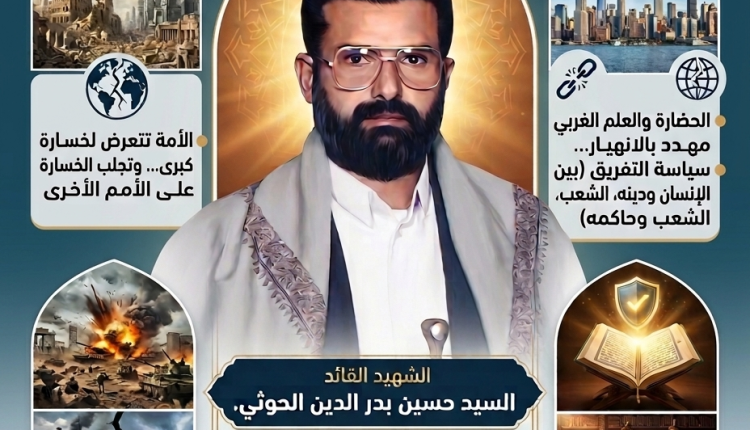
The Nation Between Guidance and Loss
In an era of accelerating international transformations and intertwined interests and conflicts, the vision of the martyr leader Hussein Badr al-Din al-Houthi emerges as an analytical discourse that transcends the present moment, offering a profound reading of the trajectory of both the nation and humanity. This vision does not merely diagnose reality but reveals the roots of crises and their consequences, grounded in a Quranic principle that considers divine guidance the foundation of stability and civilizational development.
The Greatest Loss When Guidance is Absent
The martyr leader establishes a central principle for understanding the nation’s reality, stating: “When a nation turns away from God’s guidance, it suffers immense losses and brings losses upon other nations as well.” This statement encapsulates a comprehensive philosophy that sees deviation from the divine path not only as an internal matter but as one that affects all of humanity. According to this view, the issue is not simply one of individual piety or ritualistic adherence, but rather a matter connected to the very structure of civilization itself. Divine guidance represents the moral and intellectual framework that preserves human equilibrium in dealing with knowledge, authority, and others.
Dismantling Civilization: The Project of Division as a Tool of Domination
The vision of the martyr of the Quran indicates that dominant global powers adopt a policy of “division” as a strategic approach to weaken nations. This manifests itself on several levels: separating individuals from their religion, thus emptying values of their meaning; separating individuals from their Lord; transforming life into a purely materialistic path; isolating Muslims from the Holy Quran, depriving them of their fundamental reference point; fragmenting societies into warring entities; and deepening the gap between rulers and the people as a means of weakening states. According to the analysis, these policies are not spontaneous but rather part of a comprehensive project to reshape the world in a way that ensures the continuation of dominance. Internal division is the easiest way to bring down nations without the need for direct confrontation.
Western Civilization on the Brink of Contradiction
The vision rests on a striking paradox: that Western civilization, despite its scientific and technological advancements, carries within it the seeds of its own collapse. Science, when divorced from values, transforms from a tool for construction into a means of destruction.
The martyred leader warns that scientifically advanced nations may be drawn into destructive conflicts that lead to the destruction of vital infrastructure such as factories and reactors, the loss of scientific expertise—scientists and experts—the collapse of educational institutions, from schools to universities, and the loss of accumulated scientific and cultural achievements built over decades or centuries. Herein lies the strategic dimension of the vision: wars are not merely political conflicts, but rather tools for resetting civilizations to zero.
Reproducing Collapse… History Repeats Itself
The vision connects current events with past ones, asserting that the same forces that contributed to the destruction of previous civilizations are now working to replay the same scenario. This perspective offers an interpretation of history as a series of cycles, where the deviation from values leads to the downfall of civilizations, regardless of their material strength. Consequently, what appears to be absolute progress may conceal within it the precursors to collapse. The Quran as a Civilizational Guarantee
In contrast to this bleak outlook, the vision offers a clear alternative: a return to God’s guidance, as embodied in the Holy Quran. The Quran is not merely a religious text, but a system of values that preserves human equilibrium, a moral framework that governs the use of science, and a comprehensive framework for building a cohesive and sustainable civilization. The vision emphasizes that the survival and development of science depend not only on technological progress but also on the existence of an ethical system that protects this progress from deviation.
Science Between Construction and Destruction
The vision poses a fundamental question: Can science continue and grow in isolation from values? The answer it offers is clear: science without divine guidance is susceptible to becoming an instrument of destruction, while guidance ensures that science becomes a means of construction and development. The problem does not lie in science itself, but rather in the entity that directs it and the objectives for which it is employed.
The Comprehensive Human Dimension of the Vision
This vision is not limited to the Muslim world, but extends to all of humanity. The discourse here is universal, emphasizing that humanity’s need for divine guidance is a universal human need, not exclusive to any one nation. From this perspective, rescuing humanity from its successive crises requires restoring divine values as the supreme reference point.
Between Two Choices
This vision presents the world at a clear crossroads: either continuing down the path of division and conflict, leading to a comprehensive civilizational collapse, or returning to God’s guidance as a guarantee for building a balanced and stable civilization. Between these two choices, the responsibility appears collective, beginning with individual self-awareness and extending to building systems and societies based on values, not narrow interests.
Ultimately, this vision does not merely offer a critique of reality, but presents a comprehensive project for salvation, the most prominent feature of which is that divine guidance is not a secondary option, but an existential necessity for the survival of humanity and civilization.