
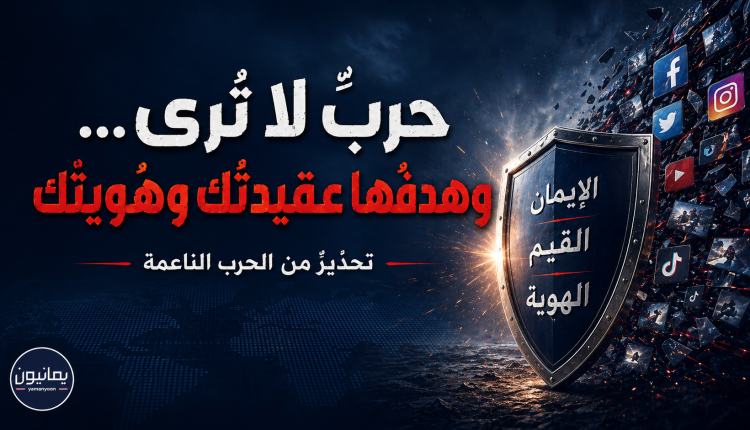
An Unseen War… Targeting Your Beliefs and Identity
In the context of the escalating use of indirect influence in contemporary conflicts, the warning issued by Sayyid Abdul-Malik Badr al-Din al-Houthi (may God protect him) regarding the dangers of “soft war” stands out. This warning represents a strategic analysis that transcends the traditional security dimension, extending to a broader sphere that impacts identity, consciousness, and culture. It highlights a qualitative shift in the nature of confrontation, which is no longer limited to weapons and economics, but has expanded to shape convictions and reshape societal priorities.
The Nature of Soft War and Its Tools
Soft war is defined as a system of non-military means that aim to influence individuals’ consciousness and behavior through media, culture, education, art, and digital platforms. These tools work to reshape values by presenting alternative models of behavior, success, and identity; dismantle established frameworks by weakening ties to religious and cultural sources that provide society with its resilience; and normalize foreign concepts by gradually introducing ideas until they become familiar and acceptable.
Targeting the Relationship with Divine Guidance and Religion
The Leader’s warning indicates that the essence of this targeting lies in separating the nation from its value and religious system, which constitutes a “shield” against deviation. This can be understood through weakening the spiritual dimension by reducing the presence of religion in public life and reducing it to a limited, individual matter; distorting concepts by reinterpreting central concepts (such as freedom and justice) in a way that contradicts their religious origins; and replacing traditional sources of knowledge with directed digital and cultural sources.
Political Implications
The speech carries clear political dimensions, as it links soft warfare to attempts to reshape the internal environment to serve the interests of external powers. Among the most prominent implications is reducing the cost of conflict by relying on soft power tools that are less expensive than direct confrontation; bringing about long-term changes by building gradual shifts in consciousness that lead to sustainable political outcomes; and ultimately influencing internal decision-making by shaping public opinion influenced by external agendas.
Cultural and Social Dimensions
The warning extends to the social fabric, where cultural identity is targeted through the dissemination of imported consumer and cultural patterns, the introduction of terms and expressions that alter ways of thinking and communicating, and through social relationships by promoting individualism at the expense of community solidarity.
The Digital Arena as a Key Battleground
Soft warfare is most evident today on digital platforms, through targeting algorithms that reshape what users see and influence their beliefs, as well as through fast-paced content that reduces complex issues to simplistic messages that may carry biases, and influencers as channels for transmitting new behavioral and value patterns.
An Analysis of the Concept of “Prevention”
The warning emphasizes that maintaining a connection with God’s guidance and religion represents the first line of defense. Prevention here is understood as an integrated system that includes fostering critical awareness through the ability to distinguish between information and verify its sources, as well as consolidating identity through education and local media that reflect authentic values, ultimately leading to cultural immunity through conscious openness that balances benefit with the preservation of privacy.
Challenges and Opportunities
Despite the challenges, this warning opens the door to strategic opportunities for developing alternative media that produces engaging content aligned with local values, reforming the educational system to foster critical thinking and a connection to religious principles, and empowering society through youth and cultural initiatives that reaffirm national identity.
In Conclusion…
The Leader’s warning against soft warfare provides an explanatory framework for understanding the nature of contemporary conflict, where the battle transforms into a battle of awareness and identity. The most significant implication is that preserving one’s relationship with God’s guidance and religion is not merely a matter of faith, but a strategic factor for protection against influences that could reshape society from within. While the tools of influence are rapidly evolving, the focus remains on building a cohesive awareness capable of engaging with the world without losing its way.