
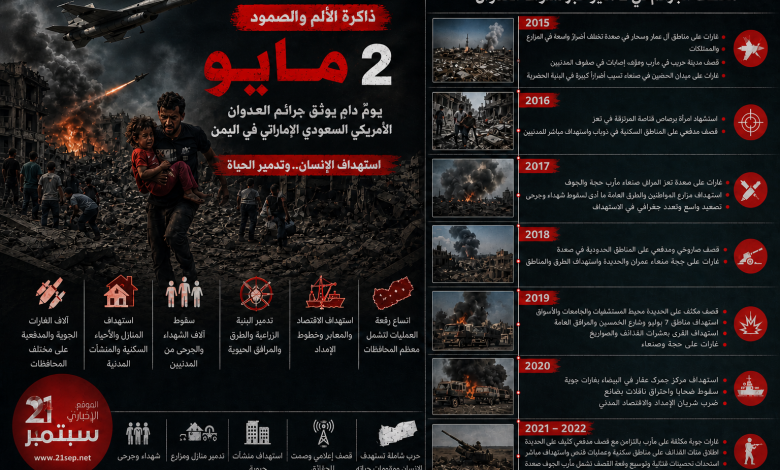
A Memory of Pain and Resilience: May 2nd, a Bloody Day Documenting the Crimes of the US-Saudi-Emirati Aggression in Yemen
May 2nd marks a significant turning point in the history of the US-Saudi-Emirati aggression against Yemen, revealing the true nature of this war. It has not been limited to military confrontations, but has extended to encompass everything connected to the lives of Yemenis, from their homes and farms to the roads and service facilities that form the lifeblood of daily existence.
A review of the crimes committed on this day throughout the years of aggression reveals a comprehensive picture of a multi-dimensional war. Various methods of bombing and targeting are employed within a strategy aimed at inflicting widespread damage on Yemeni society and keeping it under constant pressure.
2015: The Beginnings: Targeting Farms, Roads, and Vital Facilities
On May 2, 2015, the outlines of this pattern began to emerge early on, as airstrikes by the aggression targeted the Al Ammar and Sahar areas in Saada Governorate, causing extensive damage to citizens’ farms and property.
In Marib, airstrikes targeted the city of Harib, causing civilian casualties. The attacks also extended to the capital, Sana’a, where Al-Sabeen Square – one of the city’s most vital squares – was struck, resulting in significant damage. This clearly indicates a deliberate targeting of urban infrastructure and key transportation hubs within cities.
2016: Sniping and Shelling: Direct Targeting of Civilians
The following year, sniper attacks emerged as a primary method of direct targeting. A woman was killed by mercenary sniper fire in Taiz, a crime reflecting the intentional targeting of individual civilians.
Artillery shelling of residential areas, including the city of Dhubab, continued, confirming that the attacks were no longer limited to airstrikes but had become multifaceted.
2017: Widespread Escalation and Geographical Targeting
May 2, 2017, witnessed a significant escalation, with airstrikes targeting numerous governorates, from Sa’dah to Taiz, Sana’a, Hajjah, and Al-Jawf.
In Saada, civilian farms were directly targeted, resulting in deaths and injuries. Meanwhile, airstrikes hit public roads in Mocha and various areas in Taiz, reflecting a focus on disrupting movement and supplies.
The airstrikes also extended to multiple locations in Sana’a and Marib, confirming an unprecedented expansion of the operations.
2018: Border Bombardment and Targeting of Populated Areas
This year, Saudi missile and artillery shelling continued on border areas in Saada, targeting the Razih and Munabbih districts, resulting in civilian casualties.
Concurrently, the Saudi-led coalition continued its airstrikes on Hajjah, Sana’a, Amran, and Hodeidah, targeting public roads and residential areas as part of a policy of tightening the siege on the population.
2019… Hodeidah Under Fire: Intense Bombardment and Indiscriminate Targeting
On May 2, 2019, the bombardment of Hodeidah Governorate escalated significantly, targeting vital civilian areas, including the vicinity of hospitals, universities, and markets, with mortar shells and machine guns.
The bombardment also included the July 7th area, 50th Street, and the areas surrounding public facilities, in addition to targeting villages with dozens of shells and missiles, reflecting an attempt to directly strike the civilian population.
In the same context, airstrikes continued on several governorates, including Hajjah and Sana’a.
2020… Targeting the Economy and Crossings: Striking a Lifeline of Supply
In one of the most egregious economic crimes, the aggression’s warplanes targeted the Afar Customs Center in Al-Bayda Governorate, resulting in casualties and the burning of cargo trucks.
This targeting reflects a clear intent to cripple the economic infrastructure and disrupt the flow of supplies, exacerbating the suffering of citizens under the blockade.
2021-2022: A Complex Escalation: Intense Bombardment and Military Mobilization
During this period, airstrikes continued – particularly in Ma’rib – coinciding with heavy artillery shelling in Hodeidah, where hundreds of shells were recorded as having landed in residential areas.
Mercenaries also intensified their direct fire on civilian homes in several governorates and established new fortifications on multiple fronts, reflecting a trend toward stabilizing the front lines while continuing to pressure civilians.
In 2022, the scope of the bombardment expanded to include the governorates of Ma’rib, Al-Jawf, Sa’dah, Hajjah, and Al-Dhale’, employing Katyusha rockets and heavy artillery, in addition to sniper fire and direct targeting.
Summary: A Comprehensive and Multi-Tooled Attrition Strategy
The crimes of May 2nd reveal the outlines of a clear strategy of aggression based on:
Targeting farms and livelihoods to weaken the local economy.
Striking roads and vital infrastructure to disrupt daily life.
Direct targeting of civilians through sniping and shelling.
Extensive use of various types of weapons (air, artillery, and missiles).
Expansion of operations to encompass most governorates.
Targeting of border crossings and economic facilities to intensify the blockade.
These facts confirm that the war was not merely military, but comprehensive, targeting the Yemeni people in every aspect of their lives.
May 2nd: A Renewed Memory and Enduring Resilience
This date remains a living testament to the scale of the crimes committed against Yemenis, and at the same time reflects the remarkable resilience that prevented the aggression from achieving its objectives despite the ferocity and diversity of the attacks.
As the years pass, these events become a documented record in the national memory, confirming that these crimes cannot be erased, and that responsibility for them will remain, no matter how much time passes.