
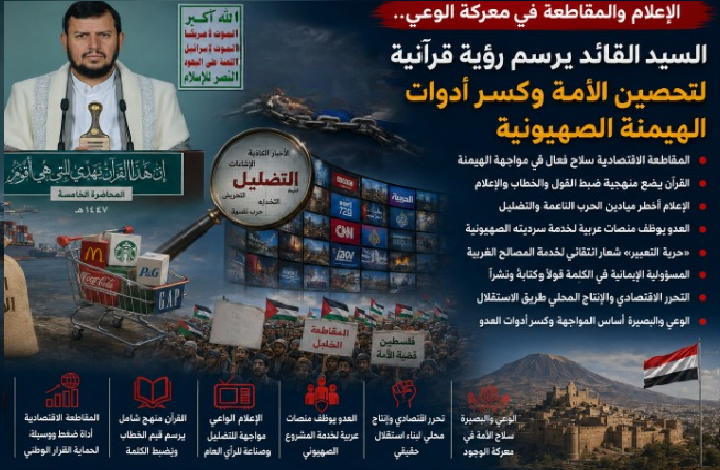
Media and boycotts in the battle for awareness: The Leader’s vision for fortifying the nation and breaking the tools of Zionist hegemony
In a time when the tools of targeting that affect the Islamic nation are increasing, the battle is no longer limited to the fields of military confrontation alone. Rather, the arenas of economy, media and awareness have become among the most dangerous fronts of conflict and the most influential in shaping destiny, where the forces of American and Zionist hegemony are moving to subjugate peoples, dismantle their value systems, distort their awareness, and reshape their priorities in a way that serves projects of control and domination.
In this context, the fifth lecture of the Leader came within his series of Quranic lectures entitled “This Quran guides to that which is most upright” to present a broad and integrated vision of the nature of the contemporary conflict, starting from the words of God Almighty: {O you who have believed, do not say, “Ra’ina,” but say, “Unzurna,” and listen.}, in a reading that goes beyond the apparent meaning of the text to its civilizational and strategic dimensions, and establishes an integrated Quranic approach in building awareness, controlling discourse, consolidating the economic boycott, and managing the media confrontation as an integral part of the nation’s great battle.
Economic boycott: An effective weapon against hegemony
The leader began his speech by emphasizing that the enemies – foremost among them America and “Israel” – are well aware of the importance of the economic weapon, and have been using it for decades as a primary means of exerting pressure on peoples and countries, noting that economic pressures, sanctions and boycotts have been and still are among the most prominent tools of targeting against many countries, including Iran, Iraq, Syria, Yemen and others.
He pointed out that the painful paradox lies in the fact that the Islamic nation itself, despite possessing this effective weapon, does not benefit from it to the required extent in confronting its enemies, while some Arab regimes adhere to American boycott policies more than they adhere to the directives of the Qur’an and the interests of the nation.
In a reading related to the Arab and Islamic economic reality, the Leader pointed out the danger of dependence on imports and reliance on foreign countries for basic needs, warning that the dependence of peoples on their adversaries for food and vital needs turns them into a permanent hostage to political and economic pressure, and makes their livelihood a tool of blackmail in the hands of enemies.
The leader linked the economic boycott to the productive revival, explaining that the money wasted on importing goods from companies supporting the Zionist enemy could be transformed into a national economic force that drives production, mobilizes the workforce, supports self-sufficiency, and contributes to addressing the crises of living conditions and unemployment, stressing that a large part of the economic solution lies in returning to local production and activating national resources.
In this context, he stressed that the boycott is not just a symbolic or emotional stance, but a practical tool with a tangible impact, calling on the conscious media to highlight real experiences that confirm its impact, citing what happened in previous periods of losses incurred by Western and Zionist companies as a result of popular boycott campaigns.
The Quran and the methodology of regulating discourse: Words are a responsibility, not chaos.
Based on the Quranic verse that formed the focus of the lecture, the leader presented a broad reading of the concept of speech and utterance in Islam, explaining that the Quranic guidance not to use a certain word because the enemy might benefit from it reveals a very important standard in managing conflict, which is that the Muslim is responsible for what he says, and that speech is not a passing act or an open space without controls.
He stressed that the Qur’an establishes an awareness that makes a person weigh what he says on the scale of truth, justice, and the public interest, so that his words do not serve the enemy or cause the misguidance or weakening of the nation, but rather are focused on supporting the truth, supporting just causes, and exposing injustice and tyranny.
The leader pointed out that God Almighty has placed constant oversight on man regarding what he says and what he writes, citing the Almighty’s words: {Not a word does he utter except that there is a watcher by him ready to record it}, indicating that writing, media and publishing in the digital space fall within the same circle of responsibility, and that what is said or written is not outside of moral and religious accountabi