
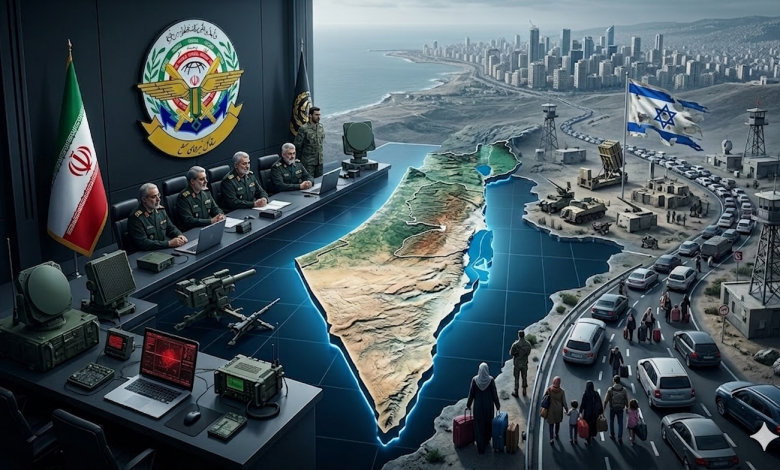
Iran’s decisive equation: “The occupied north versus the southern suburbs”: How the “Seal of the Prophets” warning turned into a strategic nightmare consuming the security of the Zionist entity.
Tehran has established a decisive equation of engagement that transcends traditional patterns of political response. The statement issued by the Khatam al-Anbiya Central Headquarters of the Iranian Armed Forces has transformed into a direct geo-military operational order, reshaping the region’s security landscape. The stern warning to the residents and settlers of the occupied north to evacuate immediately was not merely a gesture of solidarity, but a clear declaration of the activation of the “integrated deterrence” system. This system translates any threat to Beirut’s southern suburbs into a direct existential and economic cost borne by the heart of the Zionist entity.
This tactical shift represents an accurate Iranian assessment of the Zionist predicament, as the burden of displacement and forced migration is being transferred from the Beirut suburbs to the heart of the northern settlements in the occupied Palestinian territories. War criminal Benjamin Netanyahu, wanted by the International Criminal Court, and his Defense Minister Yisrael Katz can no longer market their military adventures as winning cards domestically. Instead, their threats to violate the ceasefire agreement and target the Lebanese capital have become a means of exacerbating the internal situation within the Zionist entity, transforming its northern front into a desolate and burning security zone.
The Geography of Terror and the Industry of Mutual Displacement
The Iranian military leadership is operating according to a strategy of shifting the battle to the enemy’s core environment, thus shattering the myth of the secure wall the occupation is attempting to construct. Placing the occupied north on equal footing with the southern suburbs of Beirut necessitates a new security framework, one in which Zionist cities and military installations become geographically vulnerable to the resistance’s missile range, forcing the northern settlers into a permanent displacement from which Tel Aviv holds no power to reverse.
This military warning goes beyond mere verbal admonition; it represents a systematic undermining of the occupation army’s structural foundations, rendering it incapable of protecting its rear lines and maintaining the security of its settlers. Field evidence confirms that the intensity of the fire and the evolving logistical precision of the resistance axis have reduced the defensive domes to mere showpieces, unable to prevent the erosion of trust between the settlers and their fascist government. This deepens the reverse migration crisis and dismantles the settlement fabric in the north.
This military stance aligns with Tehran’s strategic vision, which views protecting Lebanon’s strategic depth as an integral part of the overall national security of the axis. The operational coordination among the supporting forces lends the Iranian warning significant credibility, rendering Netanyahu’s threats against Beirut politically and militarily suicidal, as they open the door to unconventional targeting scenarios that simultaneously strike the economic and military centers of the Israeli entity.
The masks have fallen and the American cover has been exposed.
The joint Zionist threat from Netanyahu and Katz is a reckless escalation, a desperate attempt to violate the understandings on the ground imposed by force of arms. This folly reflects the depth of the structural crisis of an entity that thrives on war, whose leaders are trying to polish their shattered image before the International Criminal Court through a new bloody escalation, forgetting that the lost international legal immunity will not be restored by military crimes against civilians in the southern suburbs of Beirut.
In this context, the American role stands out as a continuous logistical and political cover for the occupation’s aggression, making Washington a key partner in laying the groundwork for the destruction of the northern settlements. Intelligence and military support from the American administration fuels Netanyahu’s arrogance, but conversely, it places all American interests and bases in the region within the legitimate target range should the Zionist threats against Beirut materialize.
The inability of the Zionist and American systems to grasp the new equations of deterrence is pushing the region toward a complete rebalancing of power. Attempts to leverage American support to impose new conditions on Lebanon have expired, and decision-makers in Tel Aviv must understand that the era of unilateral action is over, and that the cost of an attack on the southern suburbs of Beirut will be paid in cash from the security and future of the Zionist entity.
Missile deterrence and dismantling the defense system
Zionist options appear unprecedentedly li