
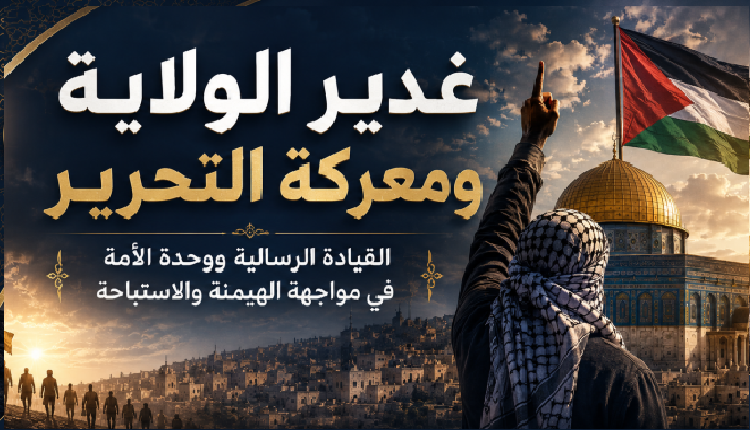
Missionary Leadership And National Unity In The Face Of The Challenges Of Hegemony And Exploitation
Today, the Islamic nation faces one of the most sensitive stages in its contemporary history, in light of the escalating aggression against Palestine, the widening circles of conflict in the region, and the growing hegemonic projects that target its identity, unity, and the independence of its political decision. In the midst of these transformations, the occasion of Eid al-Ghadir stands out as an intellectual and faith-based milestone that calls for a re-reading of the concept of guardianship as a project for building the nation, creating leadership, protecting identity, and confronting fateful challenges.
The state: a project for building leadership and creating a renaissance.
In the Islamic concept, guardianship was not merely an emotional loyalty or a symbolic connection to a historical figure, but rather represented an integrated approach to building the state and society and choosing a leadership capable of bearing the trust, achieving justice, and preserving the interests of the nation. The Islamic experience confirms that the success and stability of nations are directly linked to the integrity of the leadership that manages their affairs. The leader in the Islamic vision is not merely someone with authority or influence, but rather a model that combines faith, competence, trustworthiness, courage, and insight. Hence, the memory of Ghadir acquires its renewed significance as an affirmation that leadership is not a personal privilege, but rather a responsibility and a mission that is linked to the interests of the nation and its future.
Palestine: The compass that reveals the true nature of positions
In a time when slogans abound and positions vary, the Palestinian cause remains the clearest criterion for measuring the sincerity of belonging to the nation and the extent of commitment to its major issues. What the Palestinian people are subjected to in terms of aggression, siege, killing, and destruction does not only represent a human tragedy, but also reveals the extent of the dysfunction that has afflicted the Arab and Islamic reality as a result of internal divisions and conflicts and the abandonment of historical responsibilities towards the central issue of the nation. Palestine has become a real test of political and moral positions, and has become a clear criterion for distinguishing between those who carry the concerns of the nation and those who are preoccupied with their narrow calculations and immediate interests.
The nation’s crisis… when the values of responsibility and unity decline
The Islamic nation does not suffer from a lack of human, economic, or geographical resources, but rather from a crisis of vision, unity of position, and good management of available power elements. The state of fragmentation and division witnessed in the Islamic arena has weakened its ability to confront external challenges and has given hostile powers the opportunity to interfere in its affairs, influence its decisions, and usurp its will. At a time when the stage requires the highest degrees of coordination and integration, political, sectarian, and national disputes continue to drain the nation’s energies and dissipate its potential, which necessitates a return to the major commonalities that unite Muslims and unify their goals and interests.
The Zionist project: targeting identity before land.
The conflict with the Zionist project is not limited to the military or geographical dimension, but extends to an attempt to reshape consciousness and identity and weaken the factors of strength and immunity within Islamic societies. The real battle revolves around the future of the nation, its position and its civilizational role, and its ability to maintain the independence of its political and cultural decision away from external hegemony. From this standpoint, confronting the Zionist project is not limited to the arenas of military confrontation, but includes strengthening awareness, consolidating the culture of resistance, and building a broad popular movement that rejects normalization, submission and acquiescence.
Imam Ali (peace be upon him)… A model of leadership in times of challenges
The personality of Imam Ali bin Abi Talib, peace be upon him, represents a complete model of leadership that combines faith, justice, courage, wisdom, and responsibility. His name has been associated with defending the truth, supporting the oppressed, establishing justice, and steadfastness in difficult situations. These are values that the nation still desperately needs in light of the current challenges. Recalling the biography of Imam Ali, peace be upon him, at this stage is not only aimed at recalling the past, but also at drawing inspiration from the system of values that he embodied in his life, and transforming them into