
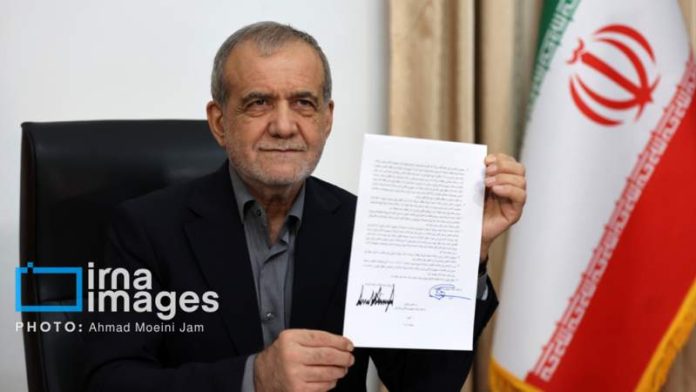
Iran, US presidents sign Islamabad MoU digitally
The memorandum of understanding between Iran and the United States has now been formally signed by the presidents of both countries, with the text finalized and the agreement officially in effect, Iran’s Foreign Ministry spokesman announced on Wednesday.
“The memorandum of understanding between Iran and the United States was agreed to be signed digitally,” Baghaei said. “No signing ceremony will be held in Switzerland,” Esmaeil Baghaei told the IRIB’s News Network.
The spokesman explained that the decision to have the agreement signed by the highest-ranking officials of both countries was intentional, given past experiences.
“When the text is signed by the highest authorities of both countries, violating it will naturally carry greater costs. Given our past experiences, we preferred that this happen,” Baghaei said.
He added that the Iranian negotiating team’s presence in Geneva was still under discussion, but the signing itself had been conducted digitally.
“The text of the Iran-US memorandum of understanding is now officially finalized because both parties have signed it,” he said.
The spokesman explained that the delay between finalization of the MoU on Sunday and its publication on Wednesday was due to standard diplomatic procedures and the importance of coordinating with mediators.
“In every diplomatic process, there are procedures that the relevant parties try to adhere to. The mediators’ views are also important so that they can bring this process to the desired conclusion,” Baghaei said.
He noted that the parties had agreed not to publish the text until it was finalized. However, he stressed that Iranian officials had already disclosed the broad outlines of the agreement.
“If we review the text now, we will see that there was nothing left unsaid during this period. We had expressed all the issues more or less. We may not have gone into details on some points, but regarding the overall issues, we had mentioned all of them,” he said.
Deal implementation harder than signing
The spokesman warned that implementing the ceasefire agreement with the United States will be more difficult than signing it, stressing that Tehran has not forgotten the lessons of the war and will carefully monitor US compliance.
Baghaei said that Iran’s diplomatic apparatus, backed by the full support of the people, had secured a text that serves the country’s interests.
“The fact that we have signed an agreement to end the war at this stage does not mean we have forgotten the past or abandoned the costly lessons we have learned,” Baghaei said.
“Our work is now harder than before, because implementing international agreements is always much more difficult than drafting them, especially with parties that are not committed to their obligations.”
He stressed that from now on, Iran must ensure that the other side is compelled to adhere to its commitments.
‘If US falters, we will falter too’
Baghaei made clear that Iran will not hesitate to respond if Washington fails to implement its obligations.
“If the Americans falter in implementing their commitments, we will falter too. It is not the case that we will fulfill our commitments while the other side evades its obligations,” he said.
He added that Iran will monitor US implementation “without any leniency” and will only carry out its own commitments once the other side fulfills its promises.
Missiles for firing, not negotiation
Baghaei explained that Iran’s wise decision was to postpone nuclear negotiations to a later stage, focusing first on ending the war.
“It was decided that we would not negotiate on the nuclear issue at this stage. The focus was on ending the war, and we did that,” he said.
“From the moment the MoU comes into effect, which is now, we will have 60 days to negotiate on the nuclear issue and sanctions. If talks reach a conclusion earlier, that is better. But given the complexity of the issue, the 60-day timeframe is reasonable, and if necessary, it can be extended.”
He added that the MoU specifies that negotiations will only cover the nuclear issue and sanctions removal.
Baghaei stressed that Iran’s missile capabilities are not a subject for discussion.
“Our missiles do not like anyone talking about them. Iran’s missiles are only for firing, not for negotiation. Iran’s defense capabilities will not be discussed in any process with any party,” he said.
Lebanon’s importance to Iran
Baghaei emphasized that Iran has never abandoned its allies, and that a ceasefire in Lebanon was as important to Tehran as the end of the war on Iran.
“The Islamic Republic has shown that it does not abandon its friends under any circumstances. For us, the ceasefire and end of war in Lebanon were as important as in Iran. In the first article of the MoU, Lebanon is mentioned three times. Respect for Lebanon’s territorial integrity and national sovereignty is included,” he said.
He warned that if Israeli