
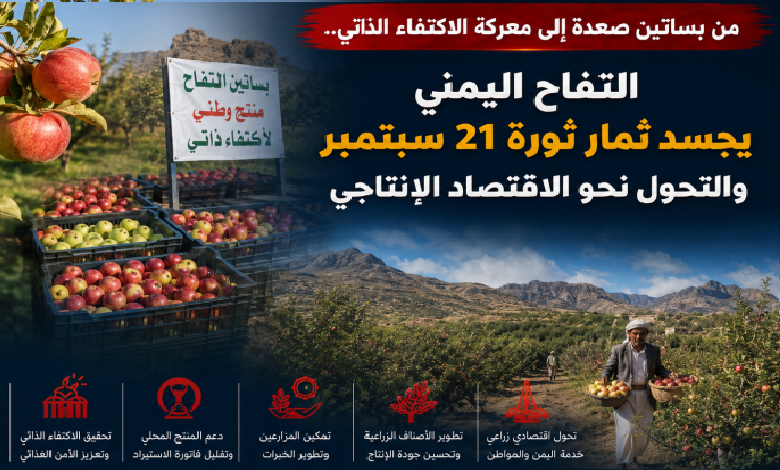
From the orchards of Saada to the battle for self-sufficiency… Yemeni apples embody the fruits of the September 21 revolution and the shift towards a productive economy
Yemen’s battle is no longer limited to the fields of defending sovereignty and national independence, but has extended to the fronts of construction, production and development, where the agricultural sector has emerged during the past years as one of the most important fields of national resilience and economic liberation, and this is clearly embodied in the successes achieved in Saada Governorate, which has turned into a leading national model in developing agricultural production and enhancing self-sufficiency.
These transformations come within the context of the national project launched by the September 21 Revolution, which established a new equation based on building an independent state, enhancing reliance on national resources, and directing energies towards productive sectors, in a way that contributes to consolidating economic sovereignty along with protecting national decision-making from external hegemony and guardianship.
Today, the apple season in Saada Governorate presents a practical and bright picture of this national vision, as the apple orchards have become a living witness to the transformation that the Yemeni agricultural sector has witnessed, after recording advanced levels of production in terms of quantity and quality, and promising national varieties have succeeded in establishing their presence within the local markets, which confirms the ability of the Yemeni farmer to achieve accomplishments whenever the will, vision and institutional support are available.
Saada: The stronghold of national agricultural production
Saada Governorate enjoys natural and climatic advantages that have made it one of the most important agricultural governorates in Yemen. The efforts made during the past years have contributed to investing in these advantages more effectively, which has led to the expansion of areas planted with apples, higher production rates, and a remarkable improvement in crop quality.
This development reflects the success of policies and approaches that have given agriculture high priority within national development programs, considering it the main pillar for achieving food security, enhancing the productive economy, and reducing dependence on foreign imports.
Saada has become an advanced center for the production of Yemeni apples, and its orchards have become a practical model of the ability of Yemenis to invest their natural resources and turn them into real economic value that serves farmers, consumers and the national economy alike.
The September 21 Revolution: From Political Liberation to Economic Independence
Since the victory of the September 21st Revolution, national efforts have been directed towards building a more independent economy capable of facing challenges, based on a firm conviction that political sovereignty is not complete without economic and food sovereignty that guarantees the Yemeni people control over their decisions and capabilities.
In this context, the agricultural sector has received great attention as one of the most important sectors capable of achieving the desired economic transformation. Agricultural expansion and land reclamation have been encouraged, the role of cooperative societies and community initiatives has been strengthened, and agricultural extension programs have been developed, which has contributed to raising production levels and improving the quality of national crops.
The success achieved in apple cultivation in Saada Governorate is one of the most prominent examples that reflect the fruits of these trends, and confirms that investment in agriculture represents the shortest path towards enhancing self-sufficiency and consolidating the foundations of national resilience.
Sugar apples: A qualitative success reflecting the development of agricultural expertise
One of the most prominent indicators of the development witnessed by the Yemeni agricultural sector is the remarkable success achieved by the sugar apple variety, which has gained an advanced position among local agricultural products thanks to its high quality, distinctive taste and competitive specifications.
This variety embodies the extent of the development that farmers’ agricultural expertise has witnessed, and the effectiveness of the technical guidance and extension programs that helped in selecting suitable varieties and improving farming and production methods.
Sugar apples also represent a model of promising crops capable of enhancing the economic value of the agricultural sector and opening new horizons for food industries related to national agricultural productio