
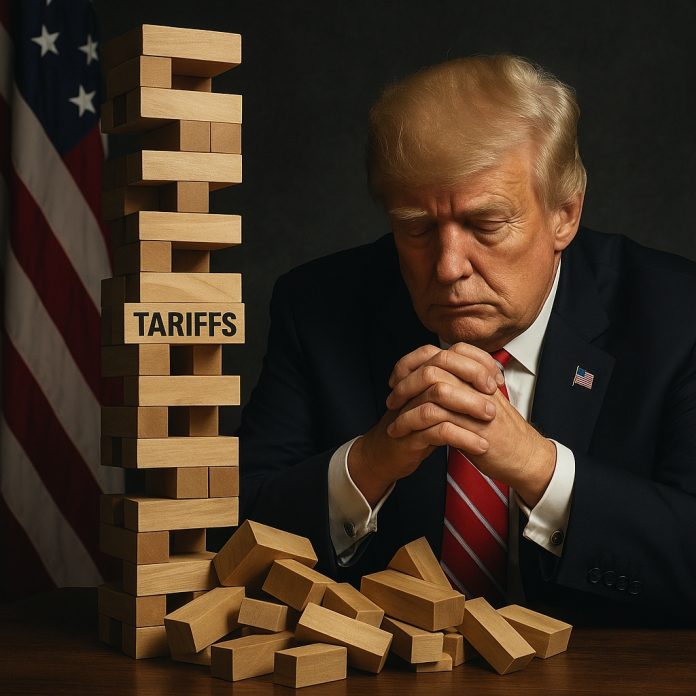
Trump’s Tariffs War A Spectacular Failure
The United States, in a typical case of late imperial power play politics that often accompanies the decline of corrupt world powers, has aggressively increased tariffs on virtually every country in the world, but particularly targeted China. Officially, this is done in a desperate bid to ensure that the US economy remains competitive globally, and to ensure a steady US productive industrial capacity, which has been steadily declining over the past decades.
If that is indeed the real goal, it seems to have failed spectacularly so far. It has succeeded only in driving up prices, increasing inflation, causing high-risk volatility on the US bond market and pushing small businesses in the US to the brink of bankruptcy.
Paradoxically, some of the worst hit sectors suffering from US tariffs are precisely the popular and modern ones, such as e-commerce and dropshipping business. As reciprocal tariffs are paid directly by the importer into the US, businesses have no choice but to either take a direct financial hit, or increase their sales prices in order to retrieve some of the costs. A group of small business owners even sued the Trump regime demanding the removal of tariffs, but lost the case in federal court.
Financial firm JPMorgan warned that the longer-term inflation and lowering of purchasing power that comes with it, has a good chance of causing a recession in the US later this year.
One of the ironies of liberal capitalism is that the major powers that generally push it through globally, end up being the victims of unshackled forces of greed and profit maximization that it unleashes as a general rule. It happened to Europe in the decades after World War II, when the United States took over as global hegemon from Britain, and profit-seeking corporations increasingly began moving their production facilities elsewhere. The merciless logic of the free market “forces” even the most well-meaning corporate entrepreneurs to cut costs and maximise profit at any cost, or risk being out-competed and bankrupted in the rat race of competition.
This has been an ongoing problem for decades all across the west. The European Trade Union Institute reported in 2024 that the EU alone had lost almost a million jobs in the productive industrial sector (the sector that actually produces material goods) in just four years. The European Commission itself has estimated that the global share of industrial output by the EU had fallen from 27% in the year 2000 to merely 16% of worldwide production by the year 2014. This trend has continued since then, ten years ago.
Despite claims to American exceptionalism, the US has suffered a similar decline in industrial production since its zenith. The Bureau of Labor Statistics estimates that since the peak of US industrial capacity in 1979, at least 6.5 million jobs in manufacturing have disappeared, a decline of approximately 33%. In the first nine years after China’s entry into the World Trade Organization in 2001, offshoring of industrial production cost the US workforce 3.7 million employment positions.
The US economy has generally relied less on industry as a whole, down from about 25% of its total GDP in the 1970s to a mere 10% now. By contrast, the so-called FIRE sector (finance, insurance and real estate) constitutes over 20% of the American economy. In fact, this often parasitic financial and rentier category now controls a larger chunk of the US economy than the entire US manufacturing, construction and mining sectors combined.
This creates a colossal economic giant with feet of clay, supporting itself less and less by domestic economic output, and ever more by financial tricks, credit systems and fiscal bubbles in order to continue its existence.
To put it into perspective: China has an industrial base that provides 28% of its total GDP, while Russia sits around 14% and Iran at 12%.
The simple fact is that a material base is necessary in order to build an economy. Unregulated free trade, free market fundamentalism and an open borders policy (for trade and good transport at least) that accompanied it, have often worked to the advantage of the imperial core in Europe and North America. But that tide is now rapidly changing. Returning the manufacturing industry to US soil, a concept known as reshoring, is not an easy feat.
As China itself has shown, industry must be actively built from the ground up. And that is exactly what China has been doing in particular since the Deng Xiaoping years in the 1980s. Sure, China adopted a limited market economy and allowed increased free trade, but always under strict government supervision, regulation and active planning. There was nothing random about the expansion of a market system in China. The very start of it came about by the state visit of Deng Xiaoping to the United States in 1979, which included a visit to the headquarters of Boeing and the NASA space cent