
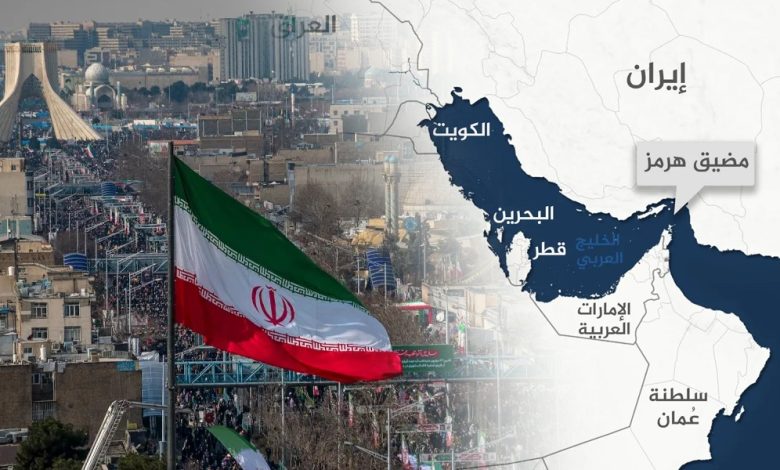
From the Strait of Hormuz to US bases: Iran expands its response equation and opens up a regional target bank.
From the Strait of Hormuz to US bases: Iran expands its response equation and opens up a regional target bank.
In a move that signals a major shift in the equations of confrontation in the region, the Islamic Republic of Iran affirmed that the era of impunity and aggression has ended, and that any aggression targeting its security and sovereignty will be met with a response that will target the sources of the threat and the sites of American military deployment in the region.
From the Strait of Hormuz, where international interests and global energy traffic intersect, to the American bases spread across West Asia, Iran has outlined a new phase of deterrence, the title of which is expanding the circle of confrontation and making the aggressor bear the cost of his choices.
Recent developments reflect Iran’s shift to a more assertive strategy in managing the confrontation, based on protecting national sovereignty and countering military and political pressures, while emphasizing that any attempt to impose facts on the ground by force will be met with responses that go beyond the borders of Iranian geography and redraw the calculations of influence in the region.
US bases under fire
The Islamic Revolutionary Guard Corps announced that the response to the American aggression was carried out in three successive stages, the first of which targeted the “Prince Hassan” air base in Jordan, where it confirmed the destruction of the command and control center and hangars of American MQ-9 reconnaissance aircraft using ballistic missiles, stressing that the operation was a direct response to the American attacks that targeted Iranian coastal bases.
In the second phase, Iran expanded the scope of its operations by targeting the US “Al-Udeid” base in Qatar, confirming that the command and control center and the fighter jet maintenance and upkeep center were hit, in conjunction with targeting and stopping a violating ship in the Strait of Hormuz, in a message confirming that maritime routes and military bases have become part of the Iranian target bank.
As for the third phase, it headed towards the logistical depth of the American forces, as the Guard announced the implementation of a large attack targeting logistical support centers and US aircraft carrier refueling platforms in the port of Duqm in the Sultanate of Oman, confirming their complete destruction.
In parallel with the Guard’s operations, the Iranian army announced that it had carried out drone attacks targeting the Patriot system, an ammunition depot, and a radar site belonging to the US Army in Kuwait, in addition to striking US military communications and radar systems in Bahrain, in an indication of the expansion of operations and the multiplicity of theaters of engagement.
Hormuz: A strategic deterrent
In parallel with the military operations, the Revolutionary Guard’s naval forces announced that the Strait of Hormuz will remain closed until further notice and until American interventions in the region cease, stressing that any attempt to impose illegal maritime routes will be met with a decisive response.
The Iranian navy revealed that it stopped a ship that violated instructions after firing warning shots, stressing that any foreign interference in managing navigation within the strait will be met with stricter measures, and that the responsibility for any escalation lies with the United States and the countries that allow their territories to be used to carry out attacks on Iran.
This announcement confirms that the Strait of Hormuz has become an essential part of the Iranian deterrence equation, given its strategic importance to global trade and energy supplies.
Military readiness and decisive messages
Amid the escalation, the Revolutionary Guard announced that Iranian air defenses had successfully shot down an American cruise missile over the city of Khorramabad in the west of the country, confirming that air defense systems remain ready to deal with any new attacks.
Iranian military spokesman Brigadier General Mohammad Akrami Nia stressed that the armed forces are firmly defending Iran’s rights in the Strait of Hormuz, emphasizing that the target bank is constantly being updated and that any new American aggression will be met with a harsh response, holding Washington responsible for the state of insecurity resulting from its interventions and attempts to impose illegal maritime routes.
The era of unilateral deals is over.
Politically, the Iranian statements carried messages no less severe than the military operations, as the Speaker of the Iranian Parliament, Mohammad Baqer Qalibaf, affirmed that “the era of unilateral deals is over,” directing a direct message to Washington that failure to adhere to commitments would have a heavy cost.
Qalibaf pointed out that the United Sta