
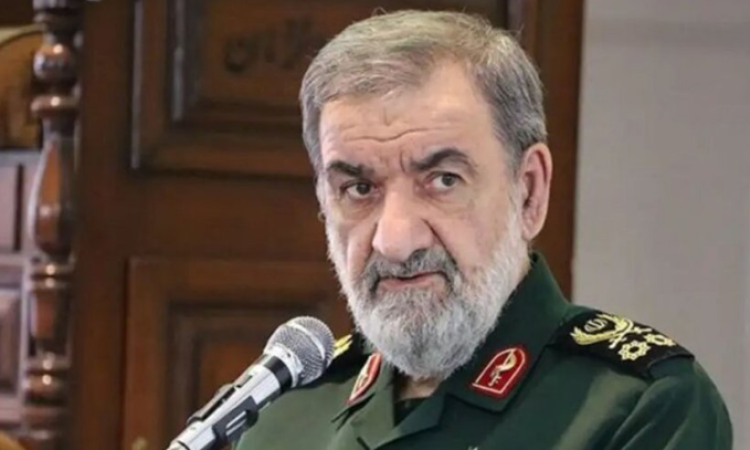
Rezaei: Iran will move to the stage of “comprehensive attack”
Major General Mohsen Rezaei, a member of Iran’s Expediency Discernment Council, warned that if the United States continues its aggression, it will lead to a shift in the nature of the Iranian response, stressing that Tehran will no longer adhere to the principle of “reciprocity,” but will move to a stage of attack and complete destruction of the enemy.
Rezaei explained, during an interview broadcast on Iranian television on Friday evening, that the policy of combining military action and negotiation is no longer viable, considering that any continuation of military operations will lead to a new stage of escalation.
He said that the United States had violated existing understandings by carrying out a military aggression and attempting to impose field pressures, noting that it had sought during the negotiation period to impose a naval blockade, but had not been able to achieve its goals.
He added that Washington had declared a unilateral ceasefire, but at the same time continued to strengthen its military presence by increasing refueling aircraft and military equipment, considering that this gave it “excessive confidence” that prompted it to try to impose its conditions on the course of negotiations.
He noted that the Iranian leadership has consistently stressed the need to uphold the country’s rights and not make concessions, adding that the negotiating team received instructions to adhere to Iranian positions and to reconsider any understandings in accordance with developments.
He pointed out that “American deception” led to a change in the landscape, considering that Washington had made new mistakes in its political and military calculations.
He accused the United States of launching an aggression that targeted the provinces of Khuzestan, Bushehr, Hormozgan, and Sistan and Baluchestan in recent days, noting that the strikes hit checkpoints, hospitals, and bridges linking the north of the country to its south.
He believed that these operations reflected a state of confusion and fear, saying that the widespread attacks on different areas came as part of an attempt to carry out a larger military operation.
He noted that the Iranian armed forces will continue to carry out “strong, precise and continuous” strikes, indicating that various formations of the army and the Revolutionary Guard, including the naval and aerospace forces, will continue their operations during the next phase.
He considered the recent military moves to be a prelude to a new operational plan aimed at breaking Iran’s resistance and creating field conditions that would give the United States an advantage in any subsequent negotiations.
He suggested that potential US plans would likely include one of three scenarios:
He carried out an operation similar to a previous attempt that he described as a failure.
Targeting Iranian nuclear facilities again.
To carry out air operations to control part of Iranian territory, and then use that as a political bargaining chip during negotiations.
He added that the ultimate goal is to force Iran to amend some of the terms of previous understandings in exchange for returning to the negotiating table.
He stressed that the stage of combining the military and negotiating tracks has ended, emphasizing that Iran, during previous confrontations, avoided expanding the circle of conflict into a regional war.
He pointed out that during the “Twelve-Day War,” Iranian forces refrained from targeting American bases in the region, including those in Kuwait, despite the participation of the United States and the Israeli enemy in the military operations.
He concluded his remarks by saying that the resumption of military operations, in his view, has led to the confrontation moving to a regional level, holding the United States and the Israeli enemy responsible for this development.