
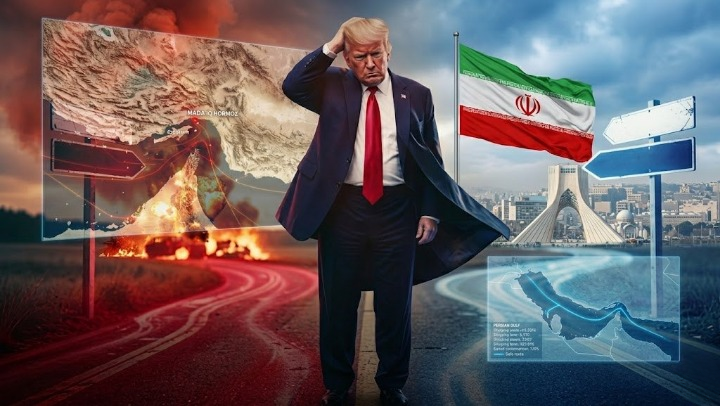
Iran is drawing up a deterrence equation: From al-Tanf to Hormuz, messages of strength are being sent to Washington.
Iran continues to establish a deterrence equation in the face of American escalation, stressing that any attack or move targeting its security and interests will be met with a decisive response, at a time when Iranian military and political messages are escalating from the battlefields to the negotiating table.
Recent statements issued by the Islamic Revolutionary Guard Corps and Iranian state leaders confirm that Tehran is proceeding on a path that combines military force and diplomatic action, based on preserving sovereignty and national interests.
From the Tanf to the heart of the confrontation
The Islamic Revolutionary Guard Corps revealed details of the operation that targeted the American al-Tanf base in Syria, confirming that the operation was carried out as part of a new wave of “Nasr 2” operations, in response to American aggression.
The Guard explained that the operation targeted the US Army Special Operations Command Center in the Tanf region, and resulted in the destruction of military systems and equipment, stressing that the response to US attacks will continue according to the deterrence equation adopted by Iran.
The Revolutionary Guard also announced that it had carried out other operations targeting American military sites and equipment, as part of confronting what it described as Washington’s hostile moves in the region.
The Strait of Hormuz: A Strategic Key
In parallel with the military operations, the Revolutionary Guard leadership confirmed that control of the Strait of Hormuz remains in the hands of Iranian forces, stressing that continued American hostilities will be met with measures to prevent this vital passage from being used to serve the aggressors.
The Guard stressed that the Strait of Hormuz is part of the Iranian power equation, and that any threat to Iran’s security and interests will be met with an appropriate response.
Diplomacy from a position of strength
On the political track, Tehran stressed that diplomacy is inseparable from deterrence power, and that any negotiations are conducted based on preserving national rights and interests.
Iranian Foreign Ministry spokesman Ismail Baghaei said his country had received proposals from mediators regarding negotiations, stressing that diplomacy and defense are two wings working to achieve one goal, which is to safeguard Iran’s interests.
He stressed that Tehran does not accept the imposition of the “negotiation or war” equation, emphasizing that defending the country and diplomatic action are proceeding in one direction.
No retreat on the right to fertilization
On the nuclear issue, Iranian Foreign Minister Abbas Araqchi confirmed that Iran has not given up its right to enrich uranium, explaining that the decisions to negotiate or stop military operations were not individual decisions, but rather came in accordance with the decisions of the Iranian Supreme National Security Council.
Araghchi pointed out that Iran entered the negotiations from a position of strength, and that dialogue for it is a means to seize rights, not to give them up.
Strengthening the home front
Inside Iran, political and military leaders stressed the importance of strengthening national unity and raising readiness to confront external pressures.
The Revolutionary Guard stressed that Iran will not tie its future to the promises of enemies, reaffirming its commitment to the approach of resistance and reliance on national capabilities.
The head of the Iranian judiciary, Gholam Hossein Mohseni Ejei, also stressed the need for quick decision-making during the stages of war, warning against attempts to disrupt the home front.
A new equation in the region
Recent developments confirm that Iran is working to establish an equation based on mutual deterrence, whereby any escalatory steps by the United States will be met with responses that go beyond traditional calculations.
While political contacts continue through intermediaries, Tehran insists that any path to de-escalation must be based on respect for sovereignty and rights, and away from the language of threats and pressure.