
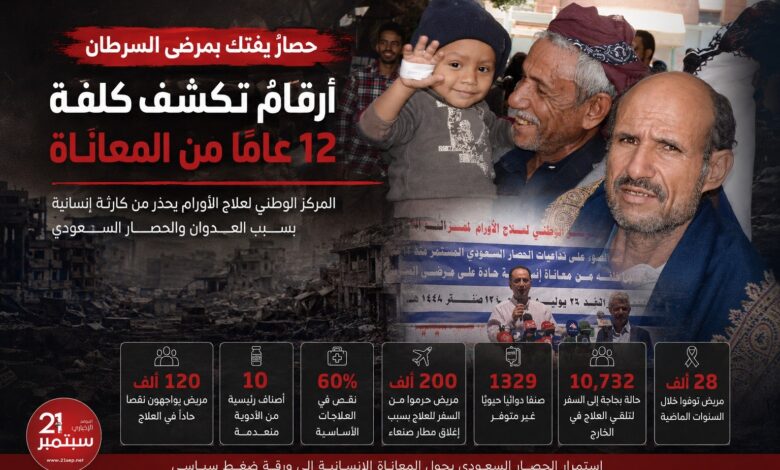
12 years of Saudi blockade: Figures documenting the tragedy of cancer patients in Yemen
The Saudi blockade of Yemen is no longer just a crisis that hinders the movement of goods or restricts travel, but has turned into a daily battle waged by thousands of patients facing disease and a lack of treatment at the same time. At the forefront of these are cancer patients, whose lives have become hostage to the continuation of the blockade, the prevention of the entry of medicines and medical supplies, and the closure of Sana’a International Airport, in one of the most cruel forms of human tragedy.
In this context, a press conference organized by the National Cancer Treatment Center in Sana’a revealed shocking figures documenting the extent of the disaster experienced by cancer patients, and highlighting the health and humanitarian repercussions of the Saudi blockade that has been ongoing for nearly 12 years, amid increasing numbers of patients and declining opportunities to obtain treatment.
The number of patients is doubling, and the need for treatment is expanding.
Dr. Abdullah Thawaba, Director General of the National Cancer Treatment Center, explained that the number of cancer patients has doubled by 100 percent, rising from 4,112 patients in 2015 to 8,250 cases during 2025, while there are 10,732 cases that need to travel to receive treatment abroad.
He stressed that the continued blockade has prevented the arrival of many medicines and medical supplies, especially items that require air transport and a special cold chain, in addition to preventing the entry of medical devices, equipment and necessary spare parts, which has led to the cessation of specialized treatment services, including treatment of thyroid cancer with radioactive iodine, nuclear scans and other vital services.
Drug shortages… and global companies withdraw
In this context, Dr. Thawaba pointed out that the blockade has caused a shortage of many basic medicines, and the withdrawal of a number of international companies from the Yemeni market. Medicine shipments now pass through Djibouti, which leads to delays in their arrival for many months, and some of them arrive after their expiry date or are damaged as a result of poor storage.
For his part, the director of pharmaceutical supplies at the center, Radwan Al-Qudsi, explained that between 12 and 15 types of medicines are currently unavailable, and some of them are still stuck in Djibouti, and need a period ranging between 6 and 8 months to reach Yemen, which directly affects treatment plans and doubles the suffering of patients.
2300 children are battling leukemia
On another front of the crisis, Abdulrahman Al-Hadi, head of the pediatric leukemia unit at Kuwait Hospital, confirmed that there are 2,300 cases of childhood leukemia, indicating that the shortage of medicines and the prevention of the entry of medical equipment and supplies increases their daily suffering.
He pointed out that leukemia patients can recover if treatment and resources are available, but the Saudi blockade has deprived patients of full medical care, and has also prevented large numbers of them from traveling to complete treatment abroad.
120,000 patients… and 28,000 deaths
The statement issued by the conference, read by the spokesman for the Ministry of Health and Environment, Dr. Anis Al-Asbahi, revealed that 120,000 cancer patients are facing a severe shortage of treatment as a result of the lack of 10 major types of drugs, with a shortage estimated at about 60 percent of basic treatments.
The statement indicated that there were 15,651 intractable cases during the period 2021-2025 that are difficult to treat inside Yemen, while 28,000 patients died during the past years as a result of not receiving appropriate treatment or being unable to travel to complete their treatment programs.
Regarding leukemia, the statement explained that 600 patients are currently receiving treatment, including 200 cases who urgently need to travel to undergo bone marrow transplants, a service that is not available inside Yemen.
1329 drug items are unavailable
The statement explained that 1,329 vital drug types are unavailable, including 12 essential chemotherapy drugs, in addition to the withdrawal of 83 global pharmaceutical companies from the market due to import complications, as well as the destruction of more than 100 tons of drugs, representing about 30 percent of the supplies, as a result of land transport conditions and poor storage.
He also noted the ban on the entry of helium gas used in tomography devices, and the shutdown of two radiotherapy devices due to the expiration of the radioactive source’s lifespan and the ban on its entry into Yemen.
The statement stressed that the closure of Sana’a International Airport deprived 200,000 patients of the opportunity to travel