
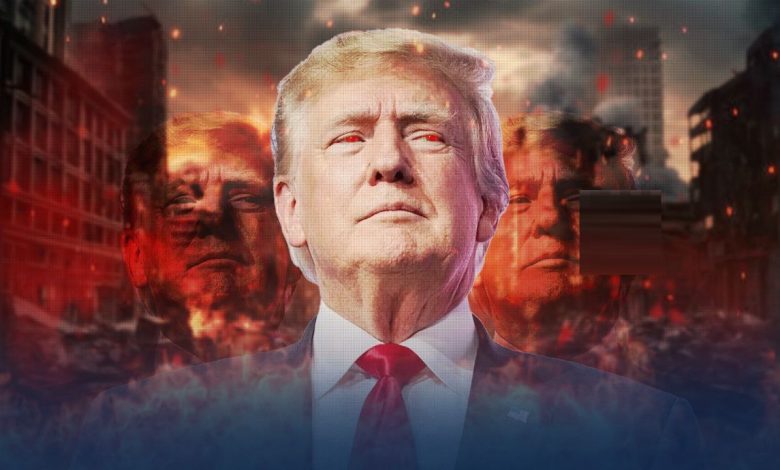
Trumpian Peace — The American Project of Hegemony and a Ceasefire of Deception in Gaza
Since President Donald Trump launched what he called the “Deal of the Century,” the notion of “peace” in Washington’s vocabulary has been turned into a tool for entrenching hegemony and legitimizing occupation. Conversation is no longer about just solutions or balanced settlements but about commercial deals imposed on peoples under the threat of aggression and blockade, presented as “practical peace.”
But the reality on the ground, from Gaza to Lebanon, has shown that this Trumpian “peace” was nothing more than a new mask for war — a means to subjugate resistance after the United States and the Zionist enemy failed to break it with fire and destruction.
With the announcement of the recent ceasefire in Gaza, old questions return to the fore: Has the war really ended, or are we entering a new phase of aggression now run with political and economic tools instead of bombs and aircraft?
Trumpism: Peace by Force — Hegemony in Terminology
Trump’s policies were not a departure from the American approach so much as an overt embodiment of it. The president who adopted “America First” did not invent a new doctrine; he rephrased the American project in the language of money and interest, making the Zionist entity the cornerstone of his Middle East strategy.
From the “Deal of the Century” to the so-called “Abraham Accords,” Trump sketched out what might be called “peace by force”: imposing facts on the ground while erasing concepts of justice, sovereignty, and dignity, until occupation becomes “a natural reality” and resistance is labeled “terrorism to be eradicated.”
At its core, this “peace” is a colonial, interest-driven peace aimed at reshaping the consciousness of peoples rather than ending the conflict. It is a project of soft domestication meant to turn the Arab and Islamic nations into markets for American dominance and into supporters of the Zionist entity’s security — using vast political, economic, and propaganda tools.
The Tools of American Peace: From Normalization to Encirclement
Washington realized that direct war no longer paid off, and that confronting the axis of resistance militarily would open uncontrollable fronts. So it resorted to “soft war” under the banner of “peace.”
Hence the “Abraham Accords,” normalization deals, and joint economic projects became instruments to consolidate Zionist supremacy and make the entity a regional hub controlling energy, trade, and security.
What Washington overlooks is that this “peace” is not built on the will of the peoples but on the dictates of compliant regimes. It cannot change the collective consciousness that views the Zionist entity as an existential enemy that cannot be lived with.
What’s offered today as a “political solution” is in fact a reproduction of occupation in new forms and an attempt to isolate resistance, besieging it with money and promises after the enemy failed to defeat it on the battlefield.
Gaza Ceasefire — A Sham Peace After a Lost War
In this context, the recent ceasefire in Gaza is another link in the chain of the “Trumpian peace” project.
After a brutal assault and a devastating war in which the Zionist enemy failed to attain its goals, Washington intervened to impose a ceasefire — not out of concern for civilian lives but to save the entity from political and military collapse.
The agreement was not an “Israeli” choice but an American dictate meant to stop the bleeding and give Netanyahu a chance to cling to power.
Yet the falsehood of this peace soon became clear: Zionist breaches continued, and the planes returned to bomb the Strip under the pretext of “preventive deterrence,” turning the ceasefire into mere cover for ongoing aggression in a new guise.
Netanyahu Between Domestic Pressure and Washington’s Tutelage
Through this “temporary peace,” war criminal Netanyahu tries to strike a precarious balance between pressure from the far right — which regards the ceasefire as weakness — and Washington’s demands for calm to preserve its image as a guarantor of stability.
What Netanyahu overlooks is the fragility of that balance and that settlers now see his government as a symbol of failure and political deceit after the collapse of the myth of an “invincible army.”
Polls inside the entity showed that more than a third of settlers consider Israel defeated in the recent war and that the so-called peace brought them nothing but more anxiety and humiliation.
Resistance — Strategic Awareness That Surpasses the Ceasefire Trap
By contrast, Palestinian resistance dealt with the complex scene with high awareness, understanding that the “ceasefire” is not the end of the struggle but a new chapter.
Resistance chose strategic patience as a considered tactic, preserving the right to respond and focusing on exposing the enemy’s v