
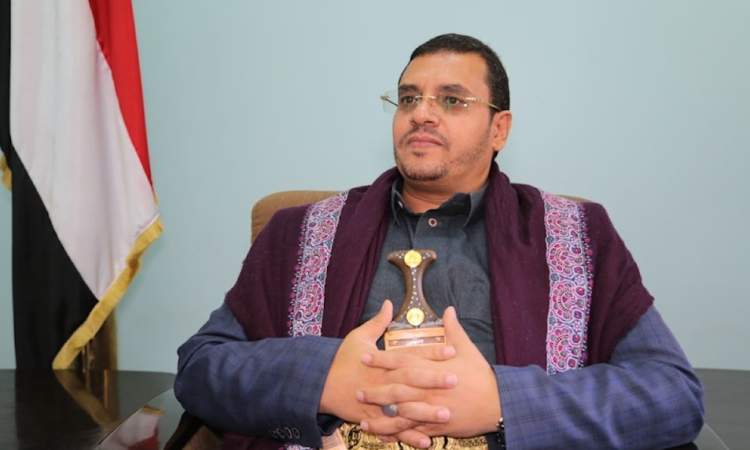
Hazem Al-Asad: The Invaders Re-Divide Yemen and Their Proxy Conflict Ignites in Hadramout
In a decisive political reading of the escalating tensions in Hadramout and the southern regions, Political Bureau member of Ansar Allah, Hazem Al-Asad, revealed the reality behind the curtain, affirming that the unrest in the occupied governorates is neither a local dispute nor a Yemeni–Yemeni conflict, as the aggression’s media portrays. Rather, it is a clear process of sharing influence and wealth between the tools of Emirati and Saudi occupation, under direct supervision from the Americans and the British.
Al-Asad’s statements came to place matters in their proper context and describe the situation as it truly is: a multi-faced occupation, an internal struggle between mercenaries over their share of resources, and a complete collapse of services and security due to a foreign administration that views Yemen solely as an open zone for plunder and control.
The Political Bureau member stressed that the recurring scenes of tension and clashes in Hadramout and across the southern regions are a direct reflection of the struggle among the aggression’s instruments over influence and wealth, explaining that the UAE and Saudi Arabia are engaged in a sharp conflict while the United States and Britain manage the scene, fund it, and secure its military and political cover.
He added that field facts reveal that the military formations deployed in the occupied areas—from UAE-backed Brigades and Giants Forces to Saudi-linked units and “Shield of the Homeland”—are nothing but mercenary groups tied to a single agenda: shifting lines of control and seizing strategically sensitive areas, far from any national interest or Yemeni priority.
Al-Asad clarified that the UAE, over the past years, has focused on controlling the southwestern coast and key locations in Aden and Shabwa, while Saudi Arabia works to expand toward Hadramout and Mahrah, exerting every effort to block Abu Dhabi from approaching its geographic and economic spheres of influence—reflecting the depth of the rift and rivalry between the two sides of the aggression.
He pointed out that the American and British presence in Mahrah and Hadramout exposes the reality of foreign administration over the occupied governorates, stressing that the deterioration of services, the worsening living conditions, and the collapse of security are direct consequences of a multi-party occupation orchestrated by Washington and distributed between Riyadh and Abu Dhabi in line with their strategic interests.
Al-Asad added that the Saudi regime, as usual, attempts to conceal its actual role in the aggression by pushing mercenaries to the forefront while portraying itself as neutral or mediating—despite being the main actor in the aggression and the architect of chaos.
He explained that, after signing the Roadmap Agreement, Riyadh used the developments in the Red Sea and Yemen’s support operations for Gaza as a pretext to evade its commitments, before igniting new tensions in Hadramout to shuffle the cards and obstruct any genuine path to peace.
He emphasized that the blood being shed today in Hadramout is the result of Emirati and Saudi mercenaries, noting that what is happening bears no relation to the demands or interests of Yemenis, but is purely a struggle for influence between the occupation’s tools, aiming to redistribute shares between the two Gulf powers under the watchful eyes of the Americans and the British.
Al-Asad added that the past years have clearly proven that all the slogans raised by the aggression coalition about “legitimacy” and “restoring Hadi” were nothing but propaganda cover, as it later became evident that the real goal was the seizure of land and wealth—while the Americans stood behind the scene, providing political, intelligence, and military cover for Riyadh and Abu Dhabi’s plans.
He noted that all fragmentation projects attempted by the aggression powers—first through the National Dialogue Conference, and later through military operations, blockade, economic collapse, and security chaos—were designed to create a reality that facilitates the division of Yemen and transforms the inhabitants of the occupied regions into dependent tools serving the goals of the foreign occupier.
Al-Asad stressed that what is happening today in the occupied governorates can no longer be concealed; its chapters have been fully exposed, and the scene has become clear: a complete occupation force dividing regions and wealth among themselves, while residents face catastrophic conditions of poverty, insecurity, and service collapse.
Finally, he affirmed that the awareness of the Yemeni people and the steadfastness of the national resistance front are sufficient to topple all these conspiracies and restore Hadramout and every inch of occupied land to the embrace of the homeland, stressing that division projects will not pass, and