
November 30… Yemenis Renew the Independence Revolution and Declare a Comprehensive Liberation Battle Against the New Occupation
Yesterday’s scene was far from a passing public gathering; it was a revival of the spirit of the first November 30, when Yemenis decided that the era of foreign dominance had ended.
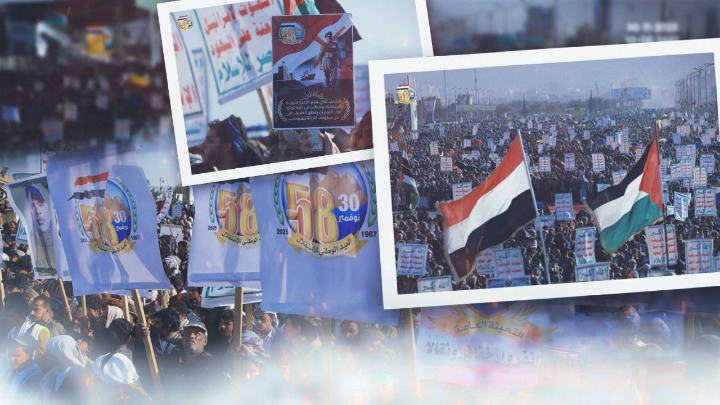
On the 58th anniversary of Independence Day, massive crowds filled the capital Sana’a and other provinces in sweeping, roaring millions, proclaiming once more that the same willpower which defeated the British Empire is today capable of breaking the tools of the Saudi-Emirati occupation and all forms of foreign guardianship.
This wide popular wave would not have been possible without the historic transformation shaped by the September 21 Revolution, which restored Yemen’s sovereignty to its people, dismantled the cloak of external dependency, and liberated the national will from American-Gulf domination.
From this free space, Yemenis found themselves able to build a firm collective stance that transcends the geography of aggression, extending to Palestine and Lebanon, with the conviction that the nation’s battle is one, and that Yemen has become an explicit part of the Axis of Resistance.
A Massive Scene Rekindles Revolutionary Memory and Announces a New Battle
Crowds poured into squares in Sana’a and the provinces in a scene binding memory, history, and the future. The national flags, liberation slogans, and chants denouncing the Saudi-Emirati occupation were all clear messages: the people who shattered the myth of “the empire upon which the sun never sets” are fully capable today of breaking modern-day tools of hegemony, no matter how tough they appear.
Voices rose in the heart of the squares to reaffirm that independence is not a fleeting commemoration, but an ongoing struggle. And that the people who once faced Britain, and prevailed against the American-Saudi-Emirati aggression for nine consecutive years, will confront with resolve any attempt to bring back occupation under new names.
Yemen in Its Natural Place: Part of the Axis of Resistance
The chants sweeping the squares were not solely rejecting the new occupation, but also affirming Yemen’s alignment with the nation’s struggle in Palestine and Lebanon.
Yemenis, who supported Gaza for two years despite war and siege, declared that the battle against the Zionist entity and the battle to liberate Yemen from the new occupiers are inseparable fronts in one united cause.
The message was unmistakable:
Those who stand with Palestine cannot accept the presence of a single American, Saudi, or Emirati soldier on Yemeni soil.
And the equation has been settled: the defense of Jerusalem begins with liberating Shabwa, Hadramout, Mahrah, and Socotra from the new occupation.
Direct and Harsh Messages to the Invaders
In Al-Sabeen Square and elsewhere, crowds gathered to send decisive warnings: Yemen is neither a broken state nor a submissive people, and any attempt to launch a new aggression will be met with a will that fights without hesitation.
Among the chants were explicit messages:
Whoever confronts America will not fear its “foot soldiers.”
The liberation project continues until every inch of Yemen is free.
There is no place for the Saudi-Emirati occupation, regardless of the tools or names.
The era of plundering resources is over, and Yemen will no longer be an open field for looting oil, gas, and ports.
These chants came with a clear public oath:
We will not betray Palestine… We will not betray Yemen… and the occupier will never return—no matter what it does.
The Occupied Governorates Expose Empty Promises
Reports from the occupied southern and eastern governorates paint a bleak picture:
lack of services, currency collapse, widespread insecurity, unpaid salaries, and the return of old colonial tactics to fragment society and ignite conflicts.
Citizens there have become fuel for struggles among invading powers and a cheap source for plundered riches.
The promises marketed by the new occupation under slogans of “reconstruction” and “empowerment” have turned into illusions. People have lived for a decade without stable electricity, services, or security, while Aden, Mukalla, and Socotra have turned into occupation hubs and warehouses of looted wealth.
Southern leader Samir Al-Masni affirmed that what is happening is a systematic policy to erase identity and national belonging through impoverishment and chaos, in an attempt to sever the South from its Yemeni depth.
Revolution Rekindled… and a National Front Reunified
The massive crowds were not a mere human presence, but a complete national realignment pushing patriotic forces towards a unified path against the new occupation.
The popular messages were sharp and decisive:
National forces must reorganize their ranks.
No place for factional loyalties planted by the occupier.
A complete North–South unity is necessary to e