
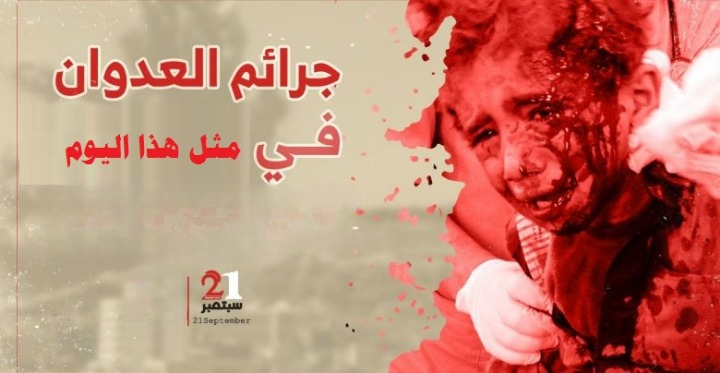
December 8: A Day When Memory Lays Bare Blood and Destruction and the Facts of the American–Saudi–Emirati Aggression Are Exposed
Each year, December 8 returns as a blood-soaked page in the record of American–Saudi–Emirati crimes against Yemen and its people—a day when victims’ testimonies intersect with the realities of bombardment and siege, and when the Yemeni memory, heavy with massacres, is renewed by attacks on villages, cities, service infrastructure, and densely populated neighborhoods.
For eight consecutive years, this day has stood as a stark embodiment of the nature of the aggression and its doctrine: targeting human beings before places, and destroying every component of life without exception. What follows are the most prominent documented crimes committed on this date from 2015 to 2022.
Crimes of December 8, 2015: Massacres of Civilian Homes and Attacks on Vital Facilities
In the first year of the aggression, horrific massacres occurred. Enemy aircraft targeted the home of citizen Saleh Jarman in the Marhadh area of Kataf District, Saada, killing three women and a man, destroying the house and damaging neighboring homes.
The headquarters of the Youth Sports, Cultural, and Social Club in Al-Bayda were also destroyed by multiple airstrikes, causing extensive property damage. Other strikes hit several areas of Taiz near the People’s Palace, the automated bakery, Sofitel Hotel, and the regions of Al-Rahda, Azzan, Hajda, and the old airport.
In Hajjah, the enemy used internationally prohibited cluster munitions against the city of Haradh, alongside intense artillery shelling by mercenaries on multiple neighborhoods.
Crimes of December 8, 2016: Comprehensive Escalation and Targeting of Agricultural and Border Areas
This year saw a woman injured and a vehicle destroyed in Ghoulah Asim, Bin Nahm, after mercenaries shelled a civilian home. Airstrikes hit Al-Takhraf, Jarban in Sanhan, and Bani Bahlul, leaving severe damage to agricultural lands.
More than 25 airstrikes were launched on Baqim in Saada, with cluster bombs used on Al-Manzilah. Shelling also struck Al-Ghubair, Sahar, and other border districts, which endured Saudi missile and artillery fire.
In the Capital Secretariat, strikes targeted the Military Engineering College, and the telecommunications tower in Al-Suwadiyah (Al-Bayda) was also hit.
Crimes of December 8, 2017: A Year of Heavy Bloodshed and Attacks on Civilian and Media Infrastructure
This was among the bloodiest years. Fifteen civilians were killed in airstrikes on Sha‘ban in Razih, and eight in Bani Mu‘adh, Sahar.
Workers and guards at the national television facility in the Capital Secretariat were targeted by two airstrikes, resulting in four killed and five wounded, including media personnel.
Multiple strikes hit Al-Far‘ and Kataf in Saada, while Najran saw eight airstrikes on Al-Shabakah and Al-Sharafah.
Sana‘a endured ten airstrikes on Yam, Dhabu‘ah, Al-Qutb, and Bran. Three civilians were wounded in Al-Dhafair, Hajjah, and Washhah, along with areas in Marib and Najran, faced intensive shelling.
Crimes of December 8, 2018: Targeting Hodeidah and Continued Shelling of Residential Areas
On this day, six civilians were killed and 12 wounded, including women and children, by mercenary shelling of Al-Rabsah Roundabout in Hodeidah city.
Airstrikes continued on Al-Jabanah in Al-Hali, and Al-Zafran and Mahall Al-Sheikh in Al-Durayhimi, with more than 135 shells, as well as strikes north of Kilometer 16.
In Sana‘a and Saada, multiple strikes hit Nihm, Kataf, Al-Malahiz, and Baqim. A drone strike targeted a telecommunications network in Bani Mu‘in, Razih, while border villages suffered intense missile and artillery fire.
Crimes of December 8, 2019: Shelling in Hodeidah and Saada and Civilian Casualties
Artillery shelling hit Al-Madman in Al-Tuhaita, killing one civilian and wounding another. A woman and her two children were injured in Al-Jah (Bayt Al-Faqih).
Homes burned in Al-Durayhimi; Al-Jabaliyah, Al-Fazah, and other areas faced missile and artillery attacks, while mercenaries continued targeting eastern Hays.
In Saada, three African migrants were killed by Saudi border guards’ fire at Al-Raqw Market, alongside the killing of a civilian in Shada and missile and artillery shelling of Razih.
Crimes of December 8, 2020: Attacks on Telecommunications and Vital Infrastructure in Amran and Hodeidah
Aggression aircraft launched nine airstrikes on the telecommunications network at Jabal Dhin in Amran, and dropped three illumination bombs on Bani Hajaj in Al-Sawdah.
In Hodeidah, surveillance aircraft struck Al-Fazah three times and Al-50 eleven times, in addition to mercenary fortifications in Hays, and 281 shells and missiles fired across multiple areas.
Saudi shelling continued on Razih and Munabbih, while airstrikes hit Al-Far‘ in Kataf, Al-Hasamah in Al-Dhahir, and areas in Mahliyah, Majzar, Sirwah (Marib), Nihm (Sana‘a), and Al-Lubnat (Al-Jawf).
Crimes of December 8, 2021: Broad Escalation in Marib and Targeting of Civilian Areas
A civilian was injured by Saudi shelling in Al-Sheikh, Munabbih. The aggressor launched 25 airstrikes on Al-Jawbah and Sirwah in Marib, and one strike on Hays in Hodeidah.
Multiple areas in Hodeidah were subjected to missile, artillery, and small-arms fire.
Crimes of December 8, 2022: Continued Violations and Artillery Shelling of Hodeidah
Mercenaries continued shelling scattered areas of Hodeidah with artillery and live fire, leaving the governorate exposed to daily violations amid entrenched international silence.
An Aggression That Was Neither Accidental nor Limited
This bloody record confirms that December 8 is not merely a date on Yemen’s calendar. It stands as enduring testimony to the nature of the American–Saudi–Emirati aggression—one rooted in targeting the Yemeni people through every means of killing and siege, and in unrestrained arrogance despite shifting phases and fronts.
The accumulation of crimes on this day over eight years clearly demonstrates that the aggression was neither incidental nor limited, but a comprehensive war project aimed at Yemen’s state, people, and identity—an imperative that obliges Yemenis to document this national memory and present it to the world as an indictment that does not expire with time.