
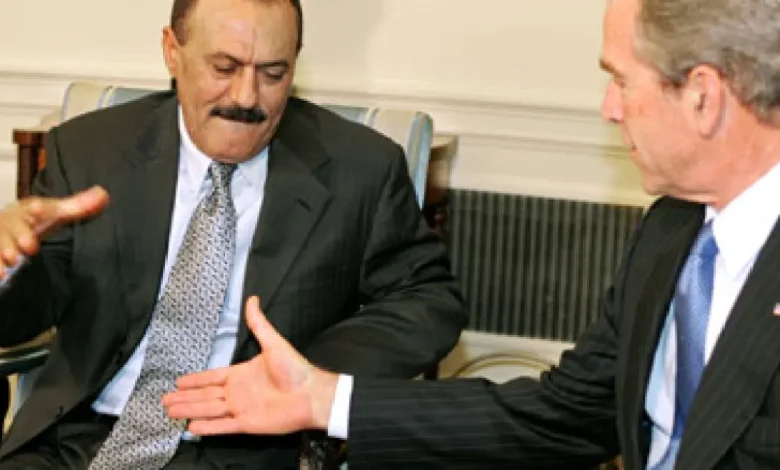
Testimonies and Cables Expose the Late Afash: How He Handed Yemen Over to Washington and Placed the Yemeni State Under American Guardianship
The subservience of the late Ali Afash to the U.S. administration was neither an allegation nor a political suspicion; it was a complete system of rule built on subordinating Yemen’s national decision-making to foreign dictates. The relationship was neither coordination nor alliance, but one of master and agent—Washington issuing commands, and Sana’a, under Afash’s rule, acting merely as an execution office for Pentagon and CIA demands: airstrikes carried out without sovereignty, intelligence handed over without legality, and an army reoriented to serve American maps inside Yemen and beyond. He turned the Republican Palace into an annexed operations room of the American command and emptied the concept of the state of its meaning when he became willing to “fight on the back of the American tank” against his own people rather than against his enemies.
What American documents and secret cables reveal are not passing details, but explicit admissions proving a fully fledged project of betrayal—a project that sold sovereignty, legitimized military intervention, and laundered the crimes of U.S. aircraft through false official statements. At this depth of decline, the former regime ceased to be merely corrupt authority and instead became an open channel for American hegemony at the heart of Yemen. This report therefore undertakes the task of dismantling that subservience and exposing the traitor who offered an entire nation as a political gift to Washington.
When the Agent Addressed His Master in the Language of Submission
At the height of a phase in which Washington operated inside Yemen with the confidence of a power treating the country as an open arena, a secret cable issued by the U.S. Embassy in Sana’a provided written proof of the extent of American dominance over the political and military decision-making of the Afash regime. Dated January 2010, the cable does not describe a protocol meeting between a head of state and a military commander, but rather documents a stark display of the real balance of power: an American general dictating terms, and the leader of betrayal offering commitments without debate.
The cable—leaked by WikiLeaks—quotes Afash explicitly pledging to General Petraeus that he would be “on the back of the [American] tank” in so-called “counterterrorism” operations. This was no slip of the tongue, but a formal declaration that Yemen’s military sovereignty had come under the direct guardianship of Washington. The reference to the “tank” was not metaphorical, but a literal description of U.S. combat operations carried out on Yemeni territory, foremost among them the drone strikes that expanded from 2009 onward, as confirmed by records of the U.S. Senate Intelligence Committee.
The document also exposes the level of compliance: the American side requested complete flexibility over Yemeni airspace, and the leader of betrayal immediately agreed without consulting any legislative or security institution. The cable confirms that the regime not only opened the skies but also agreed to deceive public opinion by attributing U.S. strikes to the “Yemeni Air Force”—a manipulation later revealed by investigations into the Al-Ma‘jalah massacre, which killed dozens of civilians.
These revelations are reinforced by other documents issued between 2007 and 2011 showing that the relationship was not a security partnership, but a full agency arrangement with an American administration controlling the Yemeni scene. Official U.S. reports spoke of joint operations rooms inside Sana’a, direct intelligence flows from regime agencies to the CIA, and logistical support conditioned on access to detailed security files containing names, locations, and data on Yemeni citizens. Collectively, these facts demonstrate that Afash handed over all the instruments of the state—military, security, and intelligence—to the U.S. administration in exchange for external protection that kept him in power.
Thus, the ambassador’s cable was not just another political document; it was the clearest witness that Yemeni decision-making at the time was under direct American domination, and that the head of the regime functioned as an executing employee within a command structure headquartered not in Sana’a, but in American operations rooms. The masks were torn away by that document: Yemen under foreign guardianship, and the leader of betrayal merely a signatory executing what he was ordered to do.
How the Republican Palace Became a Branch of the Pentagon
What the ambassador’s cable revealed was not an isolated moment, but a clear indicator of an advanced stage of betrayal—from personal admission of submission to an American general, to transforming the entire state into an executive tool of the U.S. agenda. The next step was the construction o