
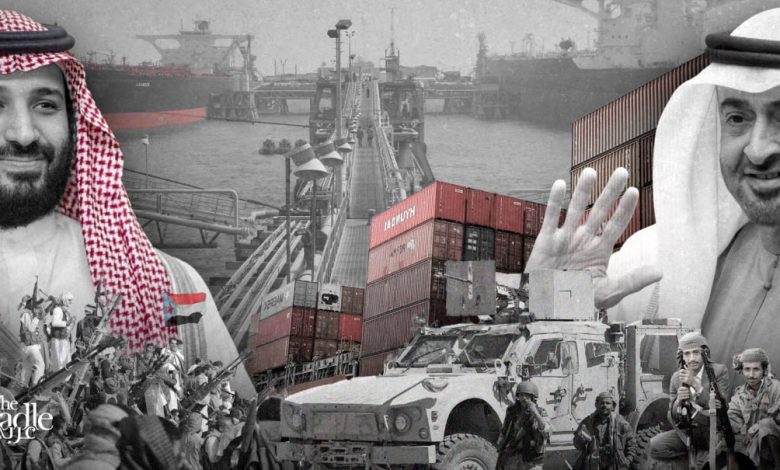
Contradictory Ambitions Dismantle the “Decisive Storm” Narrative:
From a Joint War Room to a Clash of Occupiers Competing for Influence and Geography
The conflict in the occupied eastern and southern governorates is no longer about the worn-out tale of “legitimacy,” nor about obsolete projects of “secession” and partition, nor about the fabricated narrative of “liberation” or “restoring so-called legitimacy.” Today, in broad daylight, the final curtain has fallen on a far harsher truth: the occupied governorates were never anything more than arenas for settling scores between two occupiers who once shared a single operations room, only to become rivals now dividing the corpse of a nation.
What is unfolding in Hadramawt, Shabwah, Al-Mahrah, and Aden leaves no room for interpretation. It is a live dissection of the Saudi-Emirati aggression alliance—an alliance that has lost its essence, exposed the falsity of its slogans, and transformed its parties into occupying forces locked in conflict over influence and resources. Meanwhile, the people of the occupied governorates—east and south—pay the price with their blood, dignity, and future. According to local testimonies and field reports, this conflict has led to the return of fuel crises—especially the domestic gas shortage—coinciding with escalating events in the eastern and southern governorates, alongside the depreciation of the local currency in areas under the control of the “hotel government,” proving that the coalition’s colonial nature shows no mercy to civilians.
In recent days, irrefutable evidence has emerged: sudden military withdrawals by Saudi-backed mercenaries; the expansion of UAE-backed militias; the closure of vital airports by external decisions; and open clashes between the tools of Riyadh and Abu Dhabi. All of this is happening in plain sight, cementing the reality that the occupied governorates have shifted from a purported “project” into “spoils” divided through secret correspondence and back-room deals. Field analyses of recent events indicate this shift is not a temporary tactic, but the inevitable result of an alliance built from the outset on deep contradictions of vision and interests—united briefly by a single short-term objective before mutating into a multi-headed dragon, its heads now at war with one another.
Fractured Visions and Divergent Interests: When an Alliance Becomes a Clash of Occupiers
On the ground, the UAE began practical steps toward absolute dominance over the eastern and southern governorates from the moment the alliance fractured. In Shabwah, recent events revealed a sudden withdrawal of Saudi-backed mercenaries from several strategic sites, opening the way for Abu Dhabi-backed militias to expand and seize gas fields and vital ports. Local reports and residents’ testimonies confirm this was part of a calculated plan to strengthen Emirati control over strategic economic resources. This was not a mere tactical shift, but a deliberate move to tighten control over oil-production areas and convert them into exclusive economic spoils—disregarding all prior agreements with Riyadh.
In Hadramawt and Al-Mahrah, the same pattern appeared. Emirati-backed militias took control of strategic sites, including checkpoints and military camps, while Al-Ghaydah International Airport was seized and directly administered, according to local reports and residents. Local sources also indicate that Emirati control—through its tools and mercenaries—extended to imposing fees at ports and managing internal transport of goods, granting Abu Dhabi direct economic leverage over civilian life.
Saudi Arabia’s response was swift, taking the form of simultaneous measures: reinforcing its proxies’ presence in border areas near Shabwah and Al-Mahrah; imposing partial control over key roads; and blocking gas supplies to UAE-controlled areas via Islah-affiliated militias in Marib, backed by Riyadh. This triggered electricity crises and fuel shortages with immediate impacts on civilians—demonstrating that the conflict has evolved beyond competition for influence into a tool of political and economic pressure on local populations.
The Battle for Influence in the Occupied Governorates
The ongoing conflict in Hadramawt, Shabwah, and Al-Mahrah is not the product of poor coordination or a sudden political dispute. It is a direct reflection of the structural ambitions each party carried from the outset of the aggression. The eastern and southern governorates were never administered as “liberated” areas, but as zones of influence to be divided—or monopolized—according to the balance of power between Saudi Arabia and the UAE.
As documented by Reuters in multiple reports since 2018, the UAE focused on building direct military and security influence over ports, islands, and maritime outlets—from Aden through Shabwah to the coasts of Hadramawt and Al-Mahrah. This was not merely a security approac