
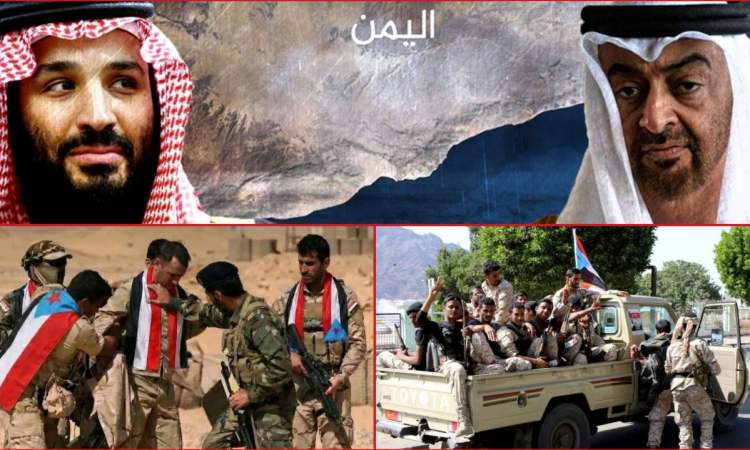
How the Saudi-Emirati Occupation Exploits the Conflict Among Its Tools
The conflict among the tools of the Saudi-Emirati occupation has entered a new phase of escalation, as Riyadh and Abu Dhabi pull delicate strings to manage the scene in the occupied southern and eastern governorates—reflecting a dual strategy aimed at advancing their interests amid comprehensive living and security chaos.
Military moves by UAE-backed forces, represented by the so-called Southern Transitional Council (STC), prompted a Saudi diplomatic, security, and economic push. This culminated in the evacuation of the so-called “hotel government” from Aden and the initiation of studies into punitive measures against Abu Dhabi’s mercenaries following their takeover of Hadramawt and Al-Mahrah and their declaration of political and “popular” escalation in Aden.
Media sources confirmed that members of the “hotel government” left Aden amid significant turmoil, following the withdrawal of Saudi occupation forces and rising tensions with the STC militia.
Reuters quoted what it described as a senior STC leader as saying that the mercenary government’s departure occurred without a request from the UAE’s tools—an indication that the government had lost control over its headquarters and influence in the city, and that it departed at Saudi direction. This underscores that Riyadh and Abu Dhabi are managing conflicts among their tools in a manner that preserves the interests of both poles of occupation.
The departure coincided with the travel—two days earlier—of the head of the so-called Eight-Member Council, mercenary Rashad Al-Alimi, and the head of the “hotel government,” Salem bin Breik, to Riyadh. There, Al-Alimi launched a sharp attack on UAE-backed tools, describing their military moves in Hadramawt and Al-Mahrah as a full coup against so-called legitimacy and calling for their immediate withdrawal in line with the Saudi position.
According to reports, Riyadh is considering imposing punitive measures, including reducing or increasing economic support to mercenary authorities in the southern and eastern governorates, which are already facing acute crises. This places STC militias before a serious challenge and may expose them to popular backlash due to worsening living conditions—conditions likely to deteriorate further with Saudi economic escalation.
In the same context, Saudi Arabia took a direct step by temporarily closing the airspace over Aden and other occupied areas, suspending flights to and from Aden. The Associated Press confirmed this move, quoting an official from the “hotel government” who said the aggression coalition had not issued the necessary flight permits. The mercenary official described the measure as a clear Saudi message to the STC following its recent military expansion in oil-rich Hadramawt, which borders the Kingdom.
While hundreds of passengers were stranded at Aden Airport for hours, the airspace was later reopened. The move, however, revealed Saudi Arabia’s deliberate blending of conflicts among its tools with citizens’ suffering—serving objectives pursued by both Riyadh and Abu Dhabi.
On the ground, UAE-affiliated forces seized the presidential palace in Aden over the weekend and forced guards to fully evacuate, according to aggression-aligned media—signaling a transfer of actual control of the city to Abu Dhabi’s tools.
Al-Alimi, described in reports as a Saudi creation, turned in recent hours to international diplomatic channels, holding an urgent meeting with ambassadors of sponsoring countries to plead for public pressure to force the so-called STC to retreat—an explicit admission of his inability to make any decision within areas supposedly under his authority, and that reactions to recent developments depend entirely on decisions by the mercenaries’ handlers.
During the meeting, Al-Alimi warned that continued STC defiance would lead to an economic and humanitarian catastrophe, noting that instability in Hadramawt and Al-Mahrah would have serious repercussions for salary payments and fuel supplies and services—overlooking that living conditions in the occupied governorates had already reached a peak of hardship, in an attempt to place responsibility on UAE occupation tools.
These warnings came after Reuters reported—quoting what it called a senior official at the Aden branch of the central bank—that the “hotel government” is facing an unprecedented financial crisis, signaling a rapid deterioration in financial indicators in areas under the aggression coalition’s control following its staged internal splits, paid for with mercenary blood.
Analysts believe that even a superficial tension between the two poles of the aggression and occupation alliance will directly affect exchange rates, the economy, and services—amid expectations of widespread collapse in areas controlled by UAE mercenaries due to the fragility of the financial situation and complete depen