
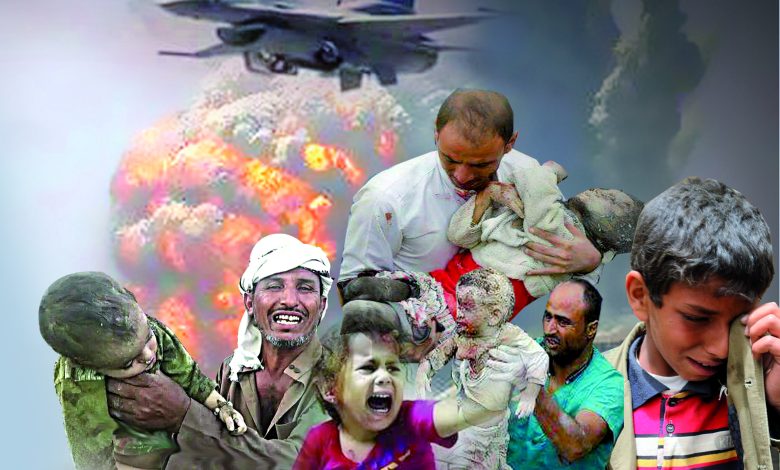
3,900 Days of Aggression: Ain Human Rights Center Reveals the Full Scale of U.S.-Saudi Crimes Against Yemen
After eleven years of war and blockade, time continues to unveil the enormity of the destruction and mass killing inflicted by the U.S.-Saudi-Emirati coalition on Yemen—through images, testimonies, and hard numbers.
On the occasion of International Human Rights Day, the Ain Human Rights and Development Center released what is arguably the most comprehensive and detailed documentation of 3,900 days of compounded crimes—affirming that what Yemen endured was not a conventional war, but a systematic project of annihilation aimed at destroying land, infrastructure, and human life to break the will of the Yemeni people. Yet, as the years of confrontation have proven, Yemenis have risen above every attempt to crush them.
Civilian Casualties: A Nationwide Tragedy
According to the statistics disclosed by Ain Human Rights Center, the total number of civilian casualties during 3,900 days of U.S.-Saudi aggression reached 54,219 civilians, killed or injured—making it one of the bloodiest conflicts in modern regional history.
The toll is broken down as follows:
19,446 civilians killed
34,773 civilians injured
Children represent the most harrowing segment:
4,244 children killed
5,401 children injured
Among men:
12,659 killed
26,135 injured
Among women:
2,543 killed
3,237 injured
These numbers alone highlight the nature of this war—one clearly designed to kill civilians, targeting gatherings, markets, and homes without regard for the laws of war or the principles of human rights.
Systematic Destruction of Infrastructure
Ain Human Rights Center presented one of the most precise datasets illustrating the magnitude of infrastructure destruction—part of a coordinated attempt to collapse Yemen’s essential systems.
Over 3,900 days of aggression, coalition forces targeted:
15 airports
16 seaports
488 power stations and generators
716 communication stations and networks
3,577 water tanks and pumping stations
2,501 government buildings
8,869 roads and bridges
These figures reflect a deliberate strategy to disable transportation, communications, water, and electricity networks—driving the country into a massive humanitarian and service-related catastrophe.
An Economy Under Siege: Targeting Every Source of Livelihood
The coalition did not stop at destroying public services—it struck directly at Yemen’s economy and traditional sources of income:
467 factories
642 fuel tankers
16,686 commercial establishments
503 poultry and livestock farms
12,196 transport vehicles
581 fishing boats
1,172 food warehouses
565 fuel stations
735 markets
1,504 food trucks
This pattern reveals a multi-layered strategy: choke food supplies, crush supply chains, destroy income sources, and engineer widespread poverty and hunger across an entire population.
Homes and Civil Institutions… A Landscape of Ruins
The data shows that the coalition targeted virtually everything connected to daily life in Yemen, following a scorched-earth approach:
622,354 homes destroyed or damaged
203 university facilities
2,018 mosques
431 tourism facilities
475 hospitals and health centers
1,487 schools and educational facilities
14,231 agricultural fields
157 sports facilities
301 archaeological sites
75 media establishments
This list paints a complete picture of the assault on education, healthcare, agriculture, heritage, and media—sectors that form the backbone of any society and its cultural identity.
Crimes Documented in Detail—No Room for Ambiguity
Ain Human Rights Center did not merely present numbers; it documented thousands of incidents, classifying them within the context of the U.S.-Saudi-Israeli assault on Yemen—carried out through a land, sea, and air blockade, the use of internationally prohibited weaponry, and repeated strikes on villages, markets, and civilian facilities without any legitimate military justification.
The timing of this report—issued on Human Rights Day—underscores the stark contradiction between international organizations’ rhetoric and their stance toward what has become the world’s most manufactured humanitarian catastrophe, executed with foreign decision-making and protected by international silence.
Yemen Proves That Blood Cannot Be Defeated
The statistics provided by Ain Human Rights Center confirm that Yemen has faced a total war over 3,900 days—one that targeted people, land, and livelihood.
Yet despite the enormity of the destruction and the suffocating blockade, Yemen—under the leadership of the September 21 Revolution—has managed to build a deterrence balance, derail the U.S.-Saudi project, and establish a model of resilience that no amount of aggression will erase from history.