
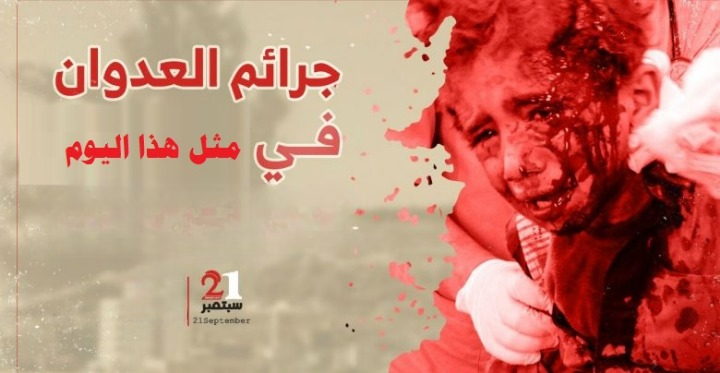
December 22: A Day on Which Crimes Are Documented and the Atrocities of the American–Saudi–Emirati Aggression Are Exposed
December 22 has never been an ordinary day in the course of the American–Saudi–Emirati aggression against Yemen. Over the years of war, it has become a bloodstained milestone on which the same crimes are repeatedly committed and the same instruments of killing and systematic targeting of civilians and their means of livelihood are renewed.
On this day, the hand of aggression reached homes, water wells, farms, markets, and service facilities. It did not stop at aerial and missile strikes, but descended into shocking moral crimes—revealing with stark clarity the nature of the war waged on Yemen: a war of extermination, terror, and comprehensive violation of human beings, land, and values.
This report presents, in chronological order, the most prominent crimes committed by the aggression on this date across successive years, affirming that what occurred were not isolated incidents, but a deliberate, systematic policy with clear objectives.
December 22, 2015: Targeting Life and the Means of Survival
On this day in 2015, the aggression opened its record of crimes with a drone strike targeting the Qashwan fuel station in Bayhan District, Shabwa Governorate, resulting in the martyrdom of one citizen, the injury of two others, and damage to nearby shops.
In Sa’ada, five citizens were martyred and six others wounded—among them women and children—when an airstrike hit a house in the Nashour area of Al-Safra District, a crime that embodied the direct targeting of families inside their homes.
The warplanes also deliberately targeted a water well and citizens’ farms in Razih District, alongside Saudi missile shelling of the border district of Ghamr—reflecting a policy of strangling life and targeting sources of water and food.
In Taiz, the aggression used cluster bombs in the Wahijah area of Dhubab, leaving martyrs and wounded, before expanding its air raids to include Al-Rahida, Hayfan, Al-Qubaita, and Al-Sharijah, targeting the Community College and densely populated areas.
In Al-Hudaydah, six airstrikes hit Bajil District, striking the Vocational Training Institute, while citizens’ farms in Abs District, Hajjah Governorate, were also targeted—within a clear pattern of destroying civilian and economic infrastructure.
December 22, 2016: Cluster Munitions and Widespread Shelling of Homes and Farms
In 2016, the aggression continued its systematic targeting of rural and agricultural areas. Airstrikes hit citizens’ homes and farms in Al-Maslub District, Al-Jawf Governorate, alongside intense artillery shelling by mercenaries.
In Nihm, Sana’a, wide areas were subjected to heavy airstrikes exceeding fifteen raids, during which cluster bombs were used, causing extensive destruction to property and farmland.
Areas in Sa’ada, Taiz, and Al-Hudaydah were also targeted. The coastal defense in Al-Jabanah was struck, and Apache helicopters shelled the Alab border crossing—marking a clear expansion of the scope of attacks.
December 22, 2017: Striking Education, Health, and Humanitarian Infrastructure
This year witnessed a qualitative escalation in targeting civilian facilities. Airstrikes hit water tankers, citizens’ homes in Dahyan, and the Higher Institute for Teachers in Sa’ada City.
Al-Hudaydah Airport was struck by two air raids, and a civilian food warehouse was targeted, causing damage to the 22 May Hospital and doctors’ housing—an egregious violation of international humanitarian law.
Airstrikes extended to Marib, Shabwa, Hajjah, Al-Jawf, and عمران (Amran), while Saudi missiles continued to target border districts in Sa’ada.
December 22, 2018: Field Crimes and Shocking Moral Violations
In this year, missile and artillery shelling continued on border areas in Sa’ada, alongside airstrikes on Kitaf and Al-Zahir.
In Al-Hudaydah, a number of citizens were injured by artillery fire and heavy machine guns targeting residential neighborhoods and agricultural areas in Al-Tuhaita, Al-Durayhimi, and Al-Hali.
This day also recorded one of the most heinous moral crimes, when mercenaries of the aggression raped a child in Al-Mokha District, Taiz Governorate—a crime that exposed the depth of the human and moral degradation reached by the aggression’s project.
December 22, 2019–2022: Continued Shelling, Fortifications, and Ceasefire Violations
Throughout these years, artillery and missile shelling continued in Al-Hudaydah, Sa’ada, Marib, and Al-Jawf, alongside the establishment of new combat fortifications by mercenaries within residential and agricultural areas, and repeated airstrikes on the same districts. This confirmed that the aggression did not abandon its policy of attrition and terror, despite all political and humanitarian claims.
A Black Record of Crimes
Thus, December 22 recurs year after year as a living witness to the nature of the Ameri