
How Did the September 21 Revolution Create a New Maritime Power Equation?
By late 2014, the naval forces were on the verge of collapse. Capabilities were limited, equipment outdated, and coastal bases threatened with siege or destruction. The sea did not constitute a strategic depth as much as it represented an open security liability, exposed to targeting and blockade.
However, the popular revolution of September 21 placed Yemen on a new trajectory. It redefined maritime sovereignty and its tools, transforming the navy from a destroyed and besieged force into an influential regional pressure element.
An Unprotected Sea… Before the Revolution
Prior to September 21, the navy suffered from long-term marginalization and complete dependence on external support for maintenance, armament, and training. This left it incapable of making any independent maritime decisions. Technical and operational readiness was limited, and the absence of a strategic vision left Yemeni waters exposed to threats, with more than 2,500 kilometers of coastline lacking effective protection.
Field sources indicate that most boats and vessels were out of service due to breakdowns and shortages of spare parts, turning Yemeni ports into clear vulnerabilities within the national security framework.
The Revolution and the Major Transformation
With the launch of the September 21 Revolution, a new approach to military thinking emerged, giving naval forces the opportunity to rebuild according to national priorities. When the aggression began in 2015, naval bases were subjected to intense bombardment, putting naval units out of service and imposing a severe maritime blockade.
Field sources confirm that this crisis was not perceived as the end of naval power, but rather as a pivotal moment to rethink the form and function of the force. Instead of attempting to restore a costly traditional model, the revolution moved toward building an asymmetric naval force based on available resources—turning constraints into tools of power and deterrence.
Rebuilding Under the Influence of the Revolution
The rebuilding process took place within a comprehensive national vision produced by the September 21 Revolution, centered on restoring sovereign decision-making and freeing naval capabilities from external dependence. This path was neither rapid nor publicly detailed; it relied on accumulated experience, organized use of available resources, and gradual performance development in line with the phase’s demands and the realities of confrontation.
This approach resulted in more cohesive and effective naval capabilities, able to operate in complex environments, adapt to evolving challenges, and impose a tangible presence in the maritime theater—despite the intensity of the blockade and continuous targeting.
Naval Missiles: The Core of the Equation
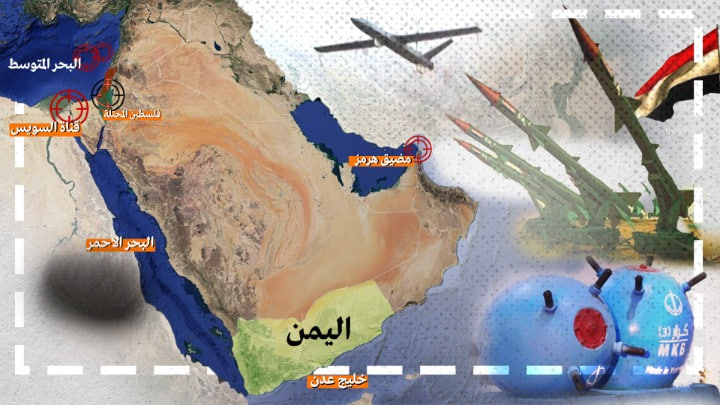
The most prominent transformation was the introduction of domestically produced naval missile systems, including ballistic and cruise missiles with ranges reaching up to 800 kilometers and warheads weighing up to 550 kilograms, supported by multiple guidance systems suitable for engaging moving maritime targets.
A strategic expert stated:
“The September 21 Revolution restored the value of maritime vision, and naval missiles have become the heart of the new equation, forcing adversaries to reconsider every move in the Red Sea and Bab al-Mandab.”
Fast Attack Boats: The Element of Surprise
Models such as Asif and Tufan were designed for speed and surprise, featuring low radar signatures and high maneuverability. This enabled naval forces to carry out rapid strike operations under complex timing and conditions.
Naval sources confirmed that these boats contributed to successful operations that impacted international shipping, proving that small size does not equate to limited effect.
Naval Mines: Silent Deterrence
Naval mines constituted another dimension of the deterrence strategy. More than 11 types of locally developed mines—some stationary and others mobile—were produced, equipped with smart detonation systems. This made any uncalculated approach to Yemeni waters highly risky.
Maritime experts noted that these mines succeeded in imposing undeclared restrictions on navigation, transforming the sea from an open space into a deterrent and strategic zone—reflecting the revolution’s impact on maritime power tools.
Naval Operations: Regional Impact
Since September 21, the Yemeni navy has demonstrated that the sea is no longer merely a geographic space, but a strategic instrument for deterrence and for reshaping balances of power. Within the framework of support operations for Gaza, as part of broader support fronts, the navy conducted precise operations targeting enemy vessels, with the number of targeted ships reaching 228 enemy-affiliated vessels.
According to official sources, these operations forced the Israeli enemy to close the port of Umm al-Ra