
From Beneath the Siege, Life Is Being Built… Major Service Projects Transform the Face of Sana’a
At a time when the forces of aggression are betting on exhausting Yemen economically and crippling its service sectors—seeking to suffocate daily life through siege and systematic targeting of infrastructure—the September 21 Revolution continues to translate its national project into tangible reality, under a clear headline: Citizens First.
From Sana’a’s impoverished and marginalized neighborhoods to its streets and vital networks, a new equation is taking shape today—one that affirms that Yemen, despite all challenges, is steadily advancing toward building an independent, service-oriented state. It is not merely enduring; it is moving with determination into a phase of genuine development.
Strategic Projects Restore the Value of Public Services
In a step reflecting the seriousness of the drive to build a cohesive service sector, Acting Prime Minister Allamah Mohammed Muftah—alongside Sana’a Mayor Dr. Hammoud Obad and Deputy Minister of Electricity, Energy, and Water Adel Bader—launched a package of vital projects in the fields of water, energy, and sanitation, with a total cost exceeding 4.125 billion Yemeni rials.
These projects include 12 solar energy initiatives with a total output of 5.3 megawatts, dedicated to operating 11 water wells and a treatment plant, at a cost surpassing 2.468 billion rials. This marks a qualitative shift that reflects the leadership’s awareness of the importance of transitioning to strategic alternatives that reduce reliance on imported fuel and ease operational burdens on service institutions.
Water and Sanitation: From Neglect to a State Priority
Alongside energy projects, 15 sanitation projects were inaugurated across most districts of the capital, with a total length exceeding 29,000 linear meters, including the construction of 820 manholes, at a cost of more than 1.517 billion rials. These were complemented by maintenance and rehabilitation works for damaged networks, as well as additional water-sector projects—representing a genuine leap in addressing the accumulated neglect of past years.
The significance of these projects lies in their direct targeting of impoverished and underserved neighborhoods, benefiting nearly three million citizens. This reflects the very essence of the project brought forth by the glorious September 21 Revolution: service equity, social justice, and transforming the state from a rent-dependent, incapacitated entity into a responsible state that safeguards its citizens.
Field Leadership and a Clear Development Vision
During the inauguration, Allamah Mohammed Muftah emphasized that these projects form part of a qualitative transformation underway in the capital—not only in water and sanitation, but across the entire infrastructure landscape. He noted that maintaining this momentum would radically transform the face of Sana’a and would stand as one of the tangible achievements of the blessed September 21 Revolution.
He further stressed that the focus on the capital stems from an understanding of its dense population and rapidly growing needs, which require urgent and continuous intervention—particularly in sectors directly tied to citizens’ daily lives.
Roads and Bridges: The Battle to Restore the City’s Dignity
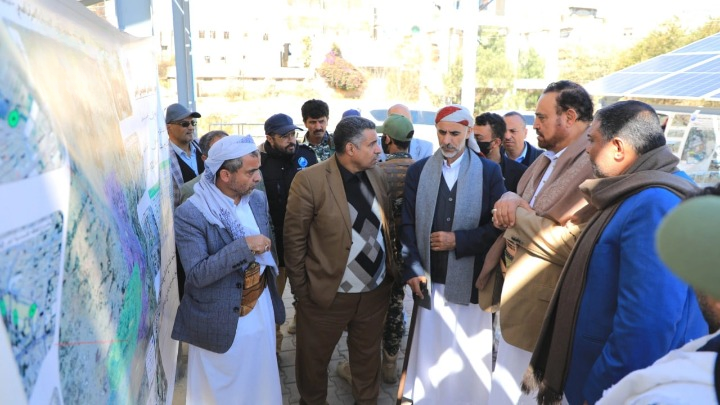
In the same context, Allamah Muftah conducted a field tour to inspect and inaugurate several service projects in the roads and infrastructure sector, with a total cost approaching one billion rials, implemented by the Executive Unit for Road Construction and Maintenance.
The tour included launching rehabilitation and maintenance projects for neighborhoods and streets in Maeen District, the surface bridge project at the Senainah entrance, projects in Al-Thawra and Shu’ub districts, the Agricultural Square in Al-Tahrir District, as well as the eastern water basin project near the airport hall in Bani Al-Harith District—considered a strategic project for rainwater harvesting and utilization.
These projects go beyond routine maintenance; they are part of a comprehensive vision to restore the capital—transforming it from a city exhausted by aggression and neglect into a resilient urban model capable of rising through its own resources.
The September 21 Revolution: From the Battle of Sovereignty to the Battle of Construction
What distinguishes these projects is not merely their financial scale, but their political and symbolic timing. They are being implemented at the height of the siege and amid ongoing aggression—sending a clear message that the September 21 Revolution was not just a political corrective movement, but a comprehensive state-building project that links national sovereignty with public service.
Experience has proven that this revolution has shifted Yemen from dependency on conditional aid to self-reliance, and from crisis management to solution-making. Today, serv