
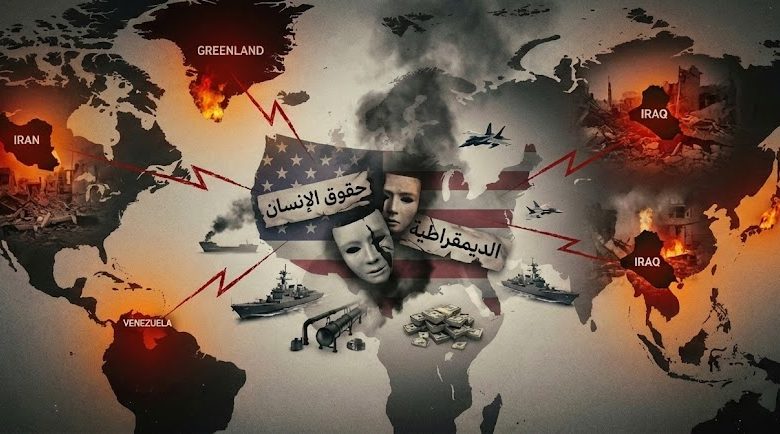
Washington as It Is, Not as It Claims: An Examination of the American Arrogance Project as Exposed by Its Historical Trajectory
The behavior of the United States on the global stage cannot be understood through its official rhetoric, nor through the repeated references to “human rights” and “protection of civilians” that appear in every statement issued by Washington whenever a crisis or unrest erupts. This language, as explained by Sayyed Abdulmalik Badr al-Din al-Houthi, serves merely as a façade of political and media deception, used to conceal a fundamentally different project in its essence, instruments, and objectives. When assessed by facts rather than slogans, the American project is built upon a clear triad: targeting, appropriation, and domination—accompanied by the plundering of resources and the removal of any force, system, or popular awareness that could obstruct its expansion.
This understanding does not stem from an ideological stance or a temporary political rivalry, but from a cumulative historical and behavioral reading of the United States’ trajectory from its founding to the present day. From the genocide of Indigenous peoples in North America, to direct military interventions, to nuclear and chemical warfare, and later to the tools of “soft chaos” through sanctions, media penetration, and the manipulation of public unrest—the same rule repeats itself in different forms. From this perspective, the report adopts Sayyed Abdulmalik al-Houthi’s vision as an analytical framework that interprets American behavior through events and realities, exposing the deep chasm between the slogans Washington raises and the practices it enforces on the ground.
Iran: When the Project of Chaos Fails
In the Iranian case, the United States attempted to apply a model it had refined across multiple arenas: creating internal chaos, investing in protests, mobilizing sabotage groups, and amplifying media campaigns aimed at eroding trust between the state and society, in preparation for weakening the system from within without the cost of direct military confrontation. This model—marketed under banners such as “defending human rights” and “supporting the aspirations of the people”—was, in essence, an attempt to reproduce scenarios that Washington had previously succeeded in imposing in less cohesive environments.
However, what unfolded in Iran, as emphasized by Sayyed Abdulmalik al-Houthi, represented a clear failure of this project. The tools on which Washington had bet collapsed, the mobilized gangs lost their capacity to influence events, and internal cohesion reasserted itself forcefully. More importantly, the American wager on exhausting the state from within failed despite substantial external political, media, and logistical support, revealing the limits of this model when confronted with a society possessing political awareness and a deeply rooted identity.
This failure carries profound strategic significance. It demonstrates that the American project is not an inevitable destiny, and that its success depends more on internal fragility than on its own intrinsic strength. When an environment is not susceptible to penetration, and when society possesses the means of political and cultural resilience, planned chaos becomes a burden on its architect rather than an effective tool of pressure.
Here emerges the central idea stressed by Sayyed al-Houthi: awareness, independence, and identity are not rhetorical slogans, but practical elements of power. They constitute the first lines of defense that thwart external projects and transform attempts at penetration into opportunities for reinforcing internal cohesion rather than pathways to collapse.
Greenland: The Logic of Appropriation When Influence Is Not Enough
What is unfolding around Greenland offers a striking contemporary example of American strategic thinking. According to Sayyed Abdulmalik al-Houthi, the United States already maintains military bases on the island, enjoys broad freedom of movement, and has been granted access by Denmark and local authorities for economic investment, resource exploitation, and even enhanced military presence. Yet Washington has not been satisfied with all this influence and has pushed further—toward full appropriation and direct control.
This case exposes the falseness of American rhetoric about “partnership” and “international cooperation.” When doors are opened to it, the United States does not stop at influence, and when privileges are granted, it never considers them sufficient. Greenland’s sensitive geopolitical position and wealth of rare minerals have made it a strategic target, but the manner in which Washington advances confirms that its logic is not mutual investment, but a gradual annexation project that begins with bases and ends with sovereignty.
For this reason, Sayyed al-Houthi considers what is happening in Greenland an extremely important les