
Gaza Between Ceasefire and Ongoing Crimes: A Harsh Winter and an Endless Humanitarian Crisis
Despite the ceasefire agreement, Gaza continues to endure one of its harshest humanitarian phases, where widespread destruction intersects with a bitter winter, a severe shortage of aid, and ongoing violations of the agreement by the Zionist enemy. This reality deepens the suffering of hundreds of thousands of displaced people and threatens their lives on a daily basis.
Winter Exacerbates the Suffering
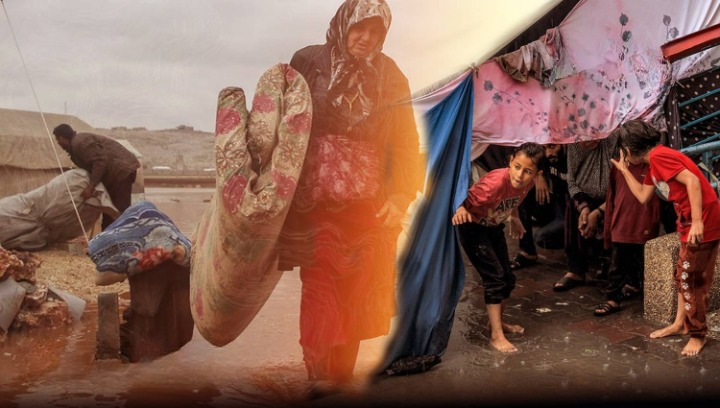
The International Committee of the Red Cross (ICRC) warned that harsh weather conditions—including heavy rainfall and strong winds—have pushed displaced people in Gaza to the limits of their ability to cope.
It noted that thousands of families who have been displaced multiple times are now facing torn tents or shelters flooded with water, in the absence of any safe refuge, forcing many to seek shelter in buildings at risk of collapse.
The ICRC confirmed that flooding has swept through low-lying areas and displacement camps, particularly in Deir al-Balah and Khan Younis, where families are living in temporary shelters lacking even the minimum standards of dignity and protection.
Unmet Needs
For its part, the United Nations Office for the Coordination of Humanitarian Affairs (OCHA) affirmed that essential protection needs for displaced people in Gaza are unavailable, noting that safe relocation options remain extremely limited due to the closure of large areas of the Strip.
The office explained that rubble removal faces major constraints because of the ban on the entry of heavy equipment, while temporary solutions such as tents remain grossly insufficient in the face of the escalating humanitarian catastrophe.
Ongoing Violations
In the same context, Hamas spokesperson Hazem Qassem stated that the Zionist enemy committed a new crime by exhuming hundreds of graves east of Gaza, in a flagrant violation of humanitarian values. This occurred alongside the killing of four civilians after they were targeted by enemy aircraft east of the city.
Qassem stressed that these crimes reflect the continuation of a war of extermination and constitute a clear challenge to all efforts aimed at stabilizing the ceasefire.
Children at the Center of the Targeting
The United Nations Relief and Works Agency (UNRWA) emphasized the need to allow it to continue supporting Palestinian refugee children, affirming that education is a right that cannot be postponed despite the massive destruction of schools.
The agency explained that tens of thousands of children are receiving their education in temporary learning spaces or through digital education programs, alongside its efforts to provide water, sanitation services, and flood-response assistance.
A Dangerous Reality
Gaza’s Ministry of Health announced that the death toll from the Zionist aggression has risen to more than 71,000 martyrs and 171,000 injured since October 7, 2023, with new deaths still being recorded, including children who died from severe cold.
The ministry also warned that the closure of the Rafah crossing threatens the lives of around 20,000 patients, amid an acute shortage of medicines and the suspension of specialized medical services. It confirmed that more than 1,000 patients have died while waiting to travel abroad for treatment.
Calls to Open the Crossings
In this context, the World Food Programme called for the continuous opening of border crossings, stressing that hundreds of thousands of Gaza residents remain without shelter and that the highest priority is to provide protection from the cold and expand humanitarian assistance.
Warnings of Undermining the Agreement
Politically, the Democratic Front for the Liberation of Palestine warned of attempts by the criminal enemy’s prime minister, Benjamin Netanyahu, to sabotage the second phase of the Gaza agreement by manipulating its clauses and imposing conditions aimed at obstructing recovery and prolonging the suffering of the population.
The Front confirmed that the continued violations by the enemy, the obstruction of the opening of the Rafah crossing, and the prevention of the flow of aid reveal clear intentions to keep the Strip trapped in a cycle of attrition and humanitarian pressure.
A Fragile Agreement and Absent International Responsibility
Between a bitter winter, unsafe shelters, a severe shortage of services, and the continuation of crimes and violations, Gaza today faces a brutal humanitarian test. The ceasefire remains fragile, while the need for genuine international action is growing—action that would guarantee the protection of civilians, the opening of crossings, and the launch of a real path toward recovery.