
Hadramawt and the Occupied Governorates Confront the New Hegemony Project:
The Leader’s Diagnosis Maps the Ambitions and the Confrontation
The vast geography of the occupied governorates in eastern and southern Yemen—particularly Hadramawt and Al-Mahrah—is undergoing profound transformations that make these regions a case study of the critical historical moment facing the country. These changes go far beyond the framework of so-called “local conflicts”—a misleading label promoted by the instruments of occupation—and rise instead to the level of an organized project that targets the very foundations of national sovereignty. Within this context, the diagnosis offered by the Leader of the Revolution, Sayyed Abdul-Malik al-Houthi, provides the theoretical and analytical framework for understanding this complex moment. He affirms that the essence of what is unfolding is “a systematic process to dismantle Yemen and seize its resources, using mercenary tools to execute the agendas of specific external powers.”
This diagnosis does not emerge in a vacuum. It is grounded in a precise reading of the intersection between vast oil and gas wealth and the strategic location of areas overlooking the Arabian Sea and international maritime chokepoints—factors that render them highly attractive to multilayered regional and international ambitions. The following report seeks to deepen this reading by organically linking the Leader’s analytical discourse with recurring field realities, in an effort to understand the mechanisms through which this hegemony project operates and its implications for the future of a unified Yemeni state.
The Leader’s Diagnosis: A Compass for Decoding a Complex Scene
For years, the speeches of the Leader of the Revolution, Sayyed Abdul-Malik al-Houthi, have served as an analytical compass for understanding the complexities of the Yemeni landscape. Regarding the occupied governorates in particular, his diagnosis has been precise and comprehensive. He views “the scene in Hadramawt and Al-Mahrah as a mirror reflecting the reality of the broader project targeting Yemen as a whole—a project that seeks not merely political control, but to transform Yemen into dependent entities stripped of national decision-making and exploited for their resources for the benefit of others.” This assessment finds clear resonance on the ground in a series of interlinked realities that point to a consistent operational pattern.
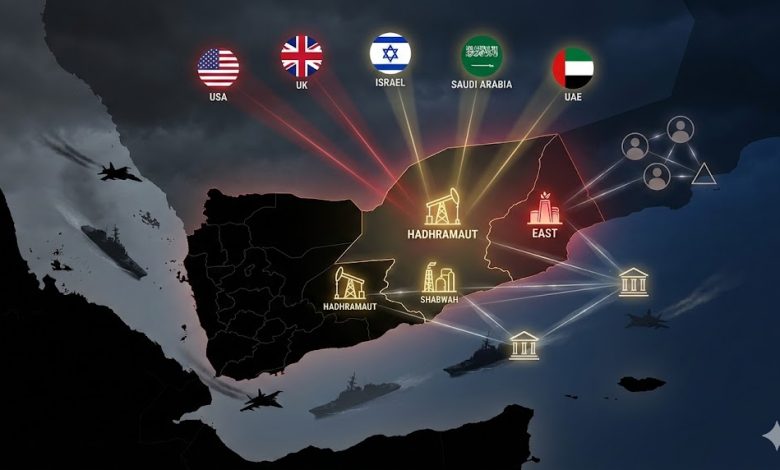
Actual control over oil and gas fields in areas such as Al-Masila and Daw’an, as well as other fields in Hadramawt and Shabwah, extends beyond security arrangements to encompass financial control. Revenues are transferred through complex banking channels to accounts in Saudi banks, according to admissions by officials of the mercenary government, including Abdulaziz Jubari, who confirmed that Saudi Arabia forced the government to deposit oil revenues in Saudi banks.
This pattern aligns precisely with the Leader’s warning that Yemen’s vast oil wealth is “a target of greed for the American, the Israeli, the British, the Saudi—those instruments.” Transferring oil revenues to Saudi banks is not merely a financial management decision; it is a practical embodiment of systematic plunder, whereby local tools are exploited to redirect national resources into external financing for the very projects of domination. This serves multiple objectives of the aggression: depriving Yemen of the backbone of its economy, funding projects of division and dependency, and ensuring the continued subservience of those tools through control over financial flows.
Another dimension highlighted by the Leader’s diagnosis is the strategic location. He emphasized that “the geographic position overlooking the Arabian Sea, and extending toward Bab al-Mandab and the Red Sea—along one of the world’s most important maritime corridors—is among the reasons those enemies focus on full control of this country.” This explains the dense foreign military and security presence along Yemen’s coasts facing these routes, particularly in Al-Mahrah and Socotra—presence that is not intended to “protect navigation,” but to exert actual control over global energy and trade arteries as part of a broader regional and global hegemony project.
Thus, the analytical linkage presented in the Leader’s diagnosis—between Yemen’s oil wealth, its strategic location, external ambitions, and the mechanisms employed—offers the most coherent framework for understanding the complexity of the scene. It not only explains why these regions are specifically targeted, but also exposes how the forces of aggression operate: transforming wealth and geography into tools for financing and entrenching dependency, in a vicious cycle aimed at turning Yemen from a sovereign state into an open arena whose resources are plundered and whose will is engineered by external powers using local proxies as an executive façade