
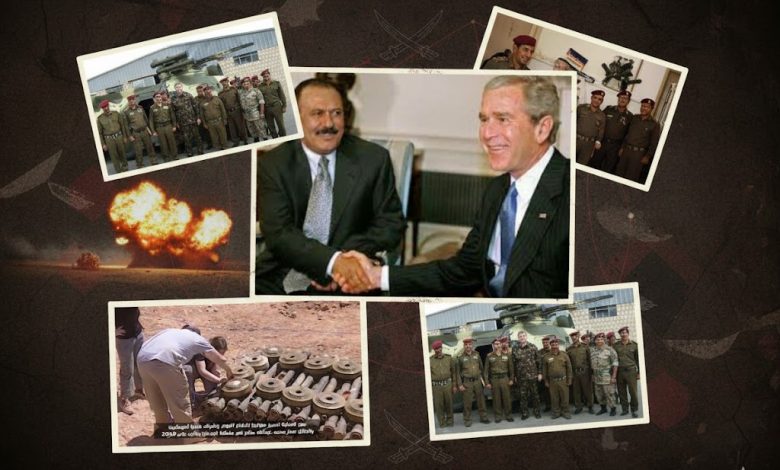
The Black Archive of Violated Sovereignty: An Analytical Documentation of Washington’s Penetration of the Yemeni Military During the Era of the Deceased Ali Abdullah Saleh
The Saleh era in modern Yemeni history was not merely a period marked by administrative corruption or political failure; it was the stage for a fully-fledged act of high treason targeting the very backbone of the Yemeni state: its military. A deep reading of what transpired behind the walls of military camps and within the closed decision-making chambers reveals that what was then termed “strategic partnership” or “counterterrorism” was nothing more than a thin veneer for a soft occupation, a systematic plan orchestrated by the Saleh regime to transform the army’s doctrine from defending the homeland to protecting the seat of power and implementing foreign agendas. Those lean years represented the most dangerous assault on the concepts of national sovereignty, as the doors were flung wide open for American intelligence agencies and the Pentagon to tamper with the most critical files of Yemeni national security, transforming the military institution from a strong shield for the nation into a fragile structure riddled with American influence from within.
It went beyond mere diplomatic relations or protocolary military cooperation, transforming into a systematic sale of sovereignty. The regime of the late Ali Abdullah Saleh handed over the reins of military and security decision-making to the Americans in exchange for flimsy guarantees of remaining in power. During that dark era, American experts were not guests, but rather the de facto “guardians” with veto power over all matters concerning the Yemeni army, from training and armament to restructuring and appointments. This subservient policy not only stripped Yemen of its defensive capabilities but also reshaped the Yemeni military mindset, rendering it subservient to the American embassy. This paved the way for the most dangerous colonial projects, which sought to dismantle Yemen and leave it vulnerable to foreign ambitions. This was later borne out by events when Yemen found itself facing an aggression in which its supposed “ally” allied with its proxies to destroy what remained of the country.
The Doctrine of Subservience: From “Protecting the Homeland” to “Protecting American Interests”
The plot against the Yemeni army began with a precise surgical operation targeting the “mind” before the “body.” This was achieved by replacing the national fighting doctrine, which viewed the Zionist entity and the enemies of the nation as the true threat, with an imported and distorted doctrine imposed through intensive American training programs. Washington, with the full complicity of the regime of the deceased Ali Abdullah Saleh, worked to brainwash officers and soldiers, redirecting their weapons inward instead of protecting Yemen’s borders and sovereignty. The CIA infiltrated the core of military decision-making, moving beyond mere consultation to the stage of selection and vetting. Appointments to sensitive leadership positions were subject to American approval, and the American veto became a constant presence, allowing for the removal of any military commander with a zealous nationalistic orientation and their replacement with figures loyal to Western interests. This led to the creation of a class of generals who considered the American ambassador a higher authority than the nominal national leadership.
Under the guise of development and modernization, American experts imposed alien organizational and administrative models ill-suited to Yemen’s geography and challenges. These models were specifically designed to fragment strong units, turning them into isolated enclaves easily penetrated and controlled. The training programs overseen by Marine officers were less about transferring combat expertise than about instilling a sense of inferiority in Yemeni soldiers compared to their American counterparts, and cultivating the belief that the Yemeni army was incapable of functioning without Western guidance. These camps became centers for ideological reprogramming, where officers were taught that the enemy was their fellow countrymen who rejected hegemony, and that the friend was the foreigner who violated sovereignty. This created a deep rift in national military identity and transformed the army, in the eyes of the regime, from a sovereign institution into mere “security companies” whose function was to protect American interests and pursue those whom Washington labeled terrorists, even if they were innocent Yemeni citizens.
The heinous crime: Stripping Yemen of its claws and destroying its deterrent capabilities.
Perhaps the most painful and blatant evidence documenting the extent of the national betrayal perpetrated by the regime of the deceased Ali Abdullah Saleh is embodied in the documented scenes circulated with bitterness by free people. These scenes show American officers brazenly supervising the destruction of the Yemeni army’s air defense missiles. This event was not merely a routine procedure for disposing of damaged weapons, as the regime’s misleading media claimed at the time. Rather, it was a systematic stripping of Yemen’s skies of any protective shield. The scene of the destruction of SAM missiles and shoulder-fired anti-aircraft guns, in the presence of Saleh’s nephew (Ammar Mohammed Abdullah Saleh), who held a high-ranking security position, represents a stark illustration of the meaning of subservience. Security leaders, who were supposed to protect the homeland, were transformed into instruments of execution in the hands of the American executioner, personally overseeing the clipping of the army’s wings and the dismantling of its defense systems.
In those dark moments, the cutting machines were not only tearing apart the missiles, but also Yemeni sovereignty and trampling on the dignity of every soldier and officer in the army. The American insistence on destroying these specific systems, with the personal presence of American destruction experts, reflected a Zionist and American fear of Yemen possessing any real defensive capability that could threaten their air superiority in the region. The regime of the deceased Ali Abdullah Saleh submitted to American dictates to destroy these missiles in exchange for crumbs of aid and political promises, thus proving that it was not to be trusted with the soil of this nation. The gravity of this crime was confirmed when the aggression began later, as Yemen found itself without air cover, and cities and children were left as easy targets for the American-Saudi coalition aircraft, proving that the destruction of the air defenses was the early and pre-planned “green light” for the invasion of Yemen.