
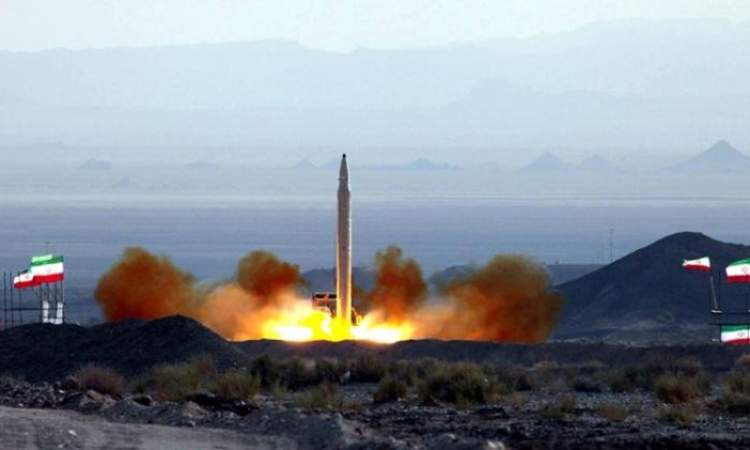
The Entering of the Battle with Sejjil Missiles: A Qualitative Shift in the Balance of Deterrence
The Iranian Revolutionary Guard Corps (IRGC) announced today, Sunday, that it targeted the Israeli entity for the first time with its strategic Sejjil ballistic missiles. This move reflects the escalation of the confrontation to a more complex technological and military level, and opens the door to a new phase of engagement with the American and Zionist enemy.
The commander of the IRGC Aerospace Force, Brigadier General Majid Mousavi, wrote on the “X” platform: “With confidence in God’s true promise, the heavy, fast, two-stage Sejjil missiles were launched today towards the command and control centers of the Zionist entity’s air operations.”
The Sejjil missile represents one of the most prominent achievements of the Iranian missile industry. It is the first long-range ballistic missile to use solid fuel in two stages. This technology gives it a significant operational advantage in terms of rapid preparation and launch compared to liquid-fueled missiles, thus reducing the chances of detection or targeting before launch.
From a military perspective, the introduction of this missile into the conflict signifies a shift in the nature of Iran’s use of missile capabilities. The significance of these missiles lies first in their long range, second in their ability to penetrate air defense systems, and third in their capacity to cause massive explosions at targeted sites.
The Sejjil missile has a range of between 2,000 and 2,500 kilometers, placing most of the settlements of the enemy entity in occupied Palestine within its operational range. Its speed reaches over 17,000 kilometers per hour, exceeding Mach 14. This speed, combined with its maneuverability both within and outside the atmosphere, grants it a significant ability to penetrate conventional interception systems.
The missile is approximately 18 meters long and 1.25 meters in diameter, with a launch weight exceeding 23 tons. It can carry a warhead weighing up to 700 kilograms.
A Military and Political Message
The Iranian Revolutionary Guard Corps’ announcement of the first use of Sejjil missiles comes as part of the 54th wave of Operation True Promise 4, which targeted Israeli air operations command centers, military industrial infrastructure, and troop concentrations.
Observers believe that the choice of this type of missile carries a political dimension in addition to its military significance. Tehran seeks to demonstrate its advanced missile capabilities amidst the escalating confrontation with the United States and Israel, and its expanding regional scope.
This move also indicates that Iran has begun using more sophisticated weapons systems than those employed in the early stages of the conflict, reinforcing the hypothesis that a significant portion of its missile arsenal has yet to be deployed.
In this context, the Revolutionary Guard Corps spokesperson stated that most of the missiles currently in use were produced approximately a decade ago, adding that many missiles developed after the last war have not yet been used.
A New Deterrent Equation
Historically, the Sejjil missile first appeared in a field test in 2008. Before Iran developed its improved version, the Sejjil-2, in 2009, Tehran is believed to possess an undisclosed number of these missiles within its arsenal.
The introduction of this missile into the conflict signals a gradual shift in the rules of engagement between Iran and Israel, moving from limited strikes to the use of more advanced weapons in terms of speed, range, and penetration capabilities.
Ultimately, the use of the Sejjil also indicates an Iranian attempt to reshape the deterrence equation in the region by demonstrating the ability to strike deep within Israel with high speed and using systems that are difficult to intercept.
With the continued military escalation between the two sides, the region appears to be entering a phase characterized by the increased use of advanced missile capabilities.