
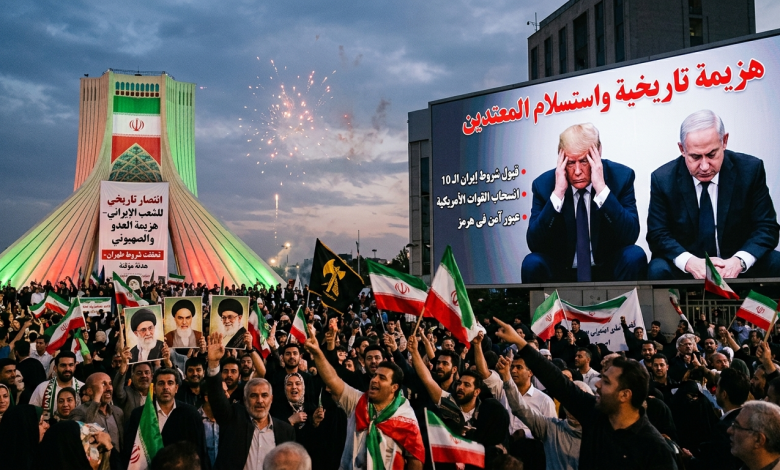
From the Battlefield to Politics: Iran Imposes Its Conditions and Establishes the Equation of Victory
In a remarkable shift reflecting the extent of the change in the balance of power, the Islamic Republic of Iran is moving from consolidating its gains on the battlefield to imposing them at the political table. This comes after its success, with the support of the Resistance Axis, in breaking the American-Zionist aggression and forcing the enemy to accept its conditions. With the announcement of upcoming negotiations in Islamabad, a new equation is being established: what is achieved by force is secured through negotiation.
From Confrontation to Negotiation
Iranian television reported that negotiations with the United States will resume on April 10 in the Pakistani capital, Islamabad, following Washington’s acceptance of the principles put forward by Tehran. According to the announced information, this path is a result of the superiority of Iran and the Resistance Axis on the battlefield and the enemy’s inability to impose its choices, which has led it to acknowledge a number of demands that were previously considered red lines.
Iran’s Decisive Conditions
Information indicates that the United States was forced to accept a set of strategic conditions, reflecting a radical shift in the nature of the conflict. The most prominent of these conditions are:
– Cessation of all acts of aggression against Iran
– Recognition of Iran’s right to uranium enrichment
– Lifting of all sanctions
– Withdrawal of US forces from the region
– Continued Iranian control of the Strait of Hormuz
– Cessation of military operations against resistance forces
These conditions are not merely negotiating demands, but rather reflect Iran’s shift to a position of imposing its will and reshaping the rules of engagement at the regional level.
The Failure of the Aggression and the Shifting Equation
In this context, the Iranian Supreme National Security Council affirmed that Tehran achieved a “great victory” during the forty days of confrontation, after the United States and the Zionist enemy failed to achieve their military objectives. It indicated that the blows inflicted on the aggressor forces will remain a landmark in the history of conflicts, signifying the collapse of military hegemony.
A New Phase of Deterrence
Across the axis of resistance, reactions welcoming what was described as a “strategic victory” poured in. Palestinian resistance factions affirmed that Washington and Israel’s capitulation to Tehran’s conditions represents a radical shift in the balance of power. They considered the developments to establish a new phase of deterrence, ending policies of blackmail and pressure, and opening the door to a different regional equation based on a balance of power, not on unilateralism and hegemony.
The Fruit of Steadfastness and Sacrifices
For his part, Iranian President Masoud Pezeshkian emphasized that the ceasefire was a direct result of the Iranian people’s steadfastness and unity. He indicated that this phase represents an extension of the battle for defense and sovereignty, both on the ground and in the political arena. This stance reflects an Iranian perspective that considers what was achieved not as a result of negotiation, but rather as the fruit of steadfastness and sacrifices that compelled the adversary to accept the new reality.
Unity and a Comprehensive Scene
In parallel with the political developments, Iranian cities witnessed widespread popular marches celebrating the victory, a scene that reflected the cohesion of the home front across its various components. Remarkable scenes also emerged of the participation of different religions and sects in commemorating the martyrs, reflecting a state of national unity that constituted one of the most important factors in the resilience against the aggression.
An Equation Written with Victory
Ultimately, these developments confirm that Iran did not merely thwart the aggression, but succeeded in transforming it into a strategic turning point, thereby imposing a new equation on the regional level. From the battlefield to the negotiating table, a different reality is being established, one whose defining characteristic is that the era of dictates is over, and that those who possess strength and resilience are the ones who determine the terms of the next phase. In light of this transformation, the region appears to be entering a phase whose features are being shaped by the will of the people and the power of deterrence, not by the force of hegemony.