
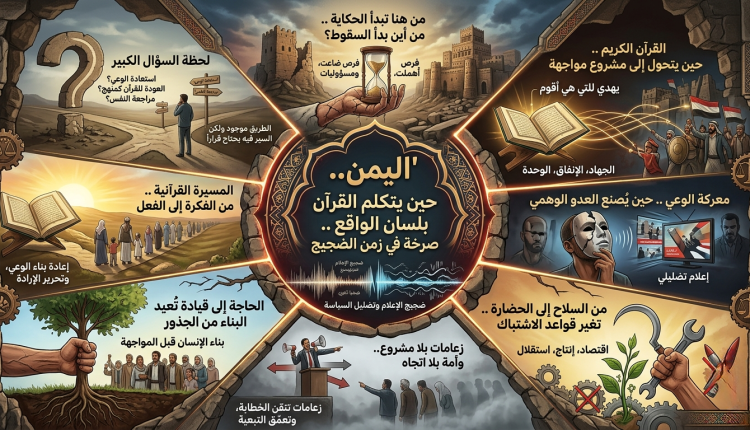
Yemen… When the Quran Speaks the Language of Reality… A Cry in a Time of Noise
In an era where slogans abound and truths are lost amidst the clamor of media and the deception of politics, a distinct voice emerges—sharp, shocking, uncompromising, and unflagging—the voice of the martyr leader Hussein Badr al-Din al-Houthi, may God be pleased with him. He reads the reality of the nation from within the Quran, not from the margins of events, and from the guidance of the Quran. The martyr of the Quran does not speak of a bygone history, but of a present that is repeating itself, and of a nation living through the same mistakes that the Quran recounted centuries ago, as if the verses are being recited today to reveal a reality that has not changed, a mind that has not learned, and a path that continues to decline.
From here the story begins… Where did the fall begin?
In a direct manner, the martyr leader puts his finger on the root of the problem. The nation was not defeated simply because it was weak, but because it neglected, abandoned, and squandered its potential. He presents a shocking reading that overturns the traditional equation; Instead of placing full blame on the enemy, he redirects the focus inward, on lost opportunities, neglected responsibilities, and declining values, as if defeat were not a sudden event, but rather the natural consequence of a long history of concessions and deviations.
The Holy Quran… When it Becomes a Project of Confrontation
The martyr leader’s approach doesn’t stop at diagnosis; it goes directly to the source he sees as the foundation of revival: the Holy Quran. But not the Quran recited on special occasions; rather, the Quran that nurtures, guides, and builds a nation. In invoking the stories of the Children of Israel, the aim is not to recount history, but to reveal the laws governing how nations rise and fall.
Here, the major concepts of jihad, charity, and unity emerge, not as religious terms, but as practical tools for building strength.
The Battle for Consciousness: When a Fictitious Enemy is Fabricated
Upon deeper reading, a more dangerous layer of conflict is revealed: the battle for consciousness. The martyred leader points out that the nation was not only defeated on the battlefield, but was defeated first and foremost in its own minds, when it was directed toward secondary enemies and diverted from the true enemy.
In this context, the media becomes a tool of war, truth becomes a casualty, and the consciousness of nations is reshaped to serve their adversaries.
From Weapons to Civilization: Changing the Rules of Engagement
The vision goes a step further, confirming that the very nature of the conflict has changed. It is no longer a direct military confrontation, but rather an economic struggle, a struggle for production, and a struggle for independence. A nation dependent on others for its food and medicine, it has no say in war, nor the option of peace. Here, the picture becomes clear: defeat is not only on the battlefield, but also in the market, the farm, and the factory.
Leaders Without a Vision… and a Nation Without Direction
In a scathing critique, this analysis highlights the leadership crisis in the Arab world. Leaders excel at rhetoric but deepen dependency, while any attempt at leadership with a genuine vision is sidelined or suppressed. The result? A nation adrift without direction, governed by reactions rather than proactive measures.
The Need for a Radical Rebuilding Leadership
Amidst this landscape, a central idea emerges: there can be no revival without leadership rooted in the Quran, understanding the nature of the conflict, and prioritizing human development before confrontation. This leadership must not merely manage the crisis but reshape reality.
The Quranic Path: From Idea to Action
Here, the vision shifts from theory to practical project: the Quranic path. It is not a slogan but a comprehensive approach based on rebuilding awareness, liberating the will, and cultivating a generation imbued with a sense of responsibility—a generation not easily deceived or led astray by illusions, but one that views reality from a different perspective—the perspective of the Quran.
The Unexploited Opportunity
With palpable bitterness, the narrative pauses at historical junctures that could have altered the nation’s course, but were squandered. The problem wasn’t always incapacity, but rather poor choices: wrong choices in alliances, in setting priorities, and in interpreting reality. Thus, opportunities were not only wasted, but sometimes transformed into compounded losses.
The Moment of the Great Question
At the end of this narrative, the martyr of the Quran doesn’t leave the reader with ready-made answers, but poses a weighty question: Is the nation still capable of regaining its consciousness? Can it return to the Quran as a way of life, not merely as a cultural heritage? Does it possess the courage to examine itself before confronting its enemy? Between the shock of the diagnosis, the sharpness of the argument, and the clarity of the vision, the martyr leader’s message remains unmistakable: the path exists, but traversing it requires a decision.