
The Ultimate Disciplinary Option: Tehran Drops the Mask of Attrition and Forces Washington to Respect Sovereignty
The region finds itself today facing a difficult period as the truce nears its end, with the clash of wills between Tehran and Washington manifesting itself in its most blatant form. American threats are no longer mere media hype, but have transformed into criminal acts at sea, aimed at subjugating the Iranian will that withstood the forty-day aggression, confirming that the era of dictates is over, replaced by the equations of field deterrence.
Faced with the treachery of arrogance, the Iranian leadership stands firm, refusing to sell its sovereignty for false promises. Observing the contradictory American behavior has exposed the falsity of “appeasement diplomacy,” prompting Tehran to brandish the “final disciplinary trigger.” This historic moment is not merely about reopening ports, but about redrawing the global balance of power, free from the grip of American hegemony and its Zionist instrument.
American Piracy and the Trap of Attrition
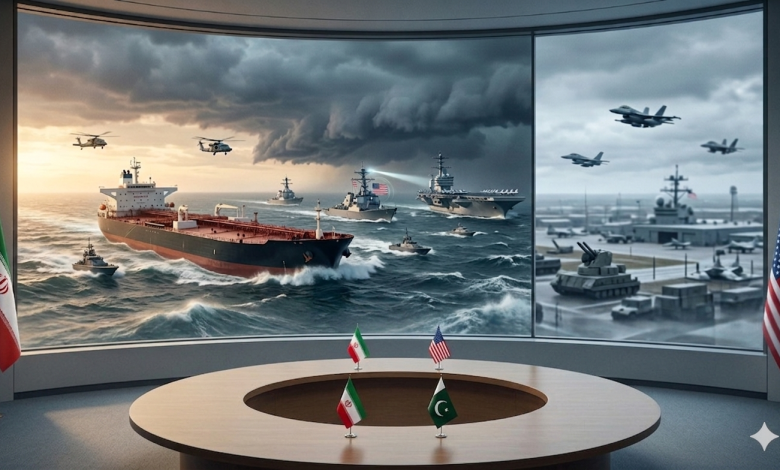
For Washington, the ceasefire that followed the February 28th aggression was nothing more than a tactical maneuver to regroup, as clearly demonstrated by the criminal attack on the container ship “Tosca” and the hostage-taking of its crew. This behavior can only be classified in the political lexicon as organized “state piracy,” through which the American administration aims to test the patience of the leadership in Tehran and attempt to transform the negotiating table into an arena for extracting sovereign concessions that it has failed to achieve through its faltering military machine.
In the context of monitoring these violations, Foreign Minister Abbas Araqchi’s warnings to his Russian counterpart, Lavrov, clarified matters. Iran does not monitor flowery words spoken behind closed doors, but rather the “behavior” on the ground that continuously violates the ceasefire. Targeting Iranian commercial vessels and ports under the guise of a ceasefire is a full-fledged act of war, proving that Washington lacks even the most basic elements of diplomatic credibility and is acting according to a Zionist agenda aimed at keeping the region in a state of perpetual turmoil.
This contradictory American approach, combining the pretense of negotiation with the practice of threats and aggression, represents a fundamental obstacle to any political progress. Washington’s intransigence in previous rounds of talks with Islamabad, and its insistence on linking humanitarian issues to matters of sovereignty, reveal its desire to transform the truce into a long-term “trap of attrition.” This is something Tehran rejects, having demonstrated that protecting its interests and national security takes precedence over any false diplomatic considerations that might be used to constrain its deterrent capabilities.
The Wall of Sovereignty and Bitter Promises
President Masoud Pezeshkian’s words expressed the depth of the “historical distrust” with a party that does not honor its commitments. Adherence to promises is the cornerstone of any successful dialogue, and what America has recently offered is nothing more than “bitter messages” reflecting a hidden desire to subjugate the Iranian people. This presidential understanding of the essence of the American scheme thwarts any attempts to circumvent Iran’s legitimate rights and confirms that the price of sovereignty is not paid with empty promises, but rather by seizing rights by force.
This firm stance transcends the immediate political dimension, touching upon the dignity of a people who refuse to surrender under the threat of attacks targeting infrastructure and power plants. Washington’s attempts to force Tehran to back down through a policy of “starvation and darkness” have historically proven futile. Today, the leadership appears more determined than ever to transform these threats into an incentive to strengthen the independence of national decision-making, emphasizing that any dialogue not based on mutual respect and the complete lifting of the sanctions is pointless.
The Equation of “The Trigger of Discipline” and the Balance of Deterrence
Mohammad Mokhber’s warnings about the “final trigger of discipline” acquire profound strategic dimensions at the time of the truce’s expiration. They clearly signify that Iranian patience is not weakness, and that diplomacy is only acceptable if it is a genuine extension of power on the ground. The concept of “discipline” here refers to a deterrent that transcends the traditional geography of the conflict, threatening colonial interests at their core and making any miscalculation by the enemy the beginning of the end of its regional influence in an unprecedented manner.
This equation presents America and the Zionist entity with two bitter choices; The choice is between accepting Iran as a fully sovereign regional superpower or facing a response that transcends the “regional boundaries” and alters the future equations of the world, as an informant indicated. Iran’s insistence on not allowing negotiations to become a cover for a war of attrition reflects strategic maturity, where the battlefield becomes the ultimate arbiter if the enemy persists in its intransigence, making “pulling the trigger” a readily available option should the political process collapse.
Diplomacy vs. Arrogance
Pakistani efforts in Islamabad represent a last-ditch attempt to salvage the diplomatic track, but “American intransigence” remains the sole obstacle. While Tehran demonstrates openness conditioned on respect, Washington persists in its contradictory positions and threatening rhetoric. This makes the close communication between Araqchi and his Pakistani counterpart a “last chance” for the American administration to step back from the brink before it is too late and the situation explodes on the ground.
Iran’s firm linkage between the continuation of diplomacy and the cessation of provocations against commercial vessels places the international community before its responsibilities. There can be no talk of “peace and stability” while naval crews are detained and ports are blockaded. This means the ball is now in the American court, which must provide concrete guarantees, not just empty promises. Otherwise, Tehran will make its sovereign decision, taking all aspects of the matter into consideration, to ensure the immediate and complete lifting of the blockade.
The Option of a Historic Resolution
Tehran is closely monitoring the adversary’s behavior, aware that the current truce may be the calm before the storm if American treachery continues. The Islamic Republic, with its army and people, has prepared for all scenarios and will not allow the sacrifices of the forty days of resistance to be squandered in the labyrinth of negotiations.