
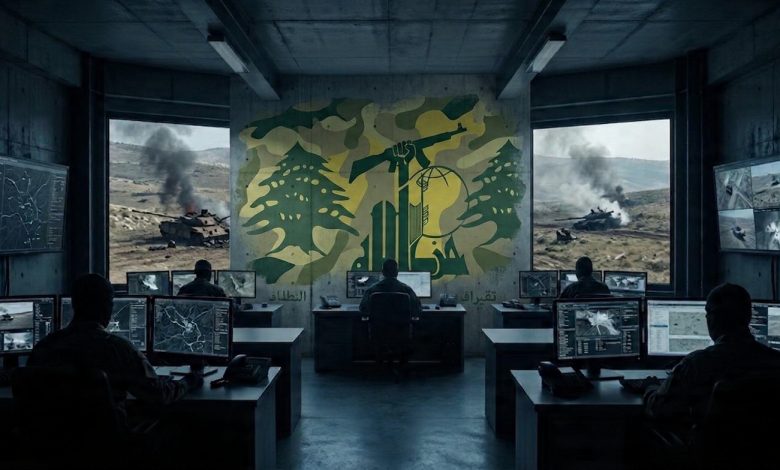
The Field Dictates the Terms: The Islamic Resistance in Lebanon Thwarts Incursion Plans and Undermines Political Pressure
Monday, April 20, 2026, witnessed a field escalation, marked by 24 Israeli airstrikes and 180 artillery shells targeting 12 border towns. Operations were concentrated in the geographical triangle of Maroun al-Ras, Yaroun, and Bint Jbeil. Ground radars documented an incursion attempt by the Israeli 98th Brigade, supported by American MK-84 bombs. This resulted in the destruction of four Israeli military vehicles and the killing and wounding of their crews in ambushes carried out by the Islamic Resistance in Lebanon.
Politically, the escalation coincided with the arrival in Tel Aviv of a draft US “framework agreement” calling for a 10-kilometer-deep buffer zone. Meanwhile, the Ministry of Health reported 26 martyrs today. In Geneva, the Lebanese issue became a pressing point in the seventh round of Iranian-American negotiations, with Tehran linking stability in the north to a comprehensive cessation of hostilities and refusing to trade Hezbollah for economic concessions.
Field Situation: Enemy Violations and Deterrent Strikes
Monitoring operations rooms recorded 42 violations of the Blue Line up to 11:00 AM, including the use of white phosphorus in the Kfarkela forest. Military media documented the destruction of two Merkava 4 tanks by Almas-3 guided missiles on the Al-Labouneh hill. Meanwhile, surveillance equipment detected 14 sorties by Hermes-450 and Hermes-900 drones over Beirut and the Bekaa Valley, aimed at intelligence gathering and identifying Islamic Resistance launch sites in Lebanon.
In response, Islamic Resistance fighters launched 11 rocket salvos targeting the Meron air observation base and the Shragha camp north of Acre. Technical data indicates that Hezbollah used Fadi-2 missiles for the first time this month, achieving direct hits on three technical towers. On the ground, the Israeli 91st Division failed to establish a foothold in the town of Rmeish after an infantry force was caught in an anti-personnel minefield, rendering the entire unit inoperable.
Political Maneuvering: Lebanon Under International Pressure
The Lebanese Foreign Ministry today submitted an official complaint to the Security Council documenting the destruction of three civil defense centers. Meanwhile, political meetings in Beirut concluded with a rejection of any amendment to Resolution 1701 that would serve Israeli interests. Information confirms Lebanon’s official rejection of the “demilitarized zone” proposal put forward by US envoy Hochstein, maintaining that any security arrangements must begin with a complete Israeli withdrawal from the 13 disputed points.
Regional intelligence reports indicate an American-Israeli plan to impose “civil administration” in the buffer zones under the guise of an international force, a move that has been met with firm rejection from the Speaker of Parliament and the leadership of Hezbollah. The Lebanese position today adheres to the principle of “unity of the battlefields,” refusing to grant security guarantees to the northern settlements before the cessation of hostilities in Gaza and the withdrawal of the occupation forces from the Shebaa Farms, Kfarshouba Hills, and Ghajar.
On the mediation front, the French-Qatari initiative faltered today due to the occupation’s insistence on the “right to preventive intervention” within Lebanese territory. The Islamic Resistance in Lebanon considers this a violation of sovereignty that is not open to discussion. Hezbollah’s leadership informed the mediators that “the battlefield dictates the terms,” and that its missile capabilities remain at 85% effectiveness despite the intense airstrikes, rendering any attempt to weaken the political position through force a losing proposition.
The Cost of the Aggression: Casualties and Infrastructure Damage
The Ministry of Public Health reported that the death toll for today has risen to 26 martyrs and 84 wounded, most of whom were killed in an attack on a residential area in Siddiqin. Statistical data indicates a 15% increase in the use of heavy munitions against civilian infrastructure compared to last week, aimed at forcing the remaining 40,000 residents of border villages to flee.
Reports from Salah Ghandour Hospital in Bint Jbeil confirmed receiving 12 cases of suffocation due to internationally prohibited incendiary weapons used in Aitaroun. The targeting of four ambulances today brings the total number of healthcare workers killed since the beginning of April to 18, a clear violation of Article 18 of the Fourth Geneva Convention, amidst international silence and complete political cover from the US administration.
Economic losses in the agricultural sector in southern Lebanon are estimated at $1.2 billion today as a result of the destruction of 45,000 olive trees by phosphorus bombing. The number of displaced persons registered in shelters in Beirut and Mount Lebanon has also risen to 120,000, who are facing a severe shortage of medical supplies due to the partial naval blockade imposed by the Israeli Air Force on Lebanese ports.
Major Negotiations: The Lebanese Card Between Tehran and Washington
In Geneva, the Hezbollah issue dominated the fourth session of the “Track Two” dialogue between Washington and Tehran. The American negotiator presented a “sanctions for withdrawal” proposal, which included freezing $4 billion in Iranian assets in exchange for the Islamic Resistance withdrawing 10 kilometers north of the Litani River. The Iranian position was decisive, emphasizing that Hezbollah is a Lebanese national force and that Tehran supports only what the party’s leadership in Beirut decides.
Leaked documents from the meeting confirm that Washington is using the “Lebanese economic crisis” as leverage to impose a ceasefire on Zionist terms. However, the “Axis of Resistance” coordination indicates that the front led by Hezbollah is inseparable from the Red Sea and Gaza tracks, rendering any unilateral agreement on Lebanon technically unenforceable without addressing the root causes of the broader conflict in the region.
Strategic Implications
Field data points to a state of “military stalemate,” where the enemy has exhausted its traditional target bank without achieving any change in the defensive posture of the Islamic Resistance in Lebanon. This reality presents Tel Aviv with two options: either to continue a war of attrition costing $250 million daily, or to accept the deterrence equation that is being imposed.