
A Nation Lost by Ignorance… and Saved by Awareness
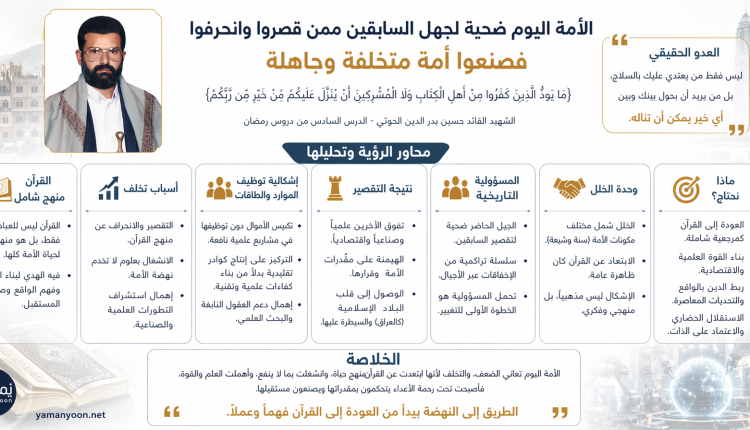
In a comprehensive analytical reading of the vision of the martyr leader Hussein Badr al-Din al-Houthi, as presented in the sixth lesson of his Ramadan lectures, profound intellectual dimensions are revealed. These dimensions transcend traditional preaching, constructing a comprehensive critical vision of the nation’s reality. This vision connects the past and present, attributing the nation’s historical decline to flaws in the understanding and application of the Holy Quran’s methodology.
The Critical Dimension of Islamic History
The martyr leader begins with a central premise: that the Islamic nation today is not solely a victim of external factors, but to a large extent, a result of accumulated internal shortcomings and deviations. He identifies the roots of the crisis as the departure from the Quran as a comprehensive way of life, not merely a book of rituals or legal rulings. This approach offers a bold re-examination of history, holding religious and political elites responsible for failing to anticipate early global transformations (such as the European Industrial Revolution), to build the foundations of scientific and economic power, and to direct resources toward empowering the nation instead of confining them within narrow, traditional frameworks.
The Holy Quran as a Strategic Approach
One of the most prominent aspects of the vision of the martyr of the Quran is the redefinition of the function of the Holy Quran. He rejects confining it to the realm of worship, emphasizing that it is a source of future vision, a guide for building civilizational strength, and a tool for understanding the nature of conflict with others. The Quranic verse he cites, “Those who disbelieve among the People of the Scripture and the polytheists do not like that any good should be sent down to you from your Lord,” is read strategically here. The enemy is not limited to those who commit military aggression, but includes all those who work to deprive the nation of the means of strength and progress. This analysis shifts the concept of “enmity” from mere direct confrontation to a struggle for knowledge, power, and superiority.
The Problem of Resource and Energy Management
The text offers a clear critique of how resources are managed within the nation, particularly within religious institutions. It points to the accumulation of funds without their investment in strategic scientific projects, and the focus on producing traditional cadres instead of building scientific and technological expertise. The lack of investment in brilliant minds reveals an important economic-cognitive dimension of the vision, where science is viewed as a tool of dominance, not merely as a separate field of knowledge.
The Reasons for Western Hegemony
The text provides an explanation for the hegemony of Western powers (especially the United States and Europe) that is not based solely on their superiority, but also on the nation’s failure to acquire the means of power, its inability to keep pace with scientific advancements, and its preoccupation with internal conflicts and rigid traditional cultures. Thus, hegemony is transformed from an imposed external force into a natural consequence of internal dysfunction.
The Concept of “Historical Victimhood”
One of the most powerful concepts presented by the martyr of the Quran is that the present generation is “victim to the shortcomings of previous generations.” This opens an important analytical perspective: that the current crises are not spontaneous, but rather the culmination of a series of failures. Cultural and intellectual deviation across generations has led to the current state of weakness. However, this proposition, despite its harshness, implicitly calls for taking responsibility and not repeating the same mistakes.
The Unity of the Problem Across All Schools of Thought
The text does not direct criticism at one side over another, but rather emphasizes that the problem has affected all components of the Muslim community (Sunni and Shia). It asserts that distancing oneself from the Quran was a widespread phenomenon, and that the issue is not so much sectarian as it is methodological and intellectual. This reinforces the comprehensive nature of the vision and gives it a unifying dimension in diagnosing the crisis.
The Civilizational Significance of the Vision
At its core, this vision seeks to rebuild the nation’s consciousness by returning to the Quran as a comprehensive reference point, connecting religion to contemporary reality and challenges, and building scientific and economic strength. It transcends intellectual stagnation, and thus does not merely criticize, but rather presents the features of a renaissance project based on awareness, knowledge, and civilizational independence.
In conclusion…
The vision of the martyred leader offers a shocking yet profound critical reading of the nation’s reality, linking current backwardness to historical shortcomings and a departure from the Quranic methodology. This vision presents the nation with a crucial question: Will it continue to repeat the mistakes of the past, or will it rebuild itself on the basis of a conscious and comprehensive understanding of the Quran?