
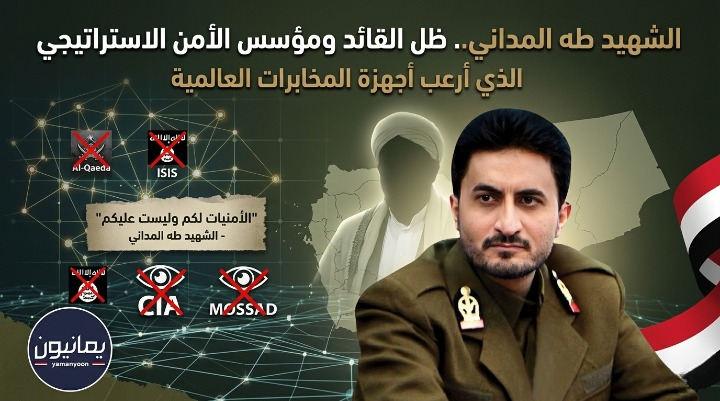
Martyr Taha al-Madani: The Shadow Leader and Founder of Strategic Security Who Terrified Global Intelligence Agencies
In the annals of nations that write their history with the blood of martyrs and the sacrifices of heroes, the name of Martyr Major General Taha Hassan Ismail al-Madani, known as “Abu Hassan” and “The Shadow Leader,” stands out as a pivotal figure who cannot be overlooked when discussing the path of resilience and transformation in Yemen. Al-Madani was not merely a military or security leader; he was a wellspring of awareness, a school of security, and a deterrent force. Throughout his life and his struggle, he embodied multiple dimensions of courage, shrewdness, and dedication, becoming a symbol of the security that protects the state and safeguards its dignity in the face of formidable challenges.
Early Life and Education
From Court Clerk to Sharia Student: Martyr Taha al-Madani was born in 1979 in the border city of Midi, Hajjah Governorate. His father, the esteemed scholar Hassan bin Ismail al-Madani, served as a court clerk. This early exposure to a scholarly and judicial environment shaped his consciousness. He later moved with his family to Sa’dah, where he completed his primary and preparatory education. Simultaneously, he actively participated in the summer programs of the Believing Youth Forum, which played a significant role in refining his character and guiding his intellectual development.
Al-Madani completed his secondary education at Abdul Nasser School in Sana’a. He then enrolled in the Faculty of Sharia and Law at Sana’a University, reaching his fourth year in 2003, demonstrating his profound interest in Islamic and legal studies.
The Jihadist and Security Journey: Founder of the Shield of Yemen
Martyr Taha al-Madani began his jihadist journey early, becoming active at the Imam al-Hadi Mosque in Sa’dah in 2003. He was among the first to be arrested for his anti-American and anti-Israeli slogan. This early experience in prison only strengthened his resolve and shrewdness, revealing his calm demeanor, composure, keen observation, and innate intelligence, which qualified him to be an exceptional security officer.
Stages of Establishing the Security Apparatus
After his release in 2006, al-Madani recognized the urgent need to establish a security apparatus to protect supporters of the Ansar Allah movement from any external or internal hostilities. Thus, he founded the Ansar Allah security apparatus, which he worked to develop into a separate entity from the military wing after the September 21 Revolution. Under his leadership, this apparatus succeeded in dismantling hundreds of Takfiri terrorist cells affiliated with the so-called al-Qaeda organization, which was supported by US intelligence, in addition to spy cells linked to hostile foreign intelligence agencies such as the Mossad, the Israeli, American, Saudi, and Emirati intelligence services.
The Tank Massacre Commander
Al-Madani’s role wasn’t limited to security; he was also a brilliant field commander. He was wounded three times during the fourth war in 2007 and led the confrontation in the Sahar district of Saada Governorate during the fifth war in 2008, where he played a key role in what became known as the “Tank Massacre.” He faced the First Armored Division, commanded by the fugitive agent Ali Mohsen al-Ahmar.
“The Leader’s Shadow” and the Philosophy of Security
Martyr Taha al-Madani was nicknamed “The Leader’s Shadow” because of his constant companionship with Sayyid Abdul-Malik al-Houthi, his protection of him, and his pivotal role in managing sensitive files as the “leadership’s ambassador” to scholars, political parties, and tribal leaders. His motto was “Security is for you, not against you,” which embodied his security philosophy based on protecting society, not suppressing it, and building security from within, not imposing it by force. This comprehensive security vision enabled Yemen to withstand seven years of aggression, a fact acknowledged by American military leaders.
Martyrdom and an Enduring Legacy
Major General Taha al-Madani was martyred on June 5, 2015, while performing his duty on one of the front lines. The date and location of his martyrdom remained secret for a time, lending his persona an aura of mystery and silent sacrifice. Al-Madani left behind an enduring legacy embodied in a strong security apparatus, a comprehensive security philosophy, and a leadership spirit that inspired many. His fingerprints are evident in Yemen’s resilience and its ability to confront challenges, making him truly the “shadow of the leader” who protected the state, enabling its voice to resonate in the face of aggression.