
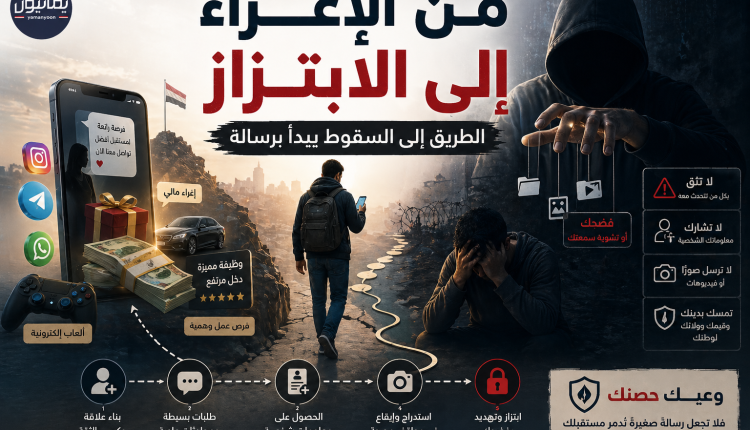
From Seduction to Blackmail: The Road to Downfall Begins with a Message
In light of the rapidly evolving nature of contemporary conflicts, Yemeni security reports reveal an advanced pattern of targeting tactics. These tactics are no longer limited to direct military confrontations but have extended to more complex and insidious areas, targeting individuals’ consciousness, behavior, and relationships. This data indicates that methods of enticement and recruitment have become among the most dangerous tools of modern conflict, given their capacity for quiet infiltration and profound influence within societies.
The Shift in the Nature of Conflict: From Confrontation to Infiltration
The methods uncovered in the security reports reflect a qualitative shift in conflict management. The objective is no longer to directly destroy the adversary, but rather to infiltrate them from within through individuals. This shift points to a growing awareness that controlling information and influencing behavior can achieve results that surpass traditional military confrontation in impact, and at a lower cost.
The Economy as a Tool for Recruitment
Financial enticement and deceptive employment tactics are prominent tools in recruitment operations. Those seeking job opportunities or improved living conditions are targeted with seemingly legitimate offers. These practices reveal a clear exploitation of economic circumstances, transforming need into a tool of pressure, reflecting a growing overlap between economic and security dimensions.
The Digital Sphere: An Open Arena for Infiltration
Modern recruitment operations rely heavily on digital means, including fake accounts, sponsored advertisements, and carefully cultivated virtual relationships. This space provides an ideal environment for recruitment operations due to the ease of accessing targets, the ability to remain hidden, and the gradual collection of information without attracting attention. Thus, the digital world transforms into an open intelligence arena where complex operations are conducted with simple tools.
Psychological Influence: Building Trust and Modifying Behavior
Data indicates that recruitment methods rely not only on enticement but also on gradually building psychological relationships with targets.
This is achieved by gaining trust, showing interest, and gradually requesting information, ultimately leading to a state of acceptance and cooperation without full awareness of the true nature of the targeting. This pattern reflects the use of what can be described as “psychological engineering” to manipulate human behavior.
Blackmail: A Tool for Control and Subjugation
Among the most dangerous methods observed are moral manipulation and blackmail. Victims are lured into sensitive situations and then threatened with the release of private material to force their cooperation. This method represents a turning point from voluntary recruitment to coercive coercion, where the individual loses the ability to withdraw or refuse.
Direct Intimidation: Breaking Down Psychological Barriers
In advanced stages, direct contact with targets may be employed, demonstrating a detailed knowledge of their personal lives. This approach aims to inflict psychological shock and reinforce a sense of surveillance, compelling the individual to comply under pressure. This reflects the integration of influence tools, combining enticement and intimidation.
Soft Warfare: The Broader Framework
These methods fall under the broader context of soft warfare, which targets values, identity, and collective consciousness. This warfare includes disseminating deviant ideas, conducting psychological campaigns, and influencing public opinion, ultimately weakening social cohesion from within.
Integration of Paths: Recruitment as a Tool in Comprehensive Conflict
These findings reveal a close link between intelligence work and military confrontation. Recruits can provide sensitive information, influence the home front, or facilitate field operations. Thus, recruitment becomes part of an integrated conflict system where security, economic, and psychological dimensions intertwine.