
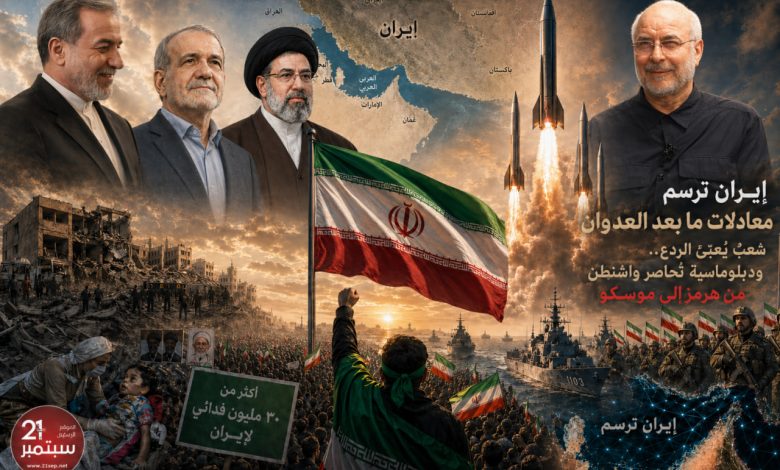
Iran Shapes Post-Aggression Equations: A Nation Mobilizes Deterrence and Diplomacy Encircles Washington from Hormuz to Moscow
In a scene reflecting the cohesion of the state and society, and the integration of the military and diplomatic tracks, the Islamic Republic of Iran emerges today as a rising power reshaping the equations of conflict in the region. This is based on unprecedented popular support, growing deterrent capabilities, and an active political movement that encircles its adversaries and leaves them with limited options.
This transformation is not occurring in a vacuum, but rather rests on the experience of a harsh confrontation during the “Third Imposed War” waged by the American and Zionist enemy, which ended with the failure of the aggression’s objectives, in contrast to a multifaceted Iranian rise that has re-established the balance of power from within to the region.
30 Million Dedicated to Defense: The Home Front Becomes a Strategic Weapon
At the forefront of Iran’s power structure, the popular factor stands out as one of the most important elements of deterrence. Iranian Parliament Speaker Mohammad Bagher Ghalibaf proudly declared his belonging to the “thirty million dedicated defenders of Iran,” referring to the widespread national mobilization that formed the first line of defense against aggression.
These figures were also confirmed by the head of the judiciary, Gholamhossein Ejei, who explained that more than 30 million Iranians had declared their readiness to sacrifice themselves. He considered this phenomenon not merely an emotional stance, but rather a real force that blocked the enemy’s path in both soft and hard warfare.
This popular support, according to a strategic analysis, not only thwarted the enemy’s attempts to dismantle the home front, but also transformed Iranian society into a comprehensive defensive depth, enhancing the state’s ability to both withstand and maneuver.
The aggression documents its crimes… and Iran opens the path to international accountability.
In response to this steadfastness, the details of the crimes committed by the American and Zionist enemy during its aggression are being revealed. Tehran has announced the start of a comprehensive documentation process in preparation for pursuing the perpetrators internationally.
Tehran Governor Mohammad Motamadian revealed that the attacks targeted sensitive civilian infrastructure, including hospitals, schools, and 57 historical sites, in flagrant violation of international law. He emphasized that these cases will be submitted to international bodies within a comprehensive legal framework.
The gravity of these crimes is compounded by the shocking figures announced by the Iranian Human Rights Committee, which confirmed the martyrdom of 383 children and the injury of more than 2,000 others. This constitutes one of the bloodiest crimes against children in the region, placing the international community before a new moral test and once again exposing Western double standards.
Field Superiority and Reverse Engineering: From Absorbing the Blow to Developing Capabilities
On the military level, Iran did not merely confront the aggression, but moved to the stage of capitalizing on its results. The Revolutionary Guard announced the discovery and neutralization of more than 15 advanced American missiles, in addition to seizing drones and advanced attack systems.
The strategic importance of this achievement lies not only in neutralizing the threat, but also in transferring these systems to research centers for “reverse engineering,” which means transforming the tools of aggression into sources for developing Iranian power.
This transformation reflects Iran’s ability to manage the battle with a cumulative logic, turning danger into opportunity and strengthening the independence of its defense system in the face of Western technological superiority.
The Strait of Hormuz: From a Global Waterway to a Sovereign Pressure Card
Economically and strategically, the Strait of Hormuz is at the forefront of the confrontation, as Tehran moves to redefine the rules of control over it, given its status as one of the most important global energy arteries.
In this context, Ebrahim Rezaei, spokesman for the National Security Committee in Parliament, asserted that the United States is under increasing international pressure as a result of being held responsible for the tensions in the Strait of Hormuz. He indicated that Iran is working on new legislation to regulate navigation and impose transit fees.
The most significant aspect of this statement is Rezaei’s assertion that the status quo in the Strait of Hormuz will not return to what it was before, a clear message that Tehran is establishing a new sovereign equation, making the Strait a strategic pressure point against Washington and its allies.
Active Diplomacy: Araqchi Builds a Network of Regional and International Balances
In parallel with this calculated escalation, Iran is leading a broad diplomatic effort, spearheaded by Foreign Minister Abbas Araqchi, who has shuttled between Muscat, Islamabad, and Moscow, as part of building a network of understandings that strengthens Tehran’s position.
In Muscat, the discussions focused on ensuring safe passage through the Strait of Hormuz, based on a shared responsibility with the Sultanate of Oman for the stability of the region. Pakistan played a mediating role in an attempt to advance the political process.
In Moscow, Araqchi presented the issue of aggression and diplomacy to Russian President Vladimir Putin, emphasizing that American behavior—including threats and violations of agreements—is hindering any political progress. Russia, for its part, stressed its support for Iran and its readiness to contribute to ending the war and promoting stability.
These moves reflect an Iranian strategy based on diversifying partnerships, expanding its room for maneuver, and shifting the conflict from its bilateral framework with Washington to a broader international arena.
Negotiations on Iranian Terms: Washington Faces the Choice of Submission
On the negotiation front, Tehran appears more resolute. Rezaei affirmed that any negotiations will not entail concessions but rather aim to impose specific Iranian conditions, including recognition of the right to enrichment, payment of compensation, and acknowledgment of Iran’s role in managing the Strait of Hormuz.
This approach reflects Iran’s shift from a defensive to a position of setting conditions, leveraging the strengths it has accumulated on the ground and politically, at a time when Washington is facing increasing internal and external pressures.
A New Equation: Firm Deterrence and Calculated Flexibility
Ultimately, these developments reveal the formation of a new Iranian equation based on a combination of:
Firm military deterrence.
Cohesion of the domestic front.
Multi-track diplomatic efforts.
Economic pressure.