
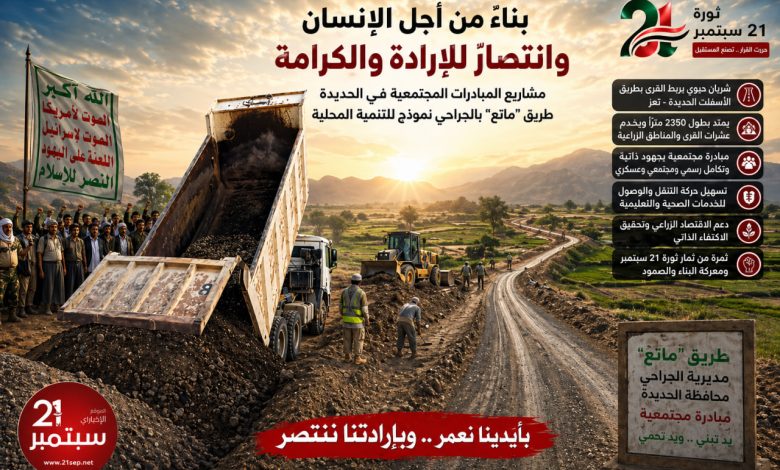
The “Mat’a” Road in Al-Jarahi: When Community Initiatives Transform into a Formula for Resilience and Development, Strengthened by the September 21 Revolution
In a developmental scene reflecting the essence of the transformation Yemen has witnessed since the September 21 Revolution, one of the most prominent examples of national unity between the state and society is evident in Al-Jarahi District, Hodeidah Governorate. This is demonstrated through the “Mat’a” road construction and paving project, which presents a practical and advanced model for community initiative projects based on public awareness and self-reliance.
This project cannot be viewed merely as a rural road, but rather as a symbol of a new era that has reordered the state’s priorities and placed the Yemeni people at the heart of all development and reconstruction policies. This has occurred under a revolutionary leadership that liberated national decision-making and propelled society to the position of an active partner in shaping the present and the future.
From Isolation to Vital Connection: A Road Opening Up New Horizons
The 2,350-meter-long Mata’a Road forms a strategic artery connecting several villages and agricultural areas to the main paved road linking Hodeidah and Taiz. This represents a qualitative leap in the infrastructure of rural Tihama.
The road serves a wide range of villages, including Mata’a, Al-Mazra’, Mahw Al-Nadhir, Mahw Al-Sayyid Issa, Al-Zuraybah, Al-Mahras, Beit Abrah, Aal Al-Afifi, Al-Ahdal, and Al-Turaybah, putting an end to the long-standing suffering caused by isolation and the difficulty of accessing basic services, whether health or education, as well as facilitating the daily movement of thousands of citizens.
Official, Community, and Military Integration: A Model of “One Hand Builds, One Hand Protects”
What gives this project its exceptional dimension is the nature of the partnership behind it. The efforts of the Hodeidah Governorate leadership, the Community Initiatives Department, and the Projects Implementation Unit are integrated with the local authority and the Public Works Office in the district, within a structured institutional framework that ensures technical supervision and the provision of logistical needs.
In the field of implementation, the principle of “one hand builds, the other protects” is vividly embodied through the active participation of military personnel and resistance fighters who, alongside civilians, contribute to the excavation and backfilling efforts, utilizing available equipment and resources. This reflects the unity of the home front and the integration of its roles.
This tripartite cohesion—official, societal, and military—reflects the philosophy of the era established by the September 21 Revolution, where development is no longer the responsibility of a single entity, but rather a comprehensive national project in which all energies are integrated.
An Economic Lever Supporting Self-Sufficiency
Given the agricultural nature of the Al-Jarahi region, the Mata’a road acquires added economic importance. It facilitates the transport of agricultural produce from fields to markets and reduces transportation costs, directly impacting farmers’ incomes and enhancing their productivity.
The project also encourages the expansion of agricultural land reclamation and supports national efforts toward achieving self-sufficiency amidst the challenges posed by the blockade. This transforms the road from a mere transport corridor into a genuine tool for production and development.
The Fruit of Leadership Directives… and Development as a Tribute to Past Sacrifices
This project is a practical implementation of the directives of the revolutionary and political leadership, which has placed community initiatives at the forefront of development tools, considering them a strategic option to overcome the effects of aggression and the blockade, and to build a resilient economy based on self-reliance.
In this context, the Governor of Hodeidah, Abdullah Atifi, affirmed that the “Mat’a” road clearly embodies the leadership’s approach to activating community initiatives as a fundamental pillar of development and alleviating the suffering of citizens. He praised the spirit of giving demonstrated by those who participated in completing this project.
He pointed out that the concerted efforts of official, community, and military entities present a practical model of resilience and confirm that self-reliance is no longer a slogan, but a daily practice that produces tangible projects on the ground.
Popular Awareness Creates Achievement… and a Community Builds Its Future with Its Own Hands
What is striking about the “Mat’a” road project is the strong presence of the local community, which did not merely receive aid, but actively participated by contributing effort, funds, and equipment, in a sincere expression of a high level of awareness of national and religious responsibility.
This popular response reflects the profound transformation brought about by the September 21st Revolution in the structure of Yemeni society. It revived the values of solidarity and cooperation, linking development work with ethical considerations, so that every project of this kind becomes a lasting legacy and a public benefit for future generations.
A Motivation to Expand the Experience… and a Development Path Expanding
For his part, Taha Muaiti, Director of Al-Jarahi District, considered the road a new lifeline for the district, emphasizing that the local authority is working to leverage this success to launch more similar initiatives, aiming to improve the level of services in various sub-districts and villages.
The success of the “Mat’a” model constitutes a strong incentive to generalize the experience of community initiatives throughout Al-Hudaydah Governorate, and indeed across the Republic, as it is one of the most important paths to sustainable development under the current circumstances.
The September 21 Revolution: From Liberating Decision-Making to Building Humanity
In essence, this achievement cannot be separated from the broader context created by the September 21 Revolution. This revolution not only liberated political decision-making from foreign domination but also redefined the role and function of the state, placing it at the service of the citizen and prioritizing their needs.
The revolution forged a new equation: national sovereignty coupled with genuine development, and resilience in the face of aggression matched by accelerated internal development. This is embodied today in dozens of service projects, including the Mat’a Road, which stands as a testament to Yemen’s unwavering progress, despite all challenges, towards establishing an independent development model.
A Message from Tihama: Building is an Unbeatable Choice
In Al-Jarahi, where roads are forged by the hands of men and isolation is overcome by the will of the community, the reality of this era is embodied: that peoples who choose dignity and sovereignty are capable of building and transforming challenges into opportunities.