
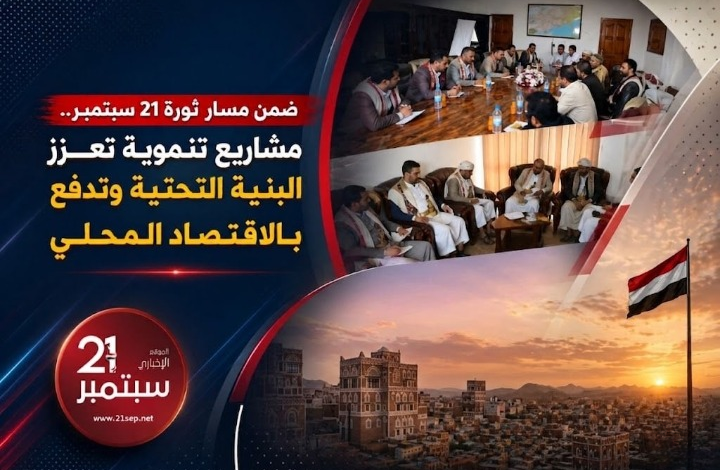
Within the framework of the September 21 Revolution: Development projects strengthen infrastructure and boost the local economy
As part of the transformations brought about by the September 21 Revolution, development efforts continue in the governorates to strengthen infrastructure and stimulate the local economy, keeping pace with current needs and enhancing the level of basic services. These initiatives are part of a practical approach that focuses on linking service projects with economic empowerment and developing productive sectors, contributing to more stable and efficient local development.
In this context, efforts to develop roads and services intersect with economic empowerment programs and the stimulation of industrial activity, forming an integrated approach that improves living standards and strengthens social stability.
Rural roads alleviate suffering
In Al Mahwit Governorate, the construction of the Al-Mu’aynah-Al-Khat Al-Da’iri road project in Al-Wasat district was launched in Jabal Al Mahwit. This community initiative aims to connect villages and neighboring areas and improve the rural road network. The project is an important step to facilitate the movement of citizens and serve farmers, especially in areas with rugged terrain, as it will contribute to accelerating the transport of agricultural products and reducing transportation costs.
The local authority confirmed that the project is supported by the Road Construction and Maintenance Executive Unit, which contributed by providing the necessary equipment, as part of the integrated efforts of official and community bodies to complete projects that directly serve citizens.
Economic Empowerment Through Organized Steps
In Sana’a Governorate, an expanded meeting discussed the procedures for implementing several economic empowerment projects in the western districts, focusing on fulfilling the legal and regulatory requirements to ensure the success and sustainability of these projects. The meeting addressed the Bani Amr water project in Al-Haymah Al-Dakhiliyah District, which will serve more than four thousand people, while also emphasizing the importance of coordination with relevant authorities to complete the legal procedures and begin implementation.
The meeting also discussed mechanisms for selecting beneficiaries according to the criteria approved by the Zakat Office, ensuring fair distribution and efficient targeting, and enhancing the impact of these projects on improving the living conditions of beneficiary families.
Revitalizing Industry and Addressing Stalled Factories
In the context of supporting the local economy, a meeting in Sana’a Governorate, chaired by the Deputy Governor for Investment, Yahya Jumaan, discussed the situation of struggling factories in the surrounding districts and ways to restart them and address the challenges they face.
The participants emphasized the importance of establishing an accurate database of factories, analyzing the reasons for their difficulties, and proposing practical solutions to enable their recovery, thereby contributing to preserving national capital and expanding job opportunities. They also stressed the need to provide a suitable investment environment and enhance coordination between relevant authorities and investors to support the stability of the industrial sector and strengthen its role in the local economy.
Integrated Development in a Single Path
These projects, in their entirety, reflect a trend toward integrating efforts between infrastructure development, economic empowerment of the community, and stimulating the industrial sector, thereby establishing the foundations for more sustainable local development.
This integration stands out as a defining characteristic of the phase that emerged from the September 21 Revolution, through its focus on projects with a direct impact and the expansion of initiatives that contribute to improving citizens’ lives.
Towards Sustainable Development
These efforts indicate that development is no longer confined to one aspect, but has become an integrated process that includes roads, services and the economy, within a framework that seeks to build a more stable and efficient reality. It also reflects the ability of institutions and community bodies to work together, which enhances development opportunities and supports the path of building a more cohesive local economy that is responsive to the requirements of the stage.