
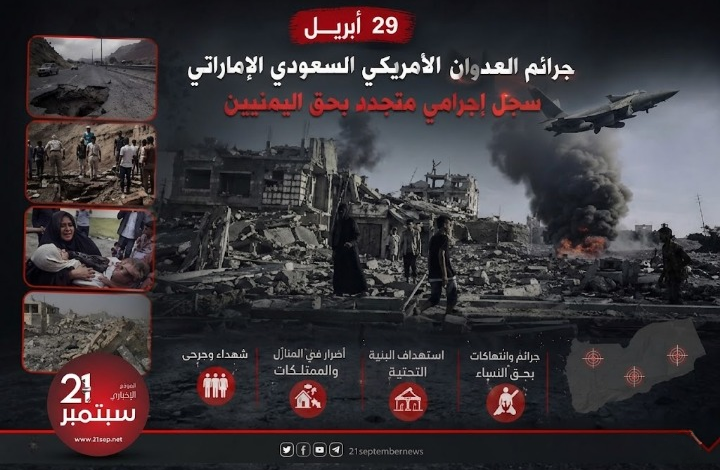
War Crimes That Do Not Expire: April 29th Bears Witness to the Brutality of the US-Saudi-Emirati Aggression
April 29th marks a significant turning point in the history of the US-Saudi-Emirati aggression against Yemen. It reveals a systematic strategy targeting the Yemeni people and their livelihoods through various means, ranging from airstrikes and artillery shelling to direct attacks that even targeted women in their homes.
Tracing the crimes committed on this day throughout the years of aggression reveals that these were not isolated incidents, but rather a coherent pattern of systematic targeting of civilians and infrastructure in an attempt to subjugate the Yemeni people and break their will.
2015: Public Roads Under Fire: Targeting a Lifeline
On April 29, 2015, the aggression launched one of its most dangerous forms of targeting when it bombed the main road in Naqil Samara, Ibb Governorate. This vital artery connects the capital, Sana’a, to several other governorates, resulting in the death of a shepherd and dozens of his livestock.
This targeting was not accidental; rather, it clearly indicated the aggression’s intent to strike civilian infrastructure, including roads, bridges, and drainage culverts. The airstrikes also hit the Saylah al-Hanisha culverts and the al-Farjadi area, causing significant damage that hampered the movement of citizens.
In the same vein, the attacks extended to Saada Governorate, where several people, including a child, were wounded in airstrikes on the Baqim district. This coincided with Saudi missile and artillery shelling of border areas.
2016: The Integrated Fire: Air and Artillery Bombardment and Widespread Targeting of Residential Areas
The following year, the crimes took on a more comprehensive character, as airstrikes were integrated with artillery and missile bombardments carried out by mercenaries in several governorates.
In Taiz, a civilian was killed by mercenary fire, while several areas were subjected to intense shelling that targeted roads and residential neighborhoods. In Nihm, Al-Jawf, Ma’rib, and Shabwa, the targeting expanded to include civilian homes and farms, using Katyusha rockets and heavy weapons.
This variety in the methods of killing reflects an operational coordination aimed at inflicting maximum casualties and maintaining constant pressure on various fronts.
2017: Intense Air Escalation and Systematic Targeting of Roads and Farms
On April 29, 2017, the aggression’s warplanes intensified their raids on Taiz Governorate, targeting civilian homes and public roads in various areas, while simultaneously using drones in military operations.
The raids also extended to Sa’dah Governorate, targeting civilian farms and roads, while Saudi missile and artillery shelling continued on border areas, reflecting a determination to target livelihoods and local economic infrastructure.
The raids also reached Hajjah and Sana’a, confirming the expansion of the operations and their targeting of various governorates without exception.
2018: Targeting Economic and Service Infrastructure
This year witnessed a new pattern of targeting, namely the attack on economic and service facilities. For example, an electricity pylon in the capital, Sana’a, was targeted, resulting in injuries to civilians and damage to the electrical infrastructure.
Furthermore, financial institutions and vital sites in Sa’dah were subjected to multiple airstrikes, coinciding with continued border shelling. This reflects a clear intent to undermine the foundations of economic and service stability.
2019: The Most Heinous Crimes: Killing Women and Violating Their Honor
April 29, 2019, stands out as one of the darkest days, as the crimes were not limited to bombing but extended to direct violations against civilians.
In Al-Dhale’a, four women were killed when mercenaries of the aggression stormed their homes, a crime that reflects the moral and behavioral depravity of the aggressor forces.
In Hodeidah, a horrific crime was committed when a mercenary assaulted a woman, a flagrant violation of all human values. This occurred amidst intense shelling that targeted farms and residential areas with dozens of missiles and shells.
Shelling also continued in several governorates, including Saada, Marib, Dhamar, and Lahj, reflecting a comprehensive escalation on all levels.
2020-2023: A Siege by Fire: Relentless Bombardment and Military Mobilization
During these years, the crimes continued at a high rate, with repeated airstrikes on Marib and Al-Jawf, coinciding with heavy artillery shelling in Hodeidah.
In Saada, airstrikes targeted residential areas, injuring women and destroying civilian property. Meanwhile, mercenaries continued to establish fortifications on several fronts, particularly on the western coast.
What is striking at this stage is the heavy reliance on large-scale artillery bombardment, with hundreds of shells fired in a single day at residential areas. This reflects a systematic policy of attrition directly targeting the civilian population.
2021-2022: Intensified Airstrikes and Comprehensive Targeting of Governorates
This period witnessed a significant escalation in the number of airstrikes, particularly in Marib, where dozens of airstrikes were launched in a single day. This coincided with artillery shelling that affected several governorates, from Saada to Hajjah, Al-Jawf, and Al-Dhale’a.
Sniper operations and direct targeting of civilians also intensified, reflecting the aggression’s shift towards more precise methods of targeting individuals, in addition to widespread indiscriminate shelling.
Summary of the Situation: A Multi-Tooled and Multi-Objective Aggressive Strategy
The crimes of April 29th, throughout the years of aggression, reveal the outlines of a clear strategy based on:
Targeting roads and infrastructure to disrupt public life
Striking farms and livelihoods to weaken the local economy
Intensive shelling of residential neighborhoods with various weapons
Committing direct violations against civilians, including women
Geographical expansion of operations to include most governorates
Integrating airstrikes, artillery shelling, and ground operations
This pattern confirms that the aggression was not merely a series of military operations, but a comprehensive war targeting the Yemeni people in their security, livelihoods, and dignity.