
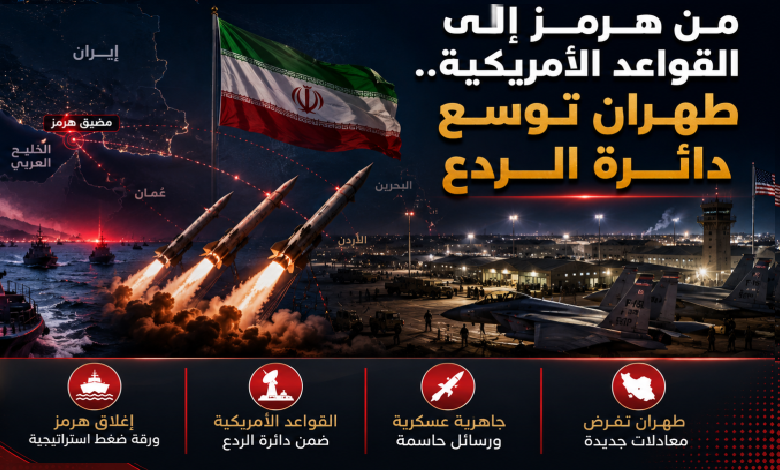
From Hormuz to US bases: Tehran expands its circle of deterrence
In a development reflecting the widening circle of regional confrontation, Iran today appears to be facing a new phase of establishing deterrence equations, after a series of military operations and political statements that carried direct messages to the United States and its allies in the region, indicating that any attack on Iranian territory will not go unanswered.
In the past few hours, military developments have taken center stage, with Iranian forces announcing operations targeting US military bases and sites in several countries in the region, coinciding with official confirmations that the Iranian response will continue as long as attacks on the sovereignty of the Islamic Republic persist.
Strikes that go beyond the limits of retaliation
In this context, the Iranian Revolutionary Guard announced that it had targeted US fighter jet positions at the Azraq airbase in Jordan, along with other US military facilities and command centers, confirming that the operations had achieved their objectives and inflicted direct damage on the targeted military infrastructure.
Tehran also announced that it had carried out operations targeting US bases in Kuwait and Bahrain, in a move that reflects the widening scope of the Iranian response, and its shift from targeting specific sites to sending strategic messages that encompass the entire US military presence in the region.
Observers believe that these operations represent a shift in the nature of Iranian deterrence, as Tehran has begun to adopt a policy of direct response to sources of threat instead of being satisfied with indirect or symbolic responses.
Hormuz… the strongest pressure card
In parallel with the military developments, the Khatam al-Anbiya Central Headquarters announced the closure of the Strait of Hormuz to ship traffic until further notice, warning that any attempt to cross the strait would be treated as a direct violation of the military measures taken.
This move is seen as one of the strongest strategic pressure tools that Iran possesses, given the vital importance of the strait to global trade and energy markets, reflecting Tehran’s willingness to use its economic leverage alongside its military capabilities.
decisive messages
In this context, the commander of the Khatam al-Anbiya headquarters, Major General Ali Abdollahi, confirmed that the Iranian armed forces are at the highest level of readiness, stressing that any new threat will be met with a decisive and effective response.
The commander of the Revolutionary Guard’s Aerospace Force, Brigadier General Majid Mousavi, also threatened that the region would turn into “hell” for US forces if threats related to the Strait of Hormuz or Iranian territory continued.
These statements reflect the level of confidence that the Iranian military establishment has in its defensive and offensive capabilities, as well as its keenness to send clear deterrent messages to adversaries.
Unity is the foundation of strength.
Besides the military factor, the Iranian leadership emphasizes that deterrence power is not based on weapons alone, but on popular cohesion and national support for state institutions.
Major General Abdollahi pointed out that the broad popular presence and continuous support for the armed forces constituted a key factor in strengthening Iran’s position and its ability to face challenges, stressing that the enemies failed to achieve their goals despite military and political pressures.
Iranian officials consider the unity of the home front to be one of the most important elements of strength in confronting any attempts to weaken the country or impose dictates upon it.
A new phase of confrontation
Recent developments confirm that Iran is proceeding with establishing a clear deterrence equation based on protecting its sovereignty and interests in the face of any threat, relying on its growing military capabilities and the unity of its internal front. Between field messages and official statements, Tehran appears with a more resolute stance in dealing with challenges, reflecting its ability to impose a new balance in the face of pressures and attacks in the region.