
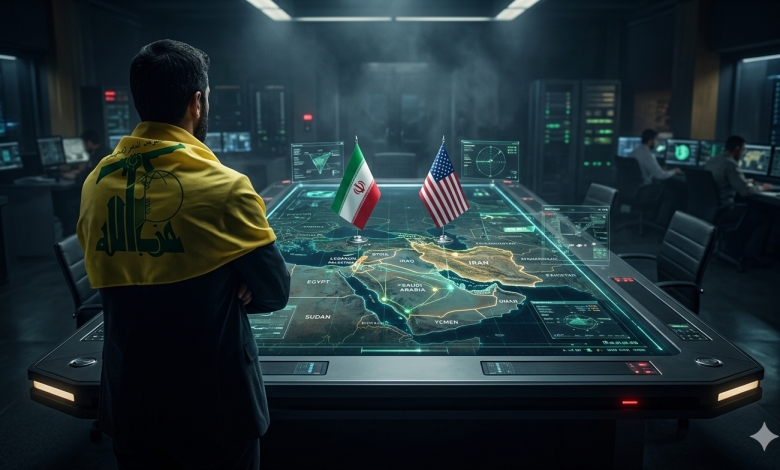
Hezbollah’s blessing of the Tehran-Washington agreement: An analysis of the limits of the ‘green light’ and the future of the rules of engagement
The leadership of Hezbollah in Lebanon congratulated the Islamic Republic of Iran, its leadership and people, on reaching a strategic memorandum of understanding with the United States, which led to a comprehensive ceasefire on all active fronts, including the Lebanese front. This announcement, following complex rounds of indirect negotiations, reflects a fundamental shift in the course of regional confrontations and the balance of military deterrence in the region.
In an official statement, the party considered this agreement a fruit of the “legendary steadfastness” and immense sacrifices made by the Iranian people and their leadership, who adhered to national choices and confronted international pressure. This field and political development comes after months of continuous and violent military escalation, putting an end to the exchange of fire and ground incursions, and ushering in a new phase of security and political arrangements in the Middle East.
Tehran is creating a major regional umbrella.
Recent field and political developments have demonstrated that Tehran has successfully imposed its conditions within the international negotiating equation by leveraging its regional power. Hezbollah’s praise for the leadership of Supreme Leader Ayatollah Mojtaba Khamenei underscores the complete alignment and centrality of Iranian influence in managing the conflict with the American-Israeli axis. Diplomacy, bolstered by the momentum on the ground, has succeeded in dismantling the imposed siege and agreements, transforming military pressure into strategic political gains.
On the Lebanese front, Iran’s insistence on including the Lebanese front as a key, non-negotiable clause in any international agreement served as a safeguard for the resistance. Throughout the months of fighting, Tehran bore significant economic, political, and military burdens to ensure that the Lebanese arena was not isolated. This interconnectedness of the fronts thwarted Israeli attempts to isolate Hezbollah and sever it from its strategic depth, and it reinforced the reality that regional security is shaped as a single, indivisible entity.
The party expressed its appreciation to the countries that contributed to overcoming the obstacles to finalizing this historic agreement, calling on the Lebanese state to make the best use of this “regional and international umbrella” to consolidate its sovereignty and liberate the remaining occupied territories. Analytical circles believe that this understanding is reshaping political roles in the region and imposing a reality in which international powers are compelled to acknowledge the pivotal role of the resistance axis in shaping regional stability.
The ruling equation of March 2nd
On the ground, the ceasefire established new rules of engagement imposed by the resistance through the blood and might of its fighters. Hezbollah declared clearly and decisively that there would be “no return to the pre-March 2nd status quo.” This date marked a turning point, shattering the illusions of the Israeli occupation army regarding the imposition of a security zone or the alteration of the geographical reality on the border. Lebanese towns and villages along the border transformed into impregnable defensive lines, inflicting heavy losses on Israeli vehicles and soldiers and crippling its offensive capabilities.
The party extended special greetings to the displaced and steadfast resistance fighters, whom it described as “the most honorable people,” continuing the legacy of the martyred Secretary-General, Sayyed Hassan Nasrallah, and linking their sacrifices to the military achievements on the ground. Despite the declaration of a comprehensive ceasefire, the resistance leadership quickly urged citizens to exercise caution and refrain from rushing indiscriminately to their villages on the front lines, awaiting precise security directives to ensure their safety and avoid potential Israeli violations and ambushes.
Organizing the internal structure and the inevitable review
Attention is now turning to the Lebanese interior, where new developments impose complex political challenges that necessitate a unified national stance to safeguard the gains achieved on the ground. The party called on the authorities and all Lebanese political forces to reassess past strategies and abandon the losing bets and illusions that prevailed during the aggression, emphasizing that relying on true friends and rallying around elements of strength is the only way to deter continued Israeli ambitions.
A political reading of the statement suggests that the next phase is one of “consolidating sovereignty and reconstruction,” requiring state institutions to swiftly engage in a comprehensive national effort to rebuild what was destroyed by the brut