
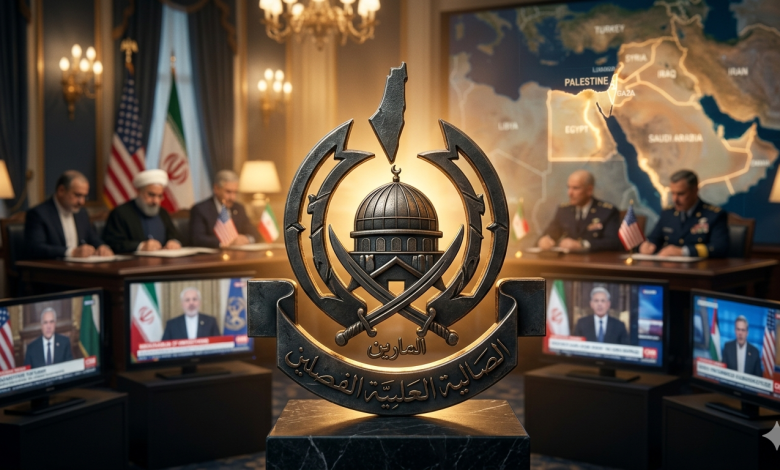
Contexts of Iranian-American understanding: Hamas’s welcome and an analysis of regional stability and deterrence equations
The announcement of the new memorandum of understanding between the Islamic Republic of Iran and the United States represents a dynamic shift in the landscape of international and Middle Eastern relations. It comes at a highly sensitive time, as the balance of power in the region is being reshaped. It was therefore unsurprising that the Islamic Resistance Movement (Hamas) was quick to officially welcome this agreement, a move that goes beyond the usual diplomatic protocols of congratulations. It appears to be an attempt to capitalize on this political breakthrough to bolster the resistance front and to assess its direct repercussions on the region’s most pressing issues, particularly the Palestinian question and the ongoing conflict in the Gaza Strip.
The movement’s welcoming stance carries strategic implications that dismantle the organic relationship between Tehran and the resistance factions. This understanding is seen as a fruit of Iran’s resilience in the face of decades of Western sanctions and pressure. Therefore, an analytical report examining the dimensions of this position acquires added significance, as it not only observes a fleeting political event but also anticipates a new phase that could redraw the map of alliances and determine the trajectories of escalation and de-escalation on multiple fronts stretching from Gaza to Beirut and deep into the region.
Timing implications: Dismantling the siege and projects of hegemony
Hamas’s official welcome, expressed in its press statement, focused directly on the philosophy of “thwarting dictates.” The movement views Iran’s success in securing a memorandum of understanding with Washington, without compromising its strategic principles, as a victory for the approach of political and economic resistance. This particular timing, amidst unprecedented military and diplomatic pressures in the region, lends the agreement significant symbolic and practical weight.
One analytical reading suggests that Hamas, through this stance, seeks to emphasize that the policies of “maximum pressure” and economic sanctions imposed on its allies have failed to achieve their ultimate goals of isolating regional powers or liquidating the Palestinian cause. On the contrary, from Hamas’s perspective, Tehran has demonstrated a remarkable capacity for resilience and maneuvering, ultimately leading the United States to the negotiating table and to acknowledge the regional realities, thus weakening the leverage held by the Western camp and its allies in the region.
Conditional link: Regional stability begins in Gaza
Hamas did not merely congratulate the Iranian leadership and people; it also astutely and directly linked this agreement to pressing regional issues. The movement established a “conditional link” for the success of any international understandings, asserting that the true positive impact of this memorandum must first and foremost translate into an immediate cessation of Zionist aggression and an end to the ongoing war of extermination, starvation, and displacement against the Palestinian people in the Gaza Strip. This must be coupled with curbing regional violations and halting the repeated attacks on Lebanese territory and other fronts of support and confrontation.
This connection reflects Hamas’s vision of “unity of arenas” not only militarily, but also diplomatically and politically. The movement understands that Tehran represents its strategic backer, and therefore any improvement in Iran’s international relations should be leveraged to pressure for a ceasefire and the lifting of the Gaza blockade. This would translate Iranian political gains into practical leverage that directly serves the Palestinian cause and alleviates the burden on the popular base of the resistance.
The dilemma of the “Zionist entity”: the absence of security under occupation
At the heart of the movement’s analytical stance, a clear and uncompromising equation emerged regarding the Israeli occupation government. Hamas asserted that security and stability in the Middle East will remain mere “illusions” as long as the true roots of the conflict remain unaddressed. These roots, according to the movement’s literature and its official statements, are embodied in the very existence of the occupation and the denial of the legitimate rights of the Palestinian people.
“Security and stability in the region will not be achieved as long as the Israeli government continues its war of extermination, starvation and displacement against the Palestinian people, and as long as the pillars of the Zionist occupation are not confronted.”
Analytically, this stance represents a clear rejection of the American and European approach, which attempts to isolate the issues from one another. Through this diplomatic discourse, Hamas clarifies