
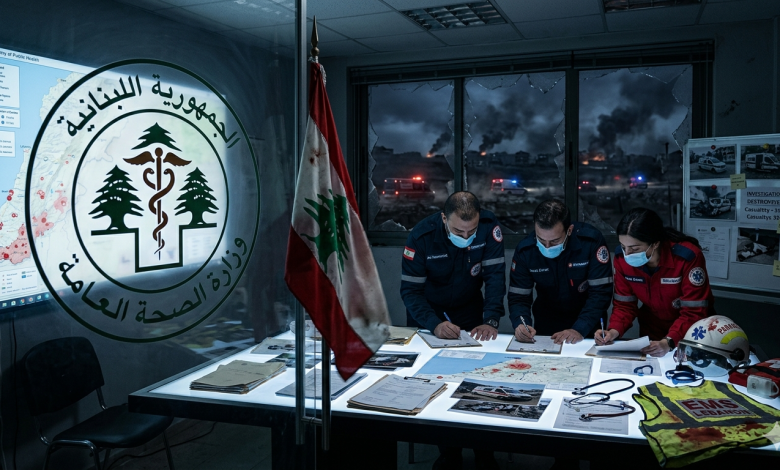
The price of this devastating tragedy: When the shattered bodies of Lebanon become mere “reference figures” in the archives of international impotence
The escalating figures released by the Lebanese Ministry of Health reveal the depth of the humanitarian tragedy and the scale of the systematic targeting Lebanon has faced since the start of the latest Israeli escalation on March 2nd. Statistical data are no longer mere numbers recited in daily bulletins; they have become a living indictment, documenting the extent of the crimes committed by the Israeli enemy army against civilians and civilian infrastructure, in violation of all international laws and conventions that guarantee the protection of medical and relief facilities during times of conflict.
This ongoing escalation, unchecked by fragile political understandings, jeopardizes regional stability and redefines the concept of a “ceasefire” in the Zionist lexicon as a cover for continued daily violations. Understanding the current Lebanese situation requires a thorough analysis of the field data to grasp the enemy’s military strategy, which aims to pressure the popular base and inflict maximum structural and human destruction before imposing any lasting political equation.
The language of numbers: The harvest of blood and the displacement of millions
The latest official statistics reveal a dramatic surge in the cumulative death toll, with the number of martyrs rising to 3,798 and the number of wounded reaching 11,798. This staggering human cost, which saw 15 martyrs and 82 wounded added in the past 24 hours alone, reflects a sustained pattern of violence and is a clear indication that the Zionist military machine makes no distinction between military and civilian targets in the towns, villages, and cities of Lebanon.
The disaster’s impact extends beyond the direct victims of the bombing, reaching into the very fabric of society through the largest displacement crisis in Lebanon’s modern history. Nearly 1.5 million Lebanese citizens have been forced to flee their homes to escape death. The deeper problem lies in the fact that the majority of these displaced people are not registered in official shelters, which exacerbates the economic and living burdens on local communities and creates a silent humanitarian crisis, largely ignored by the media, that directly strains the already weakened Lebanese state.
Targeting the health sector: Breaking the foundations of resilience
Targeting medical personnel and ambulance teams is a cornerstone of the enemy army’s military strategy. The statistical report recorded 172 direct attacks on healthcare teams, resulting in the deaths of 133 martyrs and injuries to 402 workers in this vital sector. This figure is not the result of “collateral damage,” but rather a systematic policy aimed at undermining Lebanese resilience.
Analytically, the enemy seeks to achieve multiple objectives by targeting the emergency and health system:
It paralyzed the ability to respond quickly: preventing the rescue of the wounded under the rubble, which automatically increased the number of martyrs affected by their injuries.
Spreading terror among paramedics: turning ambulances and medical centers into dangerous targets, to deter medical teams from performing their humanitarian duty in confrontation zones.
Medical siege: completely isolating targeted areas from any health care, thus accelerating their forced evacuation and imposing a new geographical reality.
A truce on paper: violations of the agreement and the equation of deterrence
Despite the temporary ceasefire agreement coming into effect in mid-April, the reality on the ground proves that the agreement was practically stillborn due to daily Israeli violations. These ongoing violations reflect the enemy’s desire to keep the flames of escalation burning and to exploit the political climate to impose new dictates on the ground that it was unable to achieve during the height of the full-scale military operations.
The continued bombardment and targeting of villages and towns, despite the existence of an international agreement, reaffirms the Israeli government’s disregard for any agreements and demonstrates that the temporary truce was merely a respite for the occupation to regroup and redeploy its forces. This behavior compels the Lebanese side and the resistance factions to maintain a high state of readiness and to consider field deterrence as the only guarantee, not paper agreements that are subject to Israeli violations at any moment.
The policy of “emptying and subjugating”: Civilian figures under fire
Lebanese towns and villages were not merely theaters of military operations; civilian infrastructure and facilities became primary targets of the enemy’s criminal raids. This policy falls under what can be termed “depopulation and subjugation,” whereby the occupation seeks to render residential areas and vital centers uninhabitable,