
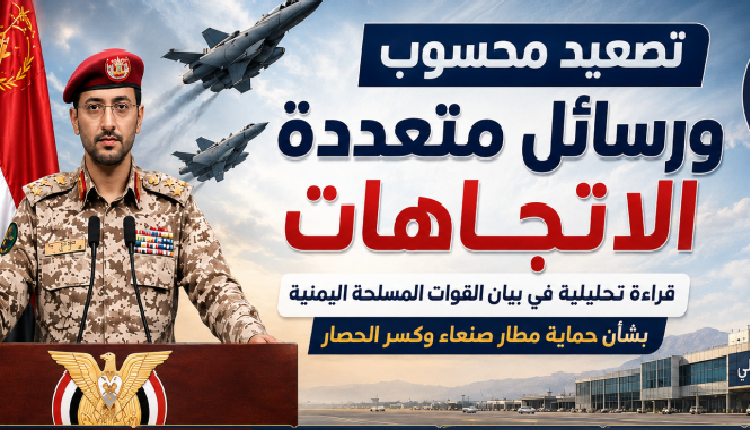
A Calculated Escalation And Multi-Directional Messages: An Analytical Reading Of The Dimensions And Implications Of The Yemeni Armed Forces’ Statement Regarding The Protection Of Sana’a Airport And Breaking The Siege.
The statement issued by the Yemeni Armed Forces regarding the response to the attempt to prevent an Iranian civilian aircraft from landing at Sana’a International Airport represents a new stage in the confrontation related to the blockade imposed on Yemen. It also reflects important shifts in the nature of the rules of engagement and the level of military and political readiness in Sana’a in dealing with any future developments related to airspace and national sovereignty. The statement was not merely an announcement of a limited military incident, but rather carried in its content complex strategic messages that went beyond the limits of the direct event to touch upon the issues of the blockade, sovereignty, deterrence, and the future of regional balances.
Yemenis | Prepared for publication by | Tariq Al-Hamami
Protecting airspace and redefining national sovereignty
The most prominent thing revealed by the statement is the Yemeni armed forces’ shift from a traditional defensive position to a stage of imposing new sovereign equations related to protecting Yemeni airspace and securing civilian navigation towards Sana’a International Airport. The announcement of confronting Saudi warplanes and forcing them to leave the airspace by means of air defense systems carries a clear indication that Sana’a now considers any attempt to prevent civilian flights or interfere with civilian air traffic as a direct hostile act that requires an immediate military response. This represents an important shift in the concept of air sovereignty, as Sana’a Airport is no longer just a service or civilian facility, but has become a sovereign symbol linked to national dignity and the right of Yemenis to movement, travel, treatment, and travel.
The blockade is shifting from a humanitarian issue to a national security matter.
The statement clearly focused on the humanitarian aspect of the incoming plane, by indicating that it was carrying more than two hundred citizens, including patients, the wounded, and those stranded. This focus was not a passing detail, but rather carries an important political and media dimension aimed at re-presenting the issue of the blockade as a humanitarian crisis that has been ongoing for nearly eleven years, and the resulting widespread suffering in the sectors of treatment, education, travel, and trade. Through this discourse, Sana’a seeks to establish a new equation, namely that the continuation of the blockade is no longer a long-term negotiation issue, but has become a direct threat to Yemeni national security that requires taking practical measures to end it.
Strategic deterrent messages directed at Saudi Arabia
The most serious aspect of the statement is the explicit warning that any new airspace violation or future aggression will be met with a comprehensive response targeting airports, vital facilities, and economic interests on land and sea. This message reflects a clear development in the Yemeni deterrence doctrine based on the principle of “an attack will be met with a similar or more impactful attack,” an equation that has already been one of the most prominent features of the confrontation in recent years. The reference to airports and vital interests also indicates that any potential escalation will not remain confined to traditional military fronts, but may extend to the economic infrastructure and centers of commercial and strategic activity.
Establishing the equation of “breaking the siege by force if necessary”
The statement indirectly confirms that the period of waiting for open-ended political solutions is nearing its end, and that Sana’a is now putting other options on the table to force an end to the blockade. The phrase “We will take all legitimate steps to end this blockade” indicates a readiness to move from the stage of political and diplomatic protest to more effective measures if the closure of air and sea ports continues. It seems that the main message here is that freedom of air navigation to Sana’a airport is no longer a subject open to negotiation, but rather a sovereign and humanitarian right that Sana’a will work to impose by all available means.
Implications of praising the Iranian role
The statement included clear praise for the Iranian initiative regarding the transfer of patients, stranded individuals, and official and popular delegations. This reflects an advanced level of political and humanitarian coordination between Sana’a and Tehran on the issue of the blockade. The emphasis on the continuation of flights between Sana’a and Tehran carries a political message that military or political pressures will not prevent the continuation of this route, and that breaking the air isolation of Yemen has become a strategic goal for bot