
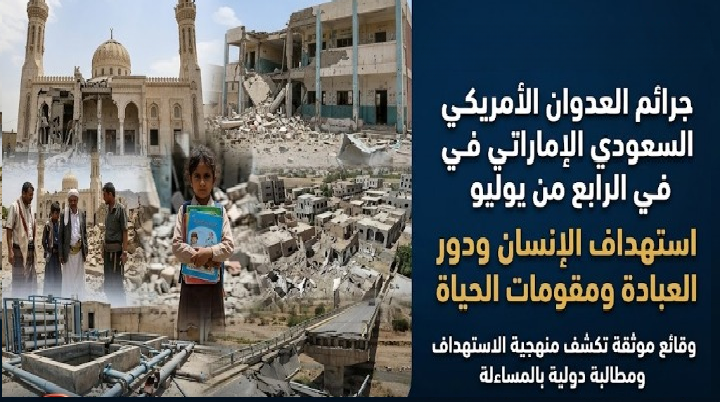
July 4th… A day when the flames of the American-Saudi-Emirati aggression reached people, places of worship, and the very foundations of life.
July 4th was not just another day in the memory of Yemen. It marked another chapter in the crimes committed by the American-Saudi-Emirati aggression against civilians throughout the years of war. On this day, airstrikes, artillery shelling, and direct targeting of homes, markets, schools, mosques, and service facilities continued. This scene reflects the widening scope of the attacks, encompassing everything related to the lives of Yemenis, from people to infrastructure, from educational institutions to water sources, roads, and public facilities.
Documented evidence shows that the crimes were not limited to inflicting the greatest number of civilian casualties, but rather took on a systematic character aimed at undermining the foundations of life and causing the greatest possible destruction to civilian infrastructure, in flagrant violation of international laws and norms that prohibit targeting civilians and civilian objects during armed conflicts.
Targeting Civilians, Homes, and Places of Worship
On July 4, 2015, Saada Governorate witnessed a series of bloody airstrikes targeting residential neighborhoods, educational facilities, and places of worship. A woman was killed and several civilians were injured when homes and an educational complex in the Bani Bahr area were bombed, while a woman and a child were killed in an airstrike targeting the Maran area.
The attacks extended to mosques in the Razih district, where the bombing resulted in deaths and injuries. This was one of the crimes that demonstrated the direct targeting of places of worship, coinciding with successive airstrikes on the Razih, Kataf, and Maran districts, and Saudi missile strikes targeting populated border areas.
The following year, the aggression’s air force continued targeting homes, completely destroying a citizen’s house in Al-Ghayl district of Al-Jawf governorate and causing significant damage to neighboring houses. Several areas in Nihm district were subjected to intense airstrikes, and mercenary forces targeted residential areas in Al-Wazi’iyah district of Taiz governorate.
In 2017, members of a family, including a child, were injured when their house was targeted in Al-Maslub district of Al-Jawf governorate. Meanwhile, Bedouin camps were directly targeted by airstrikes, resulting in the burning of tents and the death of livestock, in yet another instance of targeting civilians and their livelihoods.
The attacks continued in subsequent years. In 2018, an airstrike destroyed a citizen’s house in Haydan district of Sa’dah governorate, while homes and farms in Baqim, Sahar, and Kataf were subjected to dozens of airstrikes, in addition to Saudi missile and artillery shelling of border districts.
Education and Public Services Among the Targets
The events of July 4th reveal that schools and service facilities were among the direct targets of the aggression’s airstrikes. In 2015, the educational complex in Bani Bahr and Al-Ansar School in Kataf were bombed, while in 2017, airstrikes targeted Al-Omari schools in the Dhubab district of Taiz Governorate.
The targeting also extended to vital service facilities, with the bombing of the water desalination plant on Kamaran Island and the road linking Hays and Al-Khawkhah in Al-Hudaydah Governorate. This directly impacted basic services and the movement of citizens.
Public facilities and parks were not spared from the targeting. The September 21st Park in the capital, Sana’a, was bombed, along with main roads, farms, and various facilities in several governorates, clearly indicating the wide range of civilian targets struck by the airstrikes.
Widespread Escalation of Attacks on Yemeni Governorates
This day has witnessed successive waves of airstrikes across numerous governorates in recent years, including Marib, Al-Jawf, Hajjah, Sana’a, Sa’dah, Hodeidah, Al-Bayda, and Taiz. These airstrikes have targeted homes, farms, markets, roads, and civilian infrastructure.
In 2020 alone, the Saudi-led coalition intensified its airstrikes on the districts of Mahliyah, Al-Abadiyah, and Majzar in Marib Governorate, with dozens of airstrikes causing widespread damage to civilian homes and farms. Simultaneously, airstrikes targeted Al-Bayda Governorate.
In Hodeidah Governorate, heavy artillery shelling continued on residential neighborhoods, mountainous areas, and Al-Tuhayta. Artillery and heavy machine guns also targeted Hodeidah city, the airport area, and 50th Street, causing significant damage to civilian property.
Continued Attacks Despite the Ceasefire
Events between 2021 and 2023 confirm that attacks did not cease but continued in various forms, including artillery shelling, shooting at villages and homes, reconnaissance and spy flights, and the ongoing construction of military fortifications on several fronts.
In 2021, a child was wounded by mercenary sniper fire in Taiz Governorate, and a civilian was injured by Saudi missile fire in the border district of Shada. Meanwhile, the districts of Al-Dhaher, Al-Hudaydah, and Ma’rib were subjected to continuous airstrikes and shelling.
In 2022 and 2023, artillery shelling and gunfire continued against residential areas in the governorates of Ma’rib, Taiz, Hajjah, Sa’dah, Al-Hudaydah, and Al-Dhali’, along with the establishment of new combat fortifications and the execution of reconnaissance and spy flights. This reflects the continuation of a military approach based on targeting civilian areas and exacerbating the suffering of the population.
An Open Memory of Accountability
The documented events of July 4th confirm that the crimes committed by the US-Saudi-Emirati aggression were not isolated incidents or accidental errors, but rather constituted a recurring pattern of systematic targeting of civilians, infrastructure, educational and service facilities, and places of worship in various Yemeni governorates.
As the years pass, these crimes remain etched in the national memory as part of a long record of violations that have left thousands of victims and widespread destruction.