
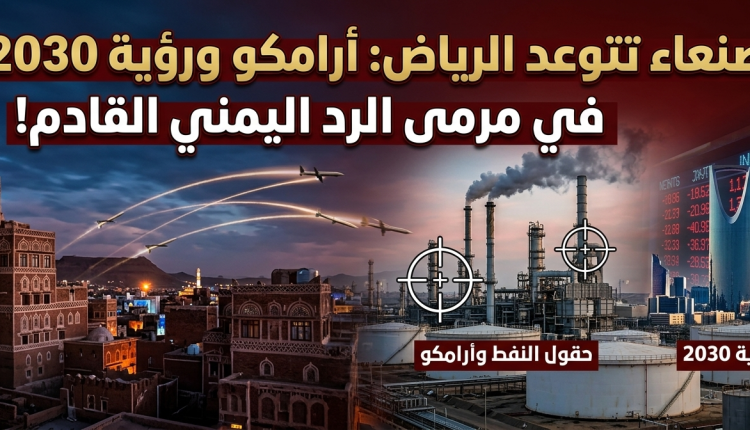
Sanaa Threatens Riyadh: Aramco and Vision 2030 in the Crosshairs of Yemen’s Coming Response!
From the heart of the steadfast capital, Sanaa, the voice of freedom and independence resounds, shattering the silence of international complicity and exposing the falsehood of claims. A strongly worded statement was issued by the Ministry of Foreign Affairs and Expatriates in response to the statement by the Saudi aggression’s spokesperson, Turki al-Maliki, and his attempt to mislead public opinion by distorting facts and falsifying realities. The statement left no room for doubt or interpretation, affirming that the Yemeni people have made their decisive choice to end the aggression and break the siege, and that the aggressor will not escape punishment, whatever the cost. It placed Saudi oil fields and financial markets under the microscope of Yemen’s response, and warned Riyadh against the consequences of any folly that could plunge the region and the world into an economic catastrophe with dire repercussions. Will the Saudi regime grasp the magnitude of this message? Will it realize that Yemen’s patience has run out, and that what is to come will be far more severe?
Yemen Rejects Submission and Affirms Sovereignty
In an unprecedented escalation of diplomatic rhetoric, the Ministry of Foreign Affairs and Expatriates in Sana’a announced that the Yemeni people, with all their institutions, have made an irrevocable decision to end the aggression and break the imposed siege. The Ministry emphasized that this decision will be implemented regardless of the sacrifices required. This statement came as a harsh response to “the Saudi enemy’s statement and its attempt to mislead public opinion by distorting facts and falsifying realities.” The message is clear: Yemeni sovereignty is a red line, and the reopening of Sana’a International Airport is a right that does not require anyone’s permission.
Yemen’s Eyes on the Saudi Economy
The statement did not stop at condemnation; it went further, issuing direct and explicit threats to the Saudi regime. The statement advised “the head of the Saudi regime to turn his attention to the oil fields, Aramco, Yanbu, and the rest of the ports, as well as the stock market, Vision 2030, and other projects.” This explicit warning, which links the continuation of the aggression and blockade to the targeting of the Kingdom’s vital economic facilities, represents a dangerous turning point in the course of the conflict and puts the global economy at risk should Riyadh commit “any folly,” as the statement put it.
Exposing the Falsity of Claims: The Roadmap and the Humanitarian Blockade
The Yemeni Ministry of Foreign Affairs refuted the Saudi regime’s claims that Sana’a had rejected the roadmap brokered by the Sultanate of Oman, asserting that Yemen had repeatedly agreed to it on numerous occasions. The statement revealed that the Saudi regime had been “lying in wait during the ‘Flood’ battle, betting first on Israeli and American aggression against Yemen, and then on American and Israeli aggression against Iran,” in an attempt to evade the requirements of peace and reimpose its control over Yemen. Sana’a emphasized that Riyadh’s claim of supporting the roadmap was discredited by its displeasure at the return of stranded Yemeni citizens and the travel of patients through Sana’a Airport. The statement held the Saudi regime fully responsible for the continued blockade, the obstruction of salary payments, and the resulting economic and humanitarian suffering.
The Saudi Regime: The Head of Aggression and a Zionist Tool
The statement did not hesitate to describe the Saudi regime as “not a neutral party, but rather the head of the aggression, the one who declared and adopted the war, the one who sponsors all hostile activities, from the blockade to the aggression, the one who occupies vast parts of Yemen, and the one who distributes roles among its mercenaries.” It pointed out that Saudi Arabia launched “more than a quarter of a million airstrikes on every governorate, city, and village across the country, causing the martyrdom of tens of thousands and the wounding of hundreds of thousands of Yemenis, and the destruction of infrastructure, all civilian sites, and the country’s resources.”
In a striking development, the statement linked the Saudi regime to the Zionist entity, considering that “the Saudi regime’s claims regarding the events in the Red Sea while supporting the Palestinian people to stop the genocide in Gaza prove once again that this regime is a Zionist tool, operating under American patronage and in service to the Israeli enemy entity.” It emphasized that the Yemeni people, despite their siege and suffering, have prioritized the interests of Palestine over their own and have acted in support of the most sacred cause of the Islamic nation.
A Final Warning
In this context, the Ministry concluded its statement with a decisive message to all countries in the region and the world, stating that Yemen demands nothing more than its freedom and independence, and an end to the misery and deprivation inflicted upon it by the Al Saud regime. It warned that “any step taken by the criminal Saudi regime will cast a negative shadow on the already volatile stability of the region, and will have disastrous consequences for the global economy.” The Ministry also called on the Saudi regime to learn from “more than a decade of aggression and blockade that has only resulted in its failure and the collapse of its bets,” and to realize that it is “committing a grave error against Yemen, whether in the north or the south.”
In conclusion…
Sana’a affirms its continued support for the leader of the revolution in reclaiming rights, ending the aggression, and breaking the blockade. It asserts that any hostile actions undertaken by Saudi Arabia will be the sole responsibility of the Saudi regime, and no one else, and that the ultimate victory belongs to the righteous, and that there is no aggression except against the oppressors.