
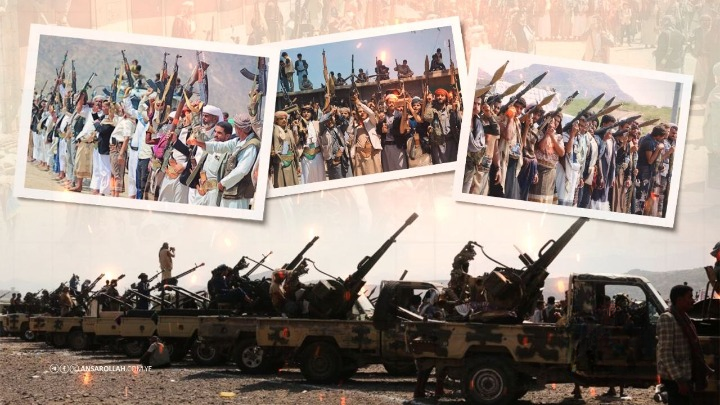
From mobilization to liberation… the tribes embody the approach of the September 21 revolution
The tribal meetings and gatherings taking place in the free governorates are no longer just events to announce positions, but have turned into a practical indicator of Yemen’s transition to a new stage, the title of which is comprehensive readiness for the battle to break the siege and complete the liberation. From Saada to Taiz, and from Al-Bayda to Al-Hudaydah and Hajjah, armed tribal gatherings continue, carrying a unified message that the Yemeni tribe has decided on its national choice and announced its readiness to participate in any battle imposed by the stage.
This movement reflects the expansion of popular mobilization, as one of the direct results of the path established by the September 21 revolution, which is based on restoring national decision-making and building a societal state capable of protecting sovereignty and confronting projects of guardianship and hegemony.
A movement that spans the entire nation
During the past few hours, the governorates of Taiz, Saada, Hajjah, Al-Bayda, Al-Hudaydah and a number of other free governorates witnessed armed tribal meetings and gatherings in which the tribes declared a general mobilization and full readiness to implement the directives of the leader of the revolution, Mr. Abdul-Malik Badr Al-Din Al-Houthi, and to prepare to end the aggression, break the siege and restore national rights and wealth.
Despite the diversity of participating governorates and tribes, the statements issued by them came in one language, confirming their support for the leadership, the armed forces, and the continuation of mobilization, qualification, and opening of training centers, as they are requirements for the next stage.
The tribe regains its national role
The most important thing this scene reveals is that the Yemeni tribe has regained its natural position as one of the most important elements of national power, after the forces of aggression tried throughout the past years to target it, weaken its role and tear apart its social structure.
Today, the tribe appears as a partner in protecting sovereignty, an incubator of the national position, and a human base that supports state institutions and the armed forces. This is a transformation that reflects the success of the awareness-building project adopted by the September 21 Revolution, which is based on unifying society around the national identity, away from fragmentation projects.
The September approach becomes a reality
What is happening in the tribal arenas today cannot be separated from the path initiated by the September 21 revolution, which restored the tribe’s status as part of the state equation, not a tool for internal conflict, and established the concept of national partnership in the face of external dangers.
During more than a decade of aggression and siege, the state of popular mobilization did not decline, but rather developed into a continuous mobilization system based on readiness, qualification, and reliance on national capabilities, which made society more capable of dealing with various challenges.
Messages that transcend the inside
The statements of the tribes were not limited to announcing military readiness, but also carried clear political messages, which were represented in confirming the continuation of the Yemeni position supporting Palestine, and adhering to the equation of the unity of the arenas, in addition to praising the positions supporting Yemen, foremost among them breaking the air blockade on Sana’a International Airport.
The tribes also stressed that ending the aggression, lifting the siege, and restoring national wealth and sovereignty are non-negotiable goals, and that any escalation will be met with escalating popular and tribal readiness.
A will that expands and a path that advances
The expansion of tribal conflicts in more than one governorate confirms that the option of confrontation is no longer limited to the military establishment, but has become a national project in which the roles of society are integrated with the state, within a vision that considers liberation and sovereignty to be a collective responsibility.
With this popular momentum continuing, the Yemeni tribe today appears to be more present in the equation of the stage, not only as a social force, but also as one of the pillars of the national project established by the September 21 revolution, and a path that is steadily moving from general mobilization to complete liberation.